What Is RegTech? How Technology Is Transforming Compliance


Compliance used to mean rooms full of analysts manually checking documents, screening names, and filling in regulatory reports by hand. As the rulebook grew heavier and fines climbed into the billions, that model stopped scaling. RegTech is the answer: using technology to make regulatory compliance faster, cheaper, and more reliable.
This guide explains what RegTech is, where it came from, the technologies behind it, its main use cases (with a close look at KYC and AML), how it differs from FinTech and SupTech, and what is driving its growth.
What Is RegTech?
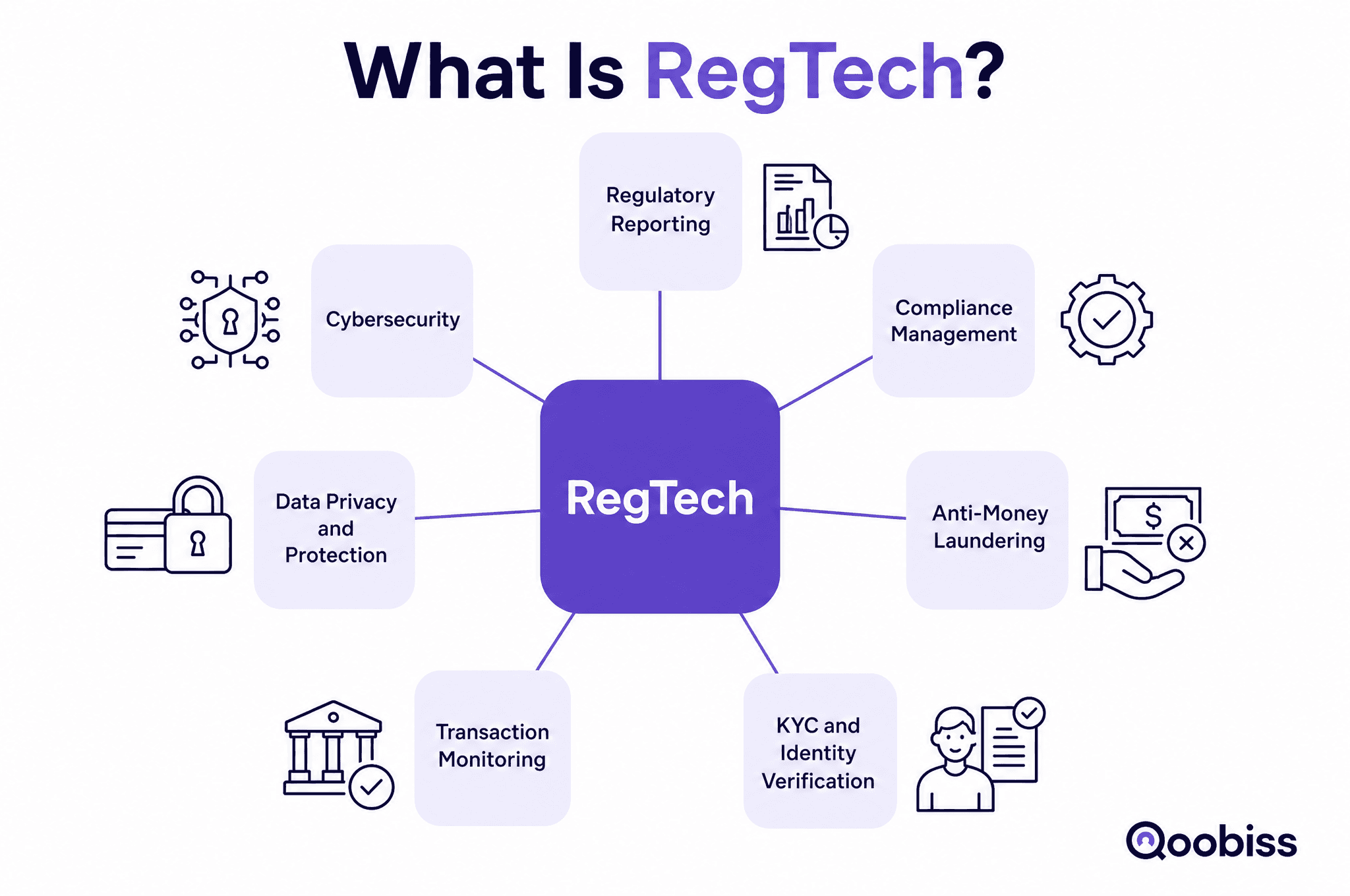
RegTech, short for regulatory technology, is the use of technology to help organizations meet their regulatory and compliance obligations more efficiently and effectively. It applies tools like artificial intelligence, big data analytics, cloud computing, and automation to tasks that were once slow and manual: verifying customer identities, screening against watchlists, monitoring transactions, managing risk, and filing regulatory reports.
The UK's Financial Conduct Authority, which helped popularize the term, describes it as "a sub-set of FinTech that focuses on technologies that may facilitate the delivery of regulatory requirements more efficiently and effectively than existing capabilities."
It is most valuable in heavily regulated industries: financial services first and foremost, but also gaming, healthcare, energy, and beyond.
Where RegTech Came From
RegTech is a child of the 2008 global financial crisis. The wave of regulation that followed (Basel III, Dodd-Frank, and stricter AML rules) sent compliance costs soaring, just as AI, cloud computing, and biometrics were becoming widely available. The two forces met, and a new category was born.
Year | Milestone |
|---|---|
2008 | Global financial crisis triggers a wave of new financial regulation |
2014 | Bank of England's Andy Haldane calls for a technology-led regulatory regime |
2015 | A UK government report (the Blackett review) coins the term "RegTech" |
2016 | The FCA becomes the first regulator to actively promote RegTech; the term goes mainstream |
How RegTech Works: The Technologies Behind It
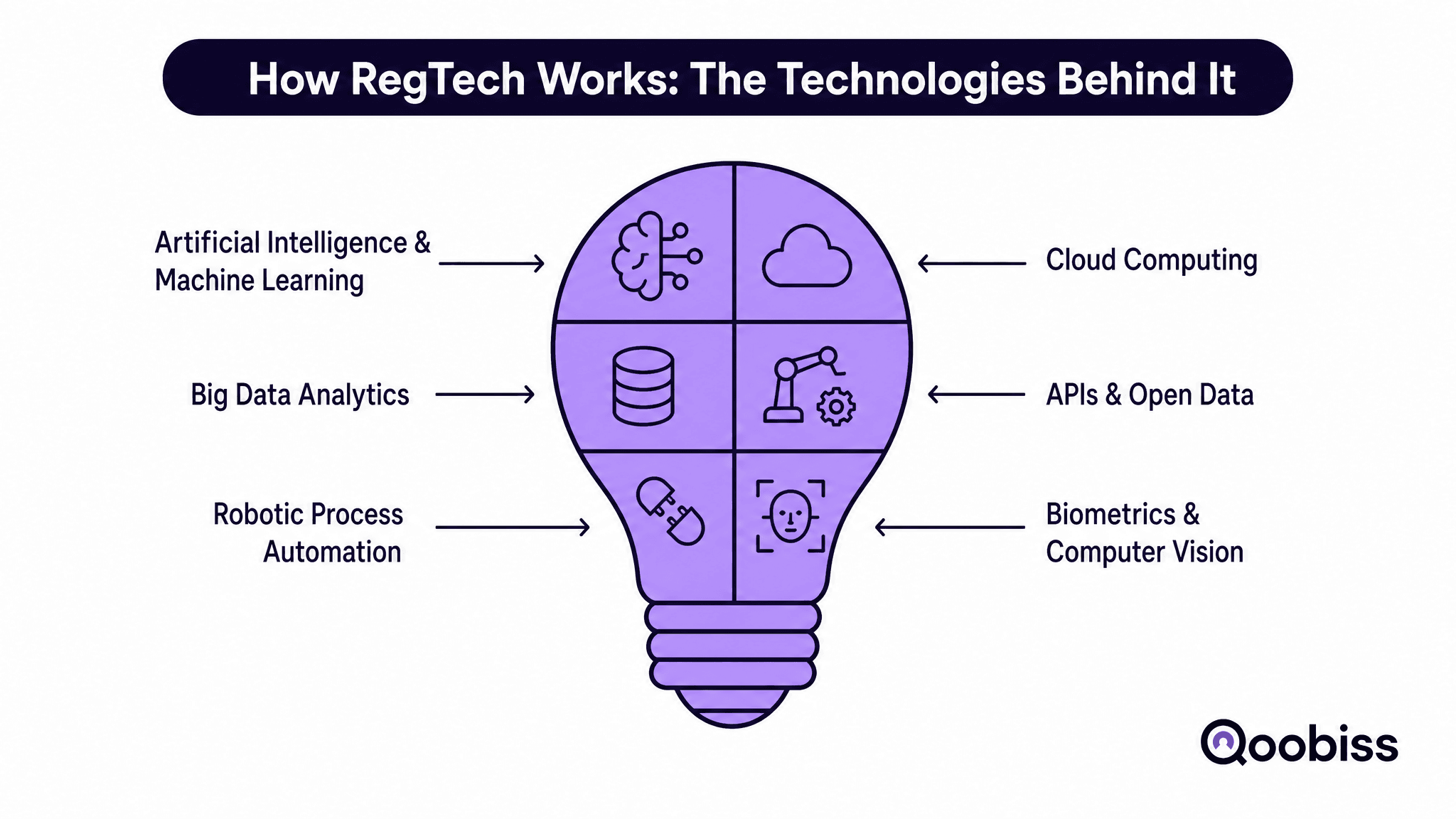
RegTech combines several technologies, usually delivered as cloud-based software, to automate compliance work across the entire customer lifecycle:
Technology | What it does in compliance |
|---|---|
AI and machine learning | Detect patterns, score risk, and flag anomalies faster and more consistently than manual review. Advanced machine learning algorithms analyze behavior to minimize false positives, enhance customer trust, and automatically freeze high-risk profiles or trigger alerts across billions of transactions daily. |
Big data analytics | Process huge volumes of customer and transaction data to surface risk. By ingesting real-time data from payment processors, banking systems, and internal databases, it enables complex rule-based and risk-based analyses based on transaction speed, volume, and geolocation. |
Natural language processing (NLP) | Read and interpret regulations, documents, and communications. NLP allows compliance software to automatically digest extensive textual changes, track regulatory updates, and seamlessly adjust active compliance workflows to maintain regulatory readiness. |
Cloud computing | Deliver scalable, always-updated compliance software (SaaS). Utilizing API-first designs, modern webhooks, and SDKs, cloud-native architectures provide dynamic scalability and allow quick software upgrades without necessitating the reconstruction of legacy systems. |
Biometrics and liveness | Verify that a customer is real and present during onboarding. Facial recognition matches real-time user selfies against identification documents, while advanced liveness detection mitigates fraud by blocking presentation attacks, video stream injections, and bot operations. |
OCR and document verification | Read and authenticate identity documents automatically. Optical Character Recognition (OCR) converts unstructured fields into structured text, checks security watermarks, and validates information against Machine Readable Zones (MRZ), often augmented by encrypted Near-Field Communication (NFC) chip reading to eliminate forgery. |
Blockchain | Provide tamper-evident records and shared, auditable data. In digital asset management, blockchain analytics trace on-chain data streams, enabling Virtual Asset Service Providers (VASPs) to prevent financial crime and effectively satisfy strict cross-border regulatory mandates like the Travel Rule. |
For a closer look at two of these in identity verification, see our guides to liveness detection and OCR.
What Is RegTech Used For? Key Use Cases
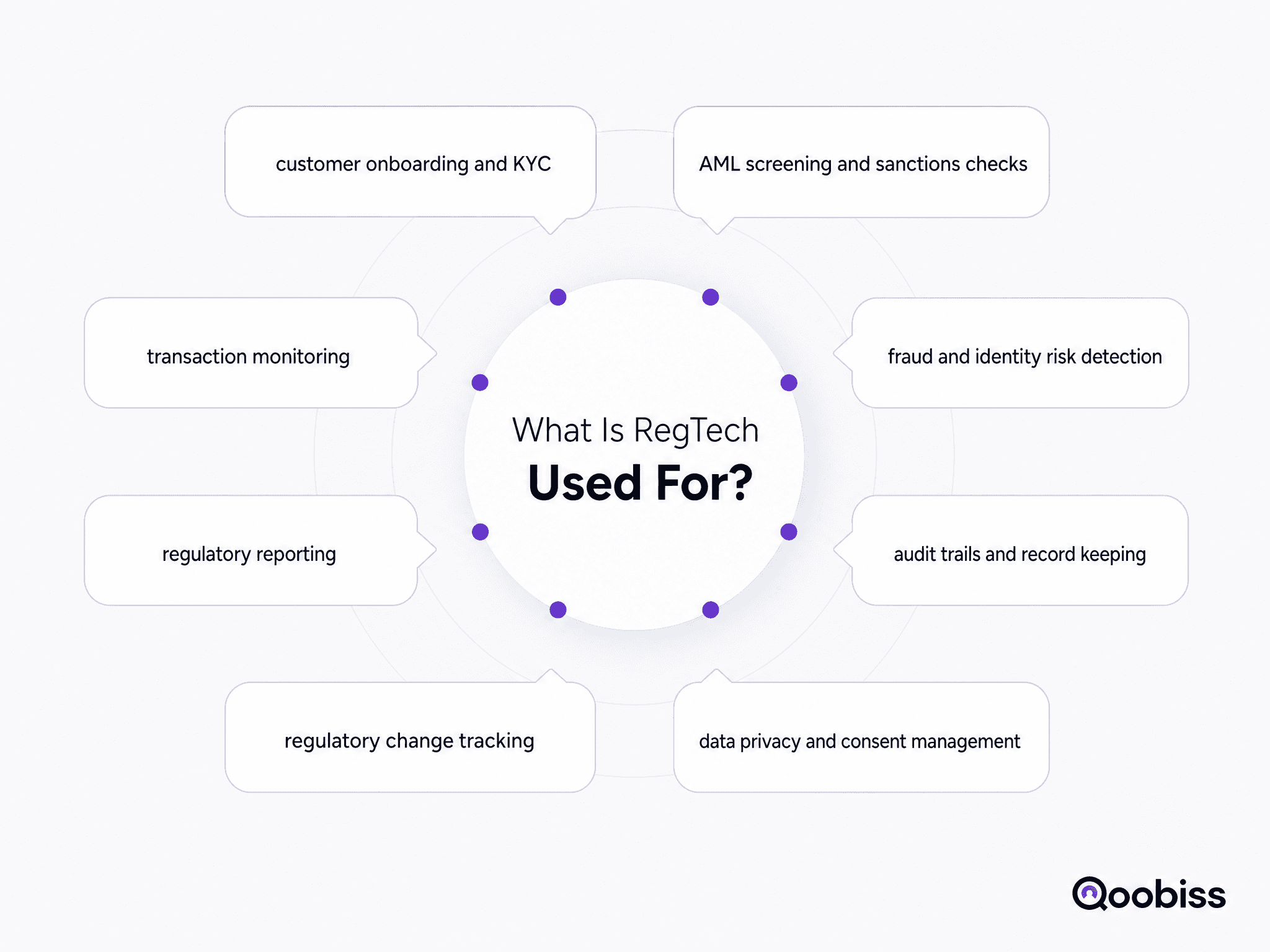
RegTech spans the full compliance lifecycle. The main categories:
Use case | What it covers |
|---|---|
Identity verification & onboarding | KYC and KYB checks, document and biometric verification at account opening |
AML & transaction monitoring | Detecting suspicious activity and money-laundering patterns in real time |
Sanctions, PEP & adverse media | Screening customers against watchlists and negative news |
Fraud prevention | Spotting identity fraud, account takeover, and synthetic identities |
Regulatory reporting | Automating structured reports to regulators (e.g. MiFID II, Basel III) |
Risk & compliance management | Tracking regulatory change, GRC workflows, and audit trails |
Data protection & cybersecurity | Meeting GDPR, DORA, and information-security obligations |
How RegTech Powers KYC and AML
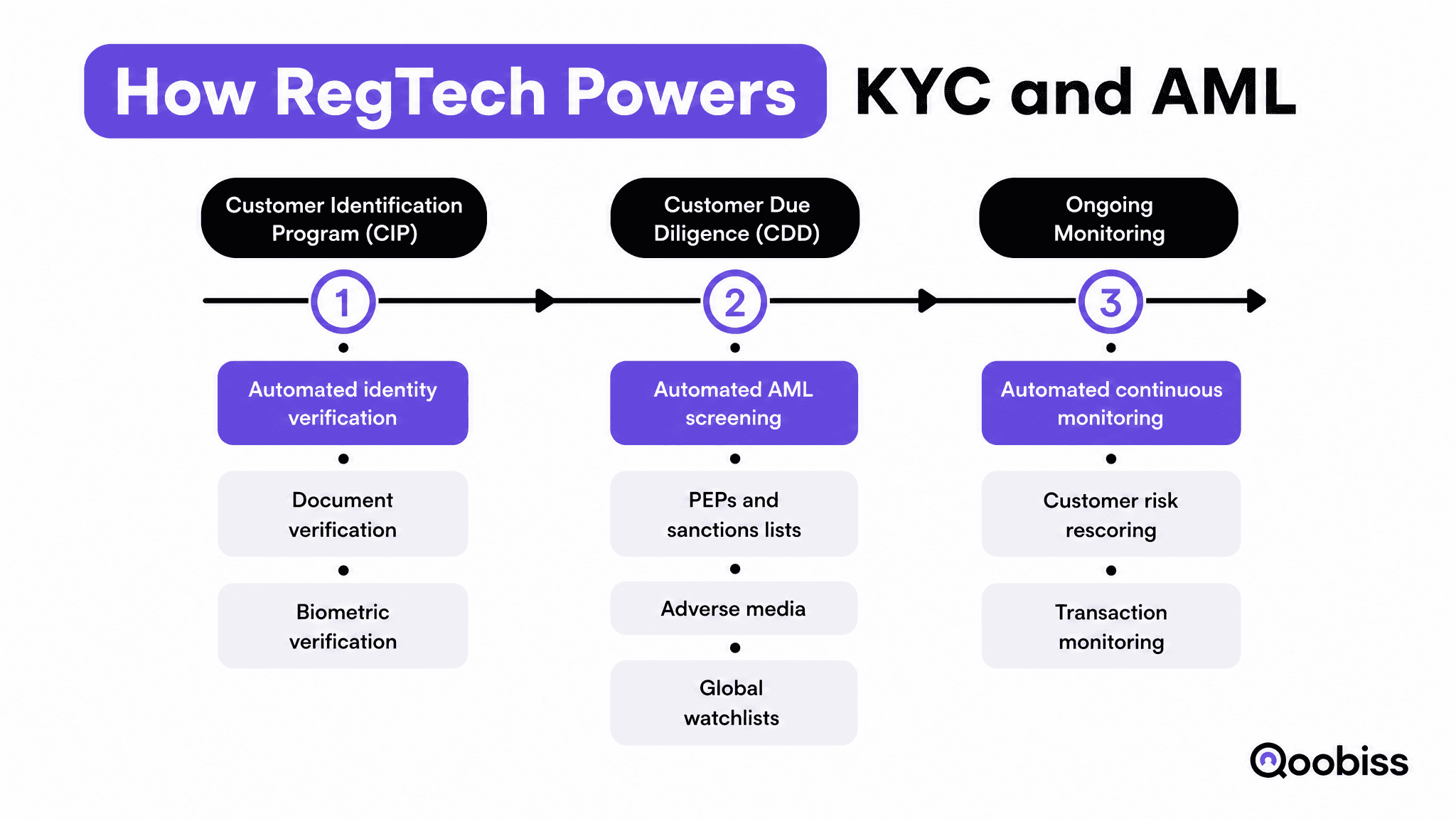
The clearest example of RegTech in action is anti-money-laundering and identity compliance, where manual checks simply cannot keep up with digital onboarding. A modern RegTech stack automates the whole journey:
Onboarding: eKYC and video KYC verify a customer's identity remotely in minutes, and KYB does the same for businesses and their owners.
Screening: automated sanctions, PEP, and adverse media checks flag high-risk customers at onboarding and continuously afterward.
Monitoring: transaction monitoring watches for the patterns of money laundering, such as structuring, and raises alerts in real time.
Evidence: every check is logged, creating the audit trail regulators expect.
The payoff is twofold: compliance teams spend their time on genuine risk instead of paperwork, and customers get through onboarding faster.
RegTech vs FinTech vs SupTech
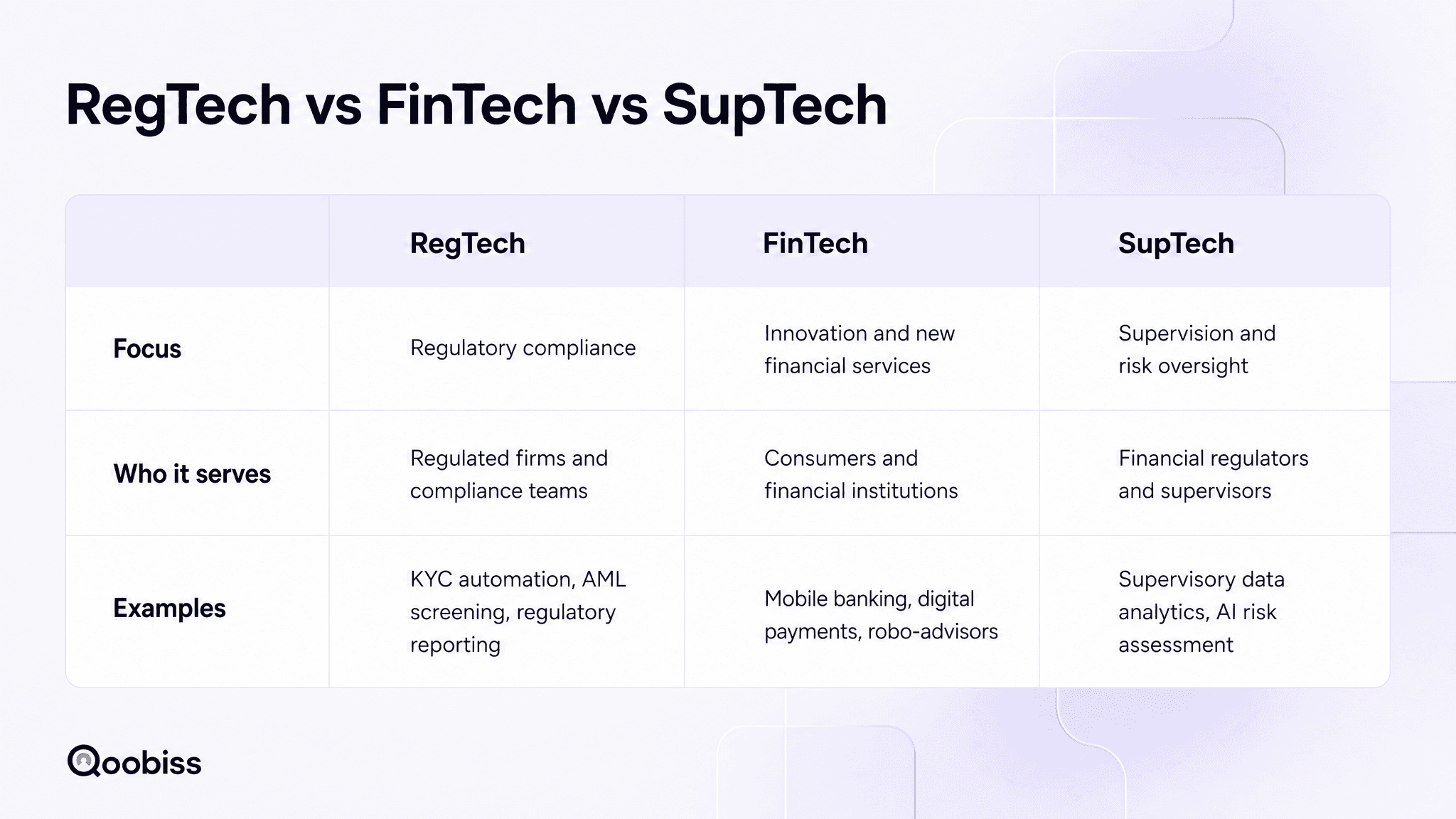
These three terms are related but distinct:
Term | What it is | Who uses it |
|---|---|---|
FinTech | Technology that delivers financial services (payments, lending, banking apps) | Consumers and financial firms |
RegTech | Technology that helps firms comply with regulation | Regulated businesses (banks, fintechs, and more) |
SupTech | Technology that helps regulators supervise compliance | Regulators and supervisory authorities |
RegTech is often described as a subset of FinTech, but it applies well beyond finance. SupTech is the mirror image: the same kind of technology, used by the regulator rather than the regulated.
Benefits of RegTech
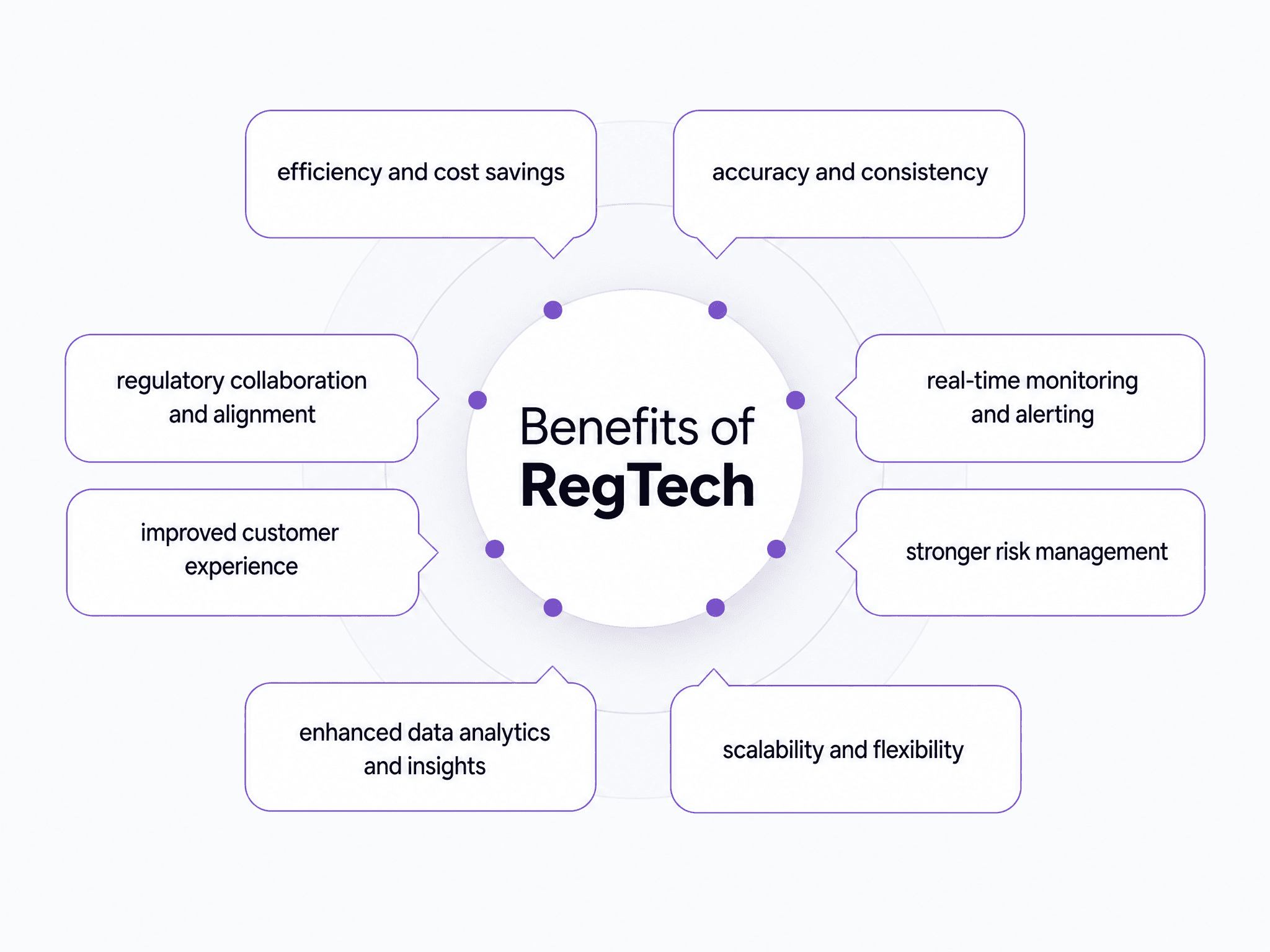
Lower cost: Automation dramatically cuts the extensive labor traditionally required behind compliance operations. For large enterprise firms and multinational banking institutions, manual compliance overhead and human review processes regularly run into the billions of dollars annually.
Speed: Comprehensive identity verifications, background screening checks, and detailed regulatory reporting outputs that historically took days or weeks to assemble manually are fully processed by software in a matter of seconds or minutes.
Accuracy: Advanced software architectures apply complex compliance rules and evaluation logic with total consistency across all operations. This systematic execution drastically reduces operational risks arising from human oversight, manual entry error, and completely missed systemic risks.
Real-time risk detection: Continuous behavioral and transactional monitoring mechanisms catch compliance violations and suspicious activities as they occur in real time, preventing major vulnerabilities from going undetected for months.
Agility: Modern cloud-native compliance software can be dynamically updated via standard APIs and webhooks to reflect rapid changes in international regulations, enabling seamless adaptability without forcing firms to rebuild their entire core legacy infrastructure.
Better customer experience: Deploying automated verification flows accelerates the remote onboarding process for new users. Providing a frictionless digital experience substantially reduces drop-off rates and minimizes abandoned sign-ups during account creation.
Challenges of Adopting RegTech
Legacy integration: Older core operational systems and legacy IT environments utilized by established firms do not always connect cleanly or natively to modern, API-first RegTech deployment tools.
Data quality: Automated analytical engines are completely dependent on the precision of their underlying data inputs. Unstructured, siloed, or messy operational data consistently produces massive amounts of false positives that overwhelm compliance teams.
Regulatory uncertainty: The global legislative environment changes constantly, requiring software solutions and automated governance rules to maintain continuous, rapid alignment with shifting jurisdictional frameworks.
Data security and privacy: Processing, storing, and managing highly sensitive personal identification records and corporate financial details raises a substantial internal information security and data governance burden.
AI explainability: Supervisory authorities and financial regulators increasingly demand complete transparency into automated workflows, requiring corporations to thoroughly explain and audit exactly how an AI-driven compliance decision was reached.
The RegTech Market
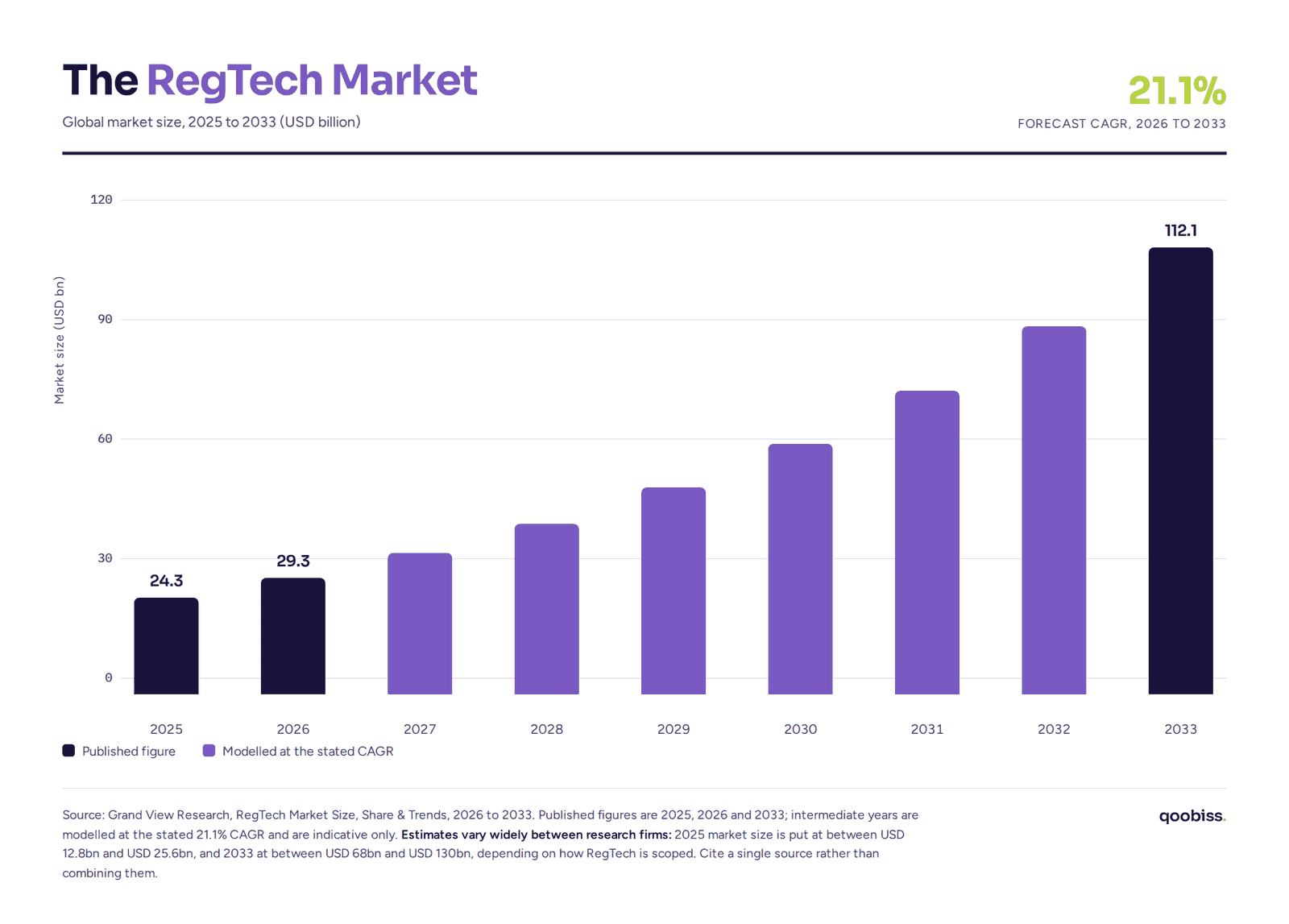
RegTech has grown from a niche into a major category. Third-party market research put the global RegTech market at roughly $15.8 billion in 2024 and projected it to reach around $83 billion by 2032, a compound annual growth rate of about 23%.
The drivers are consistent: rising regulatory complexity, the cost of compliance failures (post-crisis fines have run into the hundreds of billions of dollars), and the steady digitalization of financial services.
RegTech and the EU: AMLR, AMLA, and eIDAS 2.0
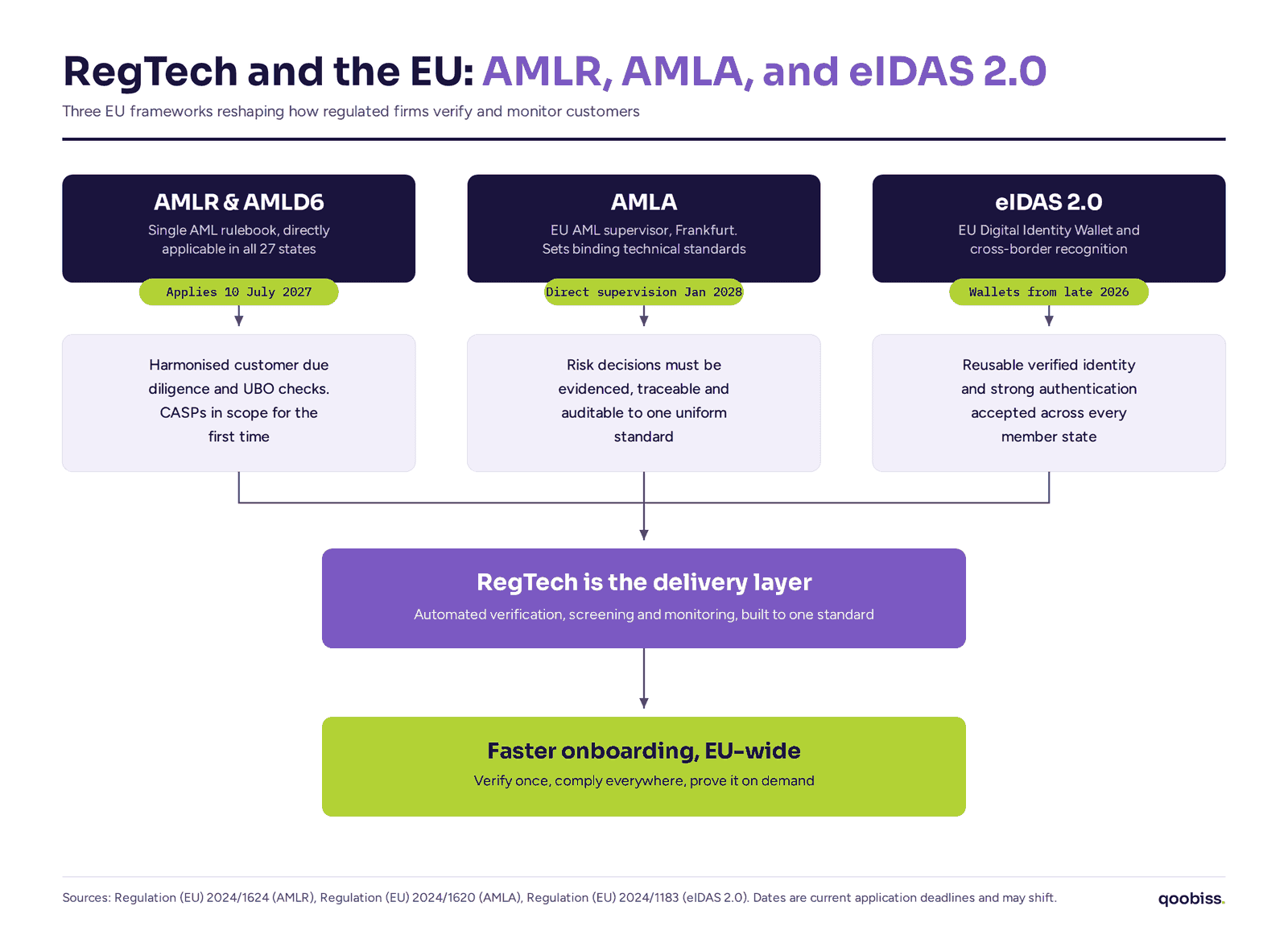
Much RegTech coverage is US and UK focused, but the European Union is now one of the biggest forces shaping the category. A wave of new rules is pushing firms toward RegTech: the EU's single Anti-Money Laundering Regulation (AMLR) and the new Anti-Money Laundering Authority (AMLA) are harmonizing AML compliance across member states, eIDAS 2.0 and the EU Digital Identity Wallet are reshaping how identity is verified, and DORA and the EU AI Act add operational-resilience and AI-governance obligations. For firms operating in Europe, RegTech is becoming less of an efficiency play and more of a necessity.
How to Choose a RegTech Solution
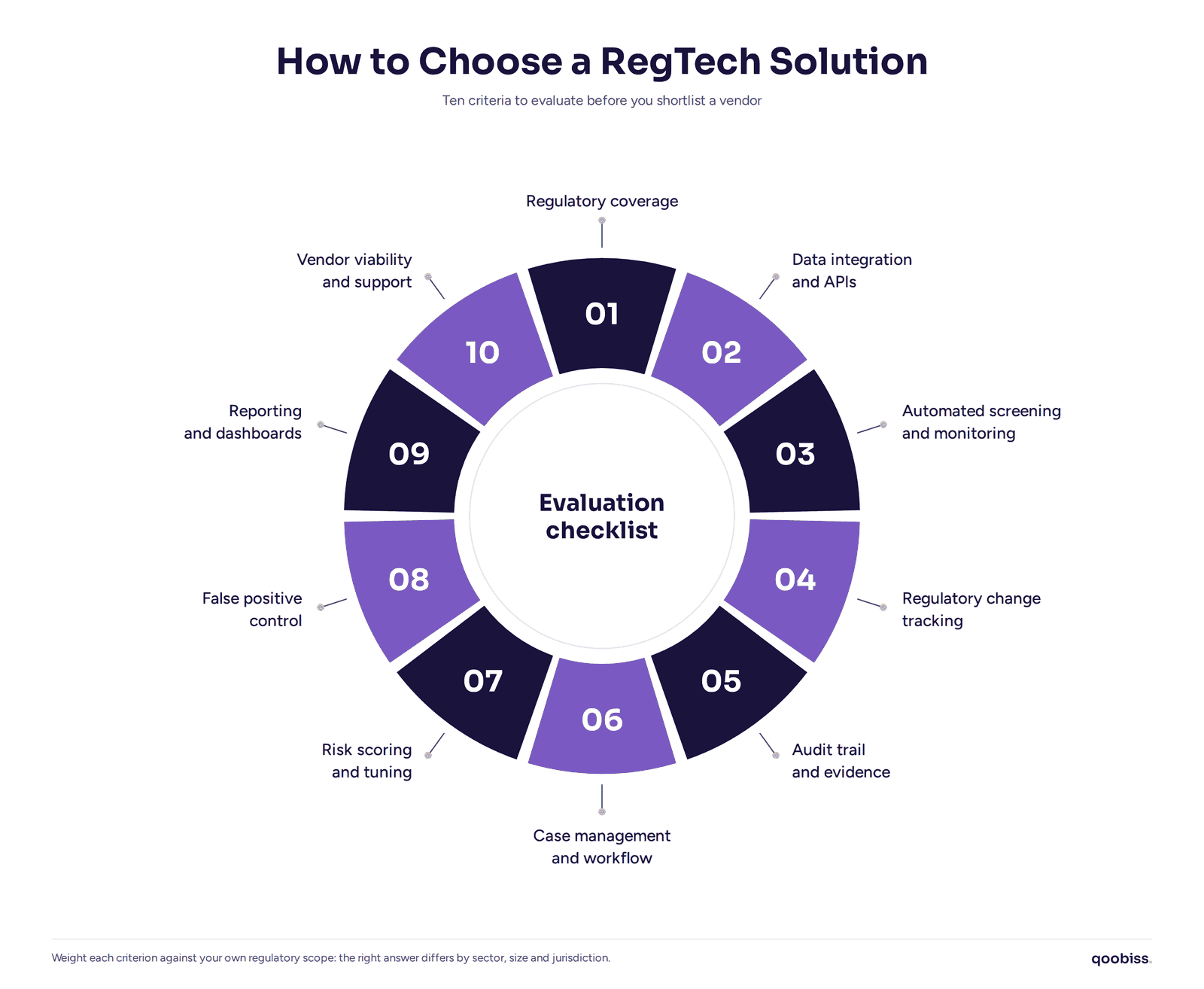
Regulatory fit: Does it cover the specific regulations and jurisdictions you operate in? Selecting a platform that comprehensively supports the document types, countries, and specific regulatory regimes of your operational footprint saves you from stitching together fragmented regional tools later.
Coverage and modularity: Does it handle the full journey (onboarding, screening, monitoring, reporting) or just one piece? Compliance leads must weigh modularity against breadth, determining whether their business requires a single unified end-to-end suite or prefers separate best-of-breed components to combine.
Integration: Look for clean APIs and SDKs that fit your existing systems. The most effective options are built API-first, slotting smoothly into your current technical stack rather than forcing a total infrastructure rebuild, and are ideally supported by clear SDKs, webhooks, and a sandbox environment for testing.
Accuracy, explainability, and audit-readiness: The solution must deliver strong detection with low false positives, alongside decisions you can thoroughly audit. Because regulators require transparency into not just the checks performed but exactly why an automated decision was reached, a complete and exportable audit trail is essential.
Data protection: Ensure GDPR-grade handling of all personal and financial data it processes to safeguard user privacy and satisfy international information-security obligations.
Practical evaluation: Define your required level of assurance based on the tangible risks a fraudulent or non-compliant user poses to your product. Shortlist two or three qualified providers and execute a live pilot using your own data to verify performance on your actual traffic before making a long-term commitment.
RegTech for Compliance with Qoobiss
Qoobiss is a RegTech platform built for identity and financial-crime compliance. It brings identity verification, document and NFC reading, biometrics and liveness, AML and sanctions screening, and transaction monitoring into one modular workflow, so regulated businesses can onboard customers quickly and stay compliant as the rules evolve.
See RegTech in action. Talk to our team about automating identity and AML compliance, book a Qoobiss demo.
Frequently Asked Questions
What is RegTech in simple terms?
What is an example of RegTech?
What is the difference between RegTech and FinTech?
What is SupTech?
What skills are needed for RegTech?
Is RegTech only for banks?