Adverse Media & Negative-News Screening: What It Is & Why It Matters


A customer may not appear on any sanctions or watchlist and still be a serious risk. They might be under investigation for fraud, named in an investigative report, or linked to a corruption scandal in the foreign-language press. Sanctions and PEP lists catch known risks after the fact. Adverse media screening is how compliance teams catch the warning signs first.
This guide explains what adverse media (also called negative news) screening is, the categories of risk it surfaces, how the process works, the regulations behind it, and how it fits into KYC and AML programs. It is written for compliance and risk teams.
What Is Adverse Media Screening?
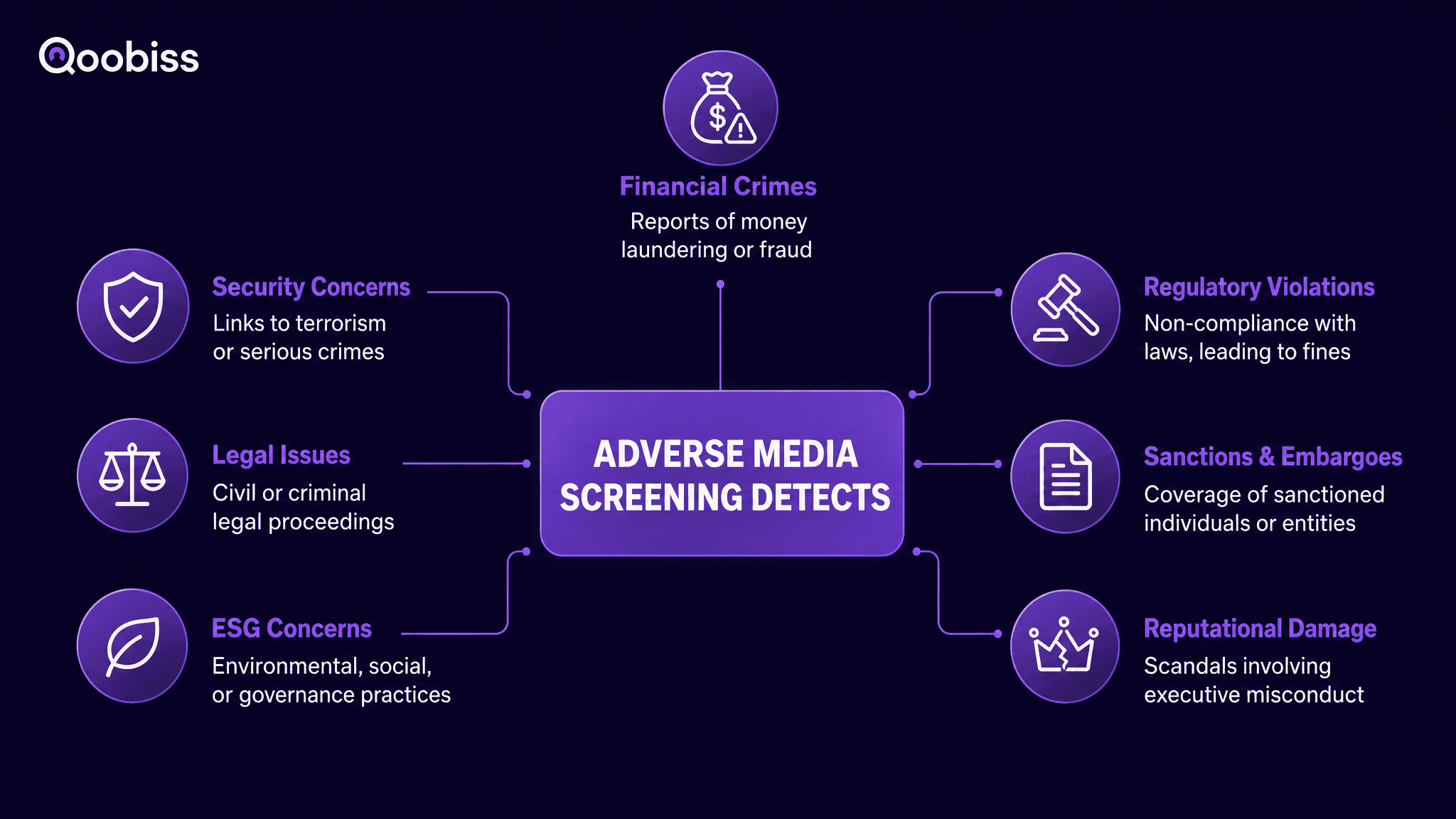
Adverse media screening, also known as negative-news screening, is the process of searching publicly available media and data sources to find negative information linking a person or business to financial crime, misconduct, or reputational risk.
The two terms are interchangeable: adverse media, negative news, and adverse news all refer to the same thing. Screening searches news outlets, court records, regulatory enforcement notices, and other sources for any indication that a customer is involved in money laundering, fraud, corruption, sanctions evasion, or similar activity.
It is a core part of customer due diligence, applied both at onboarding and through ongoing monitoring. It does not replace sanctions and PEP checks; it is a strategic layer that catches risks those lists miss.
Why Adverse Media Screening Matters
Sanctions and PEP screening can identify known or formally designated risks, but they often do not capture emerging threats. A customer may not appear on any official list and still be linked to fraud, corruption, money laundering, regulatory misconduct, or other serious allegations.
Adverse media screening helps compliance teams identify these warning signs earlier, assess how they affect the customer’s risk profile, and take proportionate action before the issue develops into a regulatory, financial, or reputational problem.
Screening negative news matters for several reasons:
Early warning: reputational risk often precedes regulatory action. Credible allegations appear in the press long before a person is added to a sanctions or watchlist.
Regulatory expectation: a risk-based approach to AML is expected to include monitoring negative news as part of due diligence.
Reputational protection: onboarding a customer later exposed as a criminal is a reputational and financial liability. A reputation can change with a single headline.
Avoiding penalties: industry reporting notes that in 2024 several global banks faced multi-million-dollar fines for failing to detect adverse media linked to sanctioned entities (Ondato).
Broad relevance: it is valuable across sectors, and especially when assessing high-risk customers, beneficial owners, and entities in jurisdictions prone to financial crime.
Categories of Adverse Media
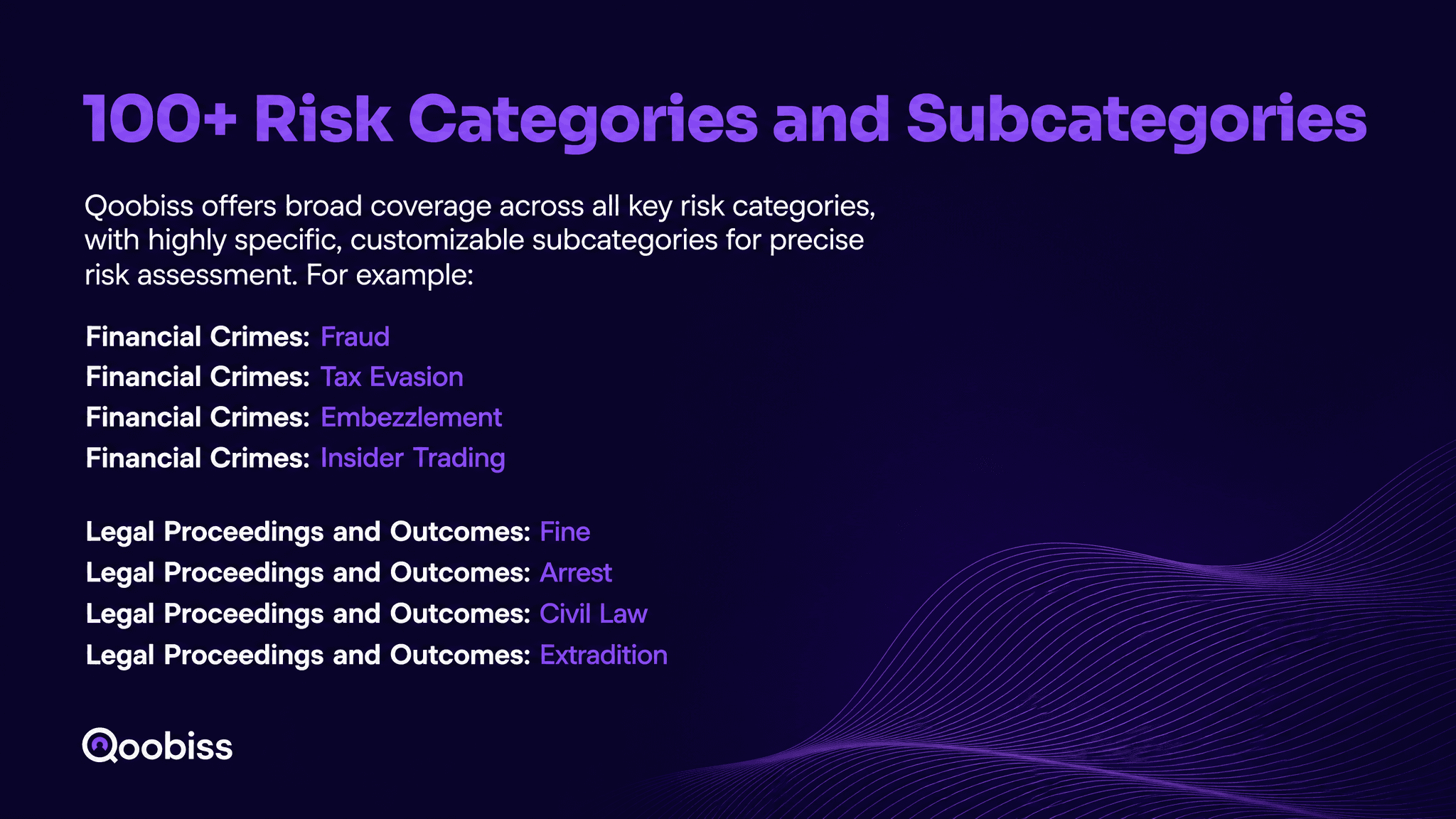
Adverse media can relate to a wide range of risks, from fraud and money laundering to corruption, organized crime, regulatory breaches, and serious reputational misconduct. Not every negative article carries the same level of risk, so compliance teams need a consistent way to classify and prioritise findings.
Organising adverse media around recognised financial-crime categories, including those aligned with FATF predicate offences, helps teams distinguish material threats from general negative publicity. It also supports more consistent triage, risk scoring, escalation, and enhanced due diligence decisions.
Category | Examples of coverage |
|---|---|
Money laundering | Layering schemes, shell companies, structuring, laundering convictions |
Fraud & financial crime | Investment fraud, embezzlement, insider trading, tax evasion |
Corruption & bribery | Kickbacks, graft, procurement scandals, foreign-official bribery |
Sanctions & terrorism financing | Sanctions evasion, threat financing, links to designated entities |
Trafficking & organized crime | Human, drug, or arms trafficking; links to criminal networks |
Regulatory & legal | Enforcement actions, investigations, charges, court judgments |
Environmental & cybercrime | Environmental offences, data breaches, ransomware, cyber fraud |
ESG & reputational | Governance failures, ethical controversies not necessarily illegal |
A useful second lens is direct vs indirect adverse media: is the subject personally implicated, or are they associated with an implicated party, network, or beneficial owner? And a severity ladder runs from accused, questioned, and investigated through arrested, charged, and convicted. Where a subject sits on that ladder shapes how a firm responds.
Structured vs Unstructured Adverse Media
Sources come in two forms. Structured data has been researched, categorized, and tagged in a database (for example, records marking an individual as investigated or convicted of a specific offence). Unstructured data is raw content such as news articles, blogs, and court filings that must be read and interpreted, increasingly with the help of natural-language processing. Good coverage requires both, across multiple languages.
Examples of Adverse Media
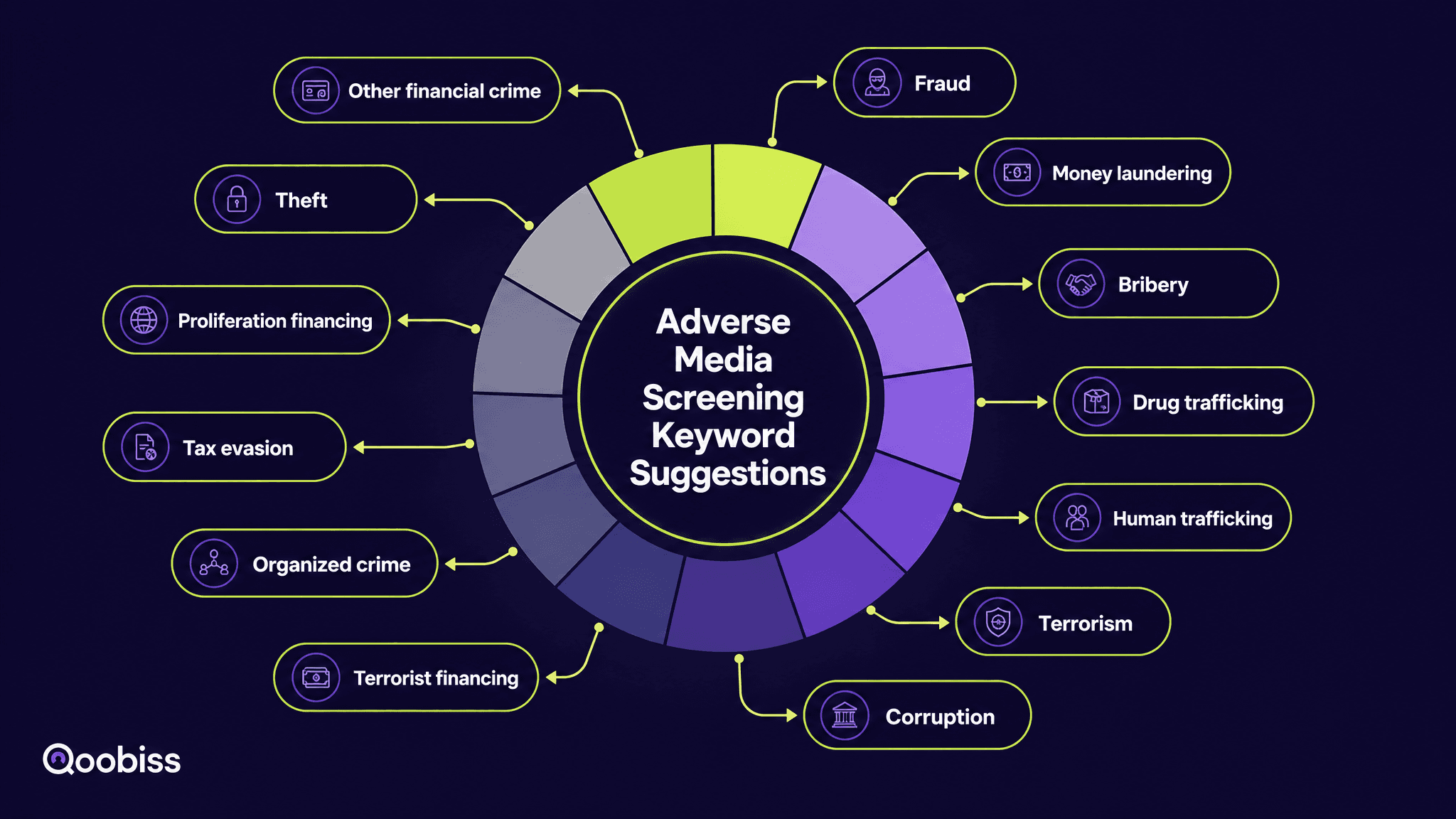
Adverse media can appear in many forms and does not need to involve a conviction or formal regulatory action to be relevant.
A credible allegation, investigation, legal proceeding, or documented association with financial crime may be enough to trigger further review.
The significance of each finding depends on the reliability of the source, the seriousness of the alleged conduct, its recency, and how directly it relates to the person or business being screened.
Common examples include:
A news report linking a company to a fraud investigation
Court filings showing ongoing litigation or a criminal charge
A regulatory enforcement notice or fine against a business
Investigative journalism tying an individual to sanctioned regimes or offshore structures (for example, the Panama Papers)
Local or foreign-language press reporting an arrest that never reaches a sanctions list
Where Adverse Media Comes From
Effective screening draws on a wide range of sources, not just a web search:
Traditional and broadcast news, plus online news portals
Court records, legal databases, and regulatory disclosures
Law-enforcement, tax-authority, and government enforcement notices
Sanctions and PEP lists (as context alongside media)
Blogs, watchdog forums, and investigative journalism
Leaked documents and whistleblower reports
Vetted social media
How the Adverse Media Screening Process Works

Effective adverse media screening involves more than searching a customer’s name online. It requires a structured, risk-based process that can distinguish credible and relevant information from unrelated mentions, duplicate stories, and unreliable sources. Each result must be matched to the correct person or business, assessed in context, and documented so that any decision can be explained and audited.
A defensible screening process follows a clear sequence:
Define scope. Decide who is screened (individuals, entities, beneficial owners) and build risk categories and keyword taxonomies by geography, industry, and language.
Search. Run searches across many structured and unstructured sources, with multilingual coverage.
Match. Identify hits that relate to the actual subject, using name and content matching.
Analyze. Assess each hit for recency, credibility, severity, and relevance. Is the source reputable? Is this your customer or a namesake? Does it materially change the risk profile?
Decide and escalate. Feed findings into onboarding or monitoring decisions and escalate high-risk cases to compliance leadership.
Document. Record search criteria, hits, rationale, and actions to create an auditable trail. This is often what regulators care about most.
Monitor. Re-screen on an ongoing basis, with cadence set by risk tier and event-driven triggers.
Adverse Media vs Sanctions vs PEP Screening
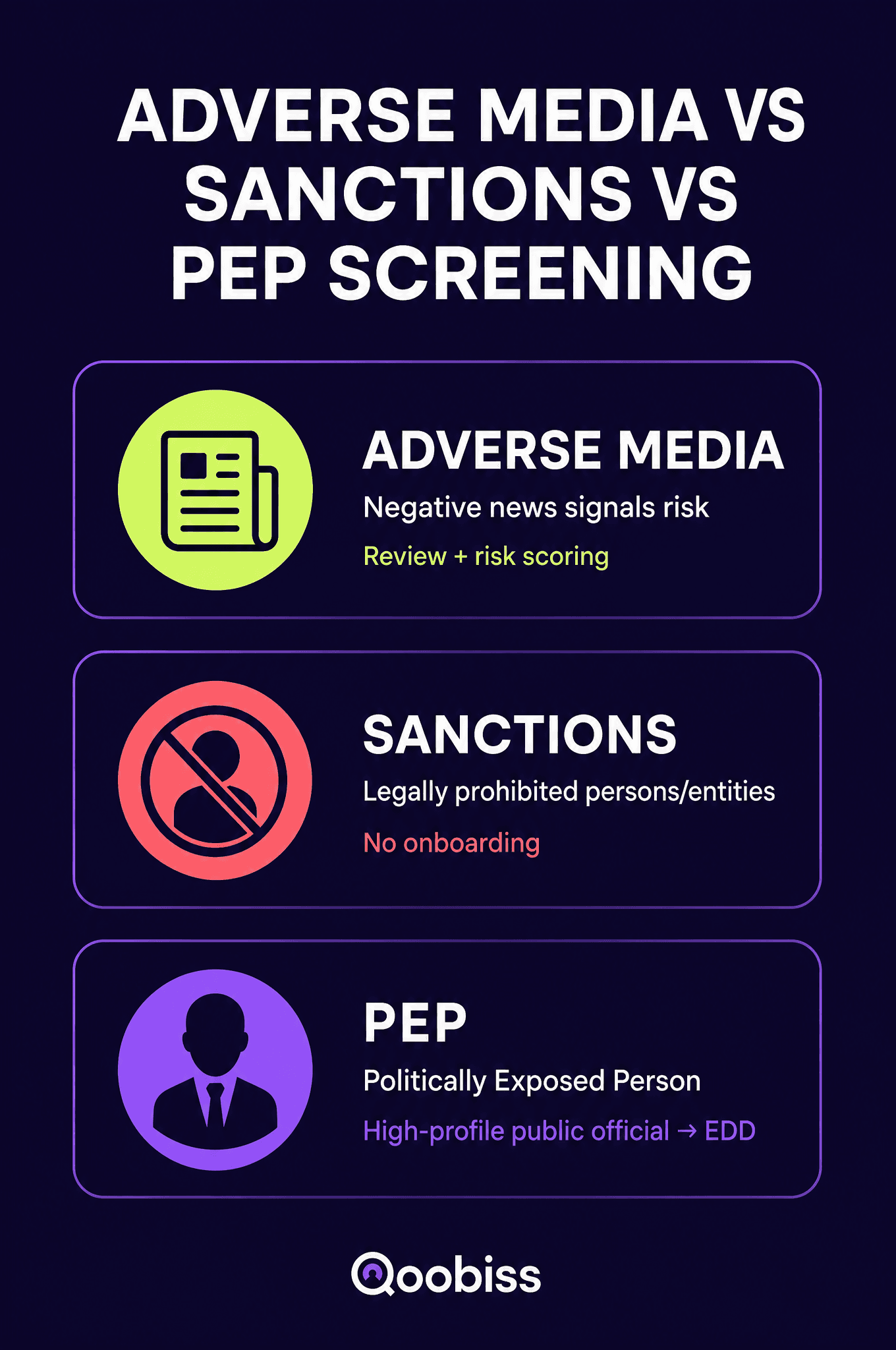
Adverse media, sanctions, and PEP screening all help organisations identify customer risk, but they examine different types of information and lead to different compliance responses.
Sanctions screening identifies people and entities subject to formal legal restrictions, while PEP screening highlights individuals whose public position may expose them to an increased risk of bribery or corruption.
Adverse media screening looks beyond official lists to identify allegations, investigations, criminal associations, and other emerging warning signs.
Using only one of these checks can leave significant gaps in a customer’s risk profile. Together, they provide a more complete view of legal, financial-crime, and reputational exposure.
These three checks are complementary layers, not substitutes:
Check | What it screens | Nature of the data |
|---|---|---|
Sanctions screening | Official government and international sanctions lists | Definitive: a match is a legal restriction |
PEP screening | Lists of politically exposed persons and associates | Status-based: flags heightened risk, not wrongdoing |
Adverse media | News and public sources for negative information | Signal-based: early, unofficial indications of risk |
Read our guides to sanctions lists and politically exposed persons for how the other two layers work.
Where Adverse Media Fits in KYC and AML
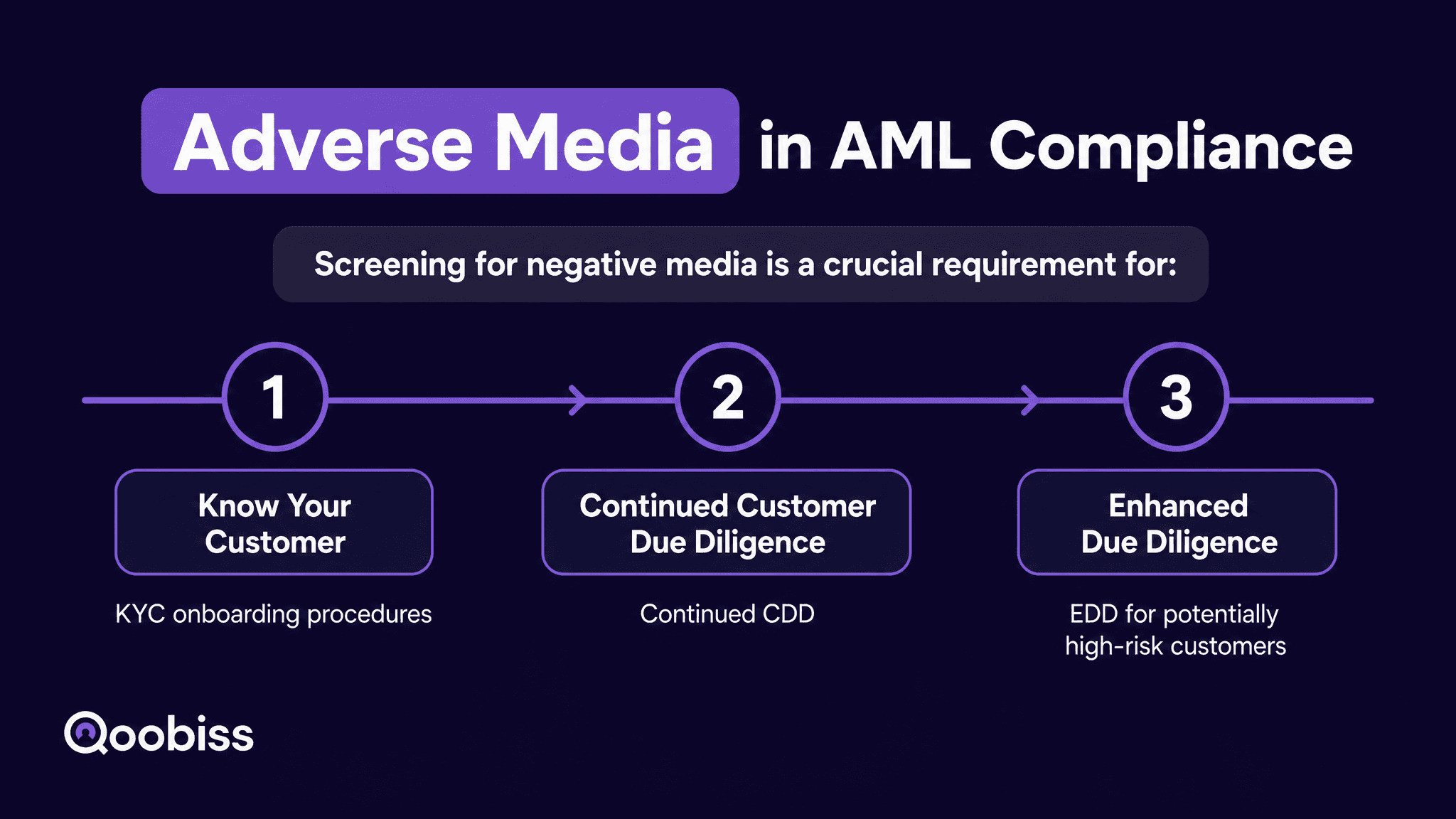
Adverse media screening is a component of CDD and KYC, and it is also a trigger for Enhanced Due Diligence. When negative news surfaces, it can signal the need to deepen investigations into a customer's background, relationships, and source of funds. Typical EDD triggers include a PEP tied to corruption reports, a high-net-worth client named in a tax-evasion scandal, or a crypto investor mentioned in an illicit-financing investigation. It runs at onboarding and continuously afterward, because KYC does not end once an account is open.
Regulations Behind Adverse Media Screening
No single rule says exactly how to screen negative news, which is part of what makes it challenging. Instead, several frameworks require it implicitly through the risk-based approach:
Framework | What it expects |
|---|---|
FATF Recommendations | A risk-based approach and enhanced measures for higher-risk customers and PEPs |
EU AML regime (AMLDs, 6AMLD, new AMLR and AMLA) | Ongoing due diligence and risk assessment across the EU, with a single supervisor emerging |
US (Bank Secrecy Act, FinCEN) | AML programs and suspicious-activity detection for higher-risk relationships |
UK (FCA), EU (EBA) | Supervisory expectations to assess customer and third-party risk, including media |
GDPR and privacy law | Processing personal data from media lawfully and proportionately |
Challenges: The False-Positive Problem
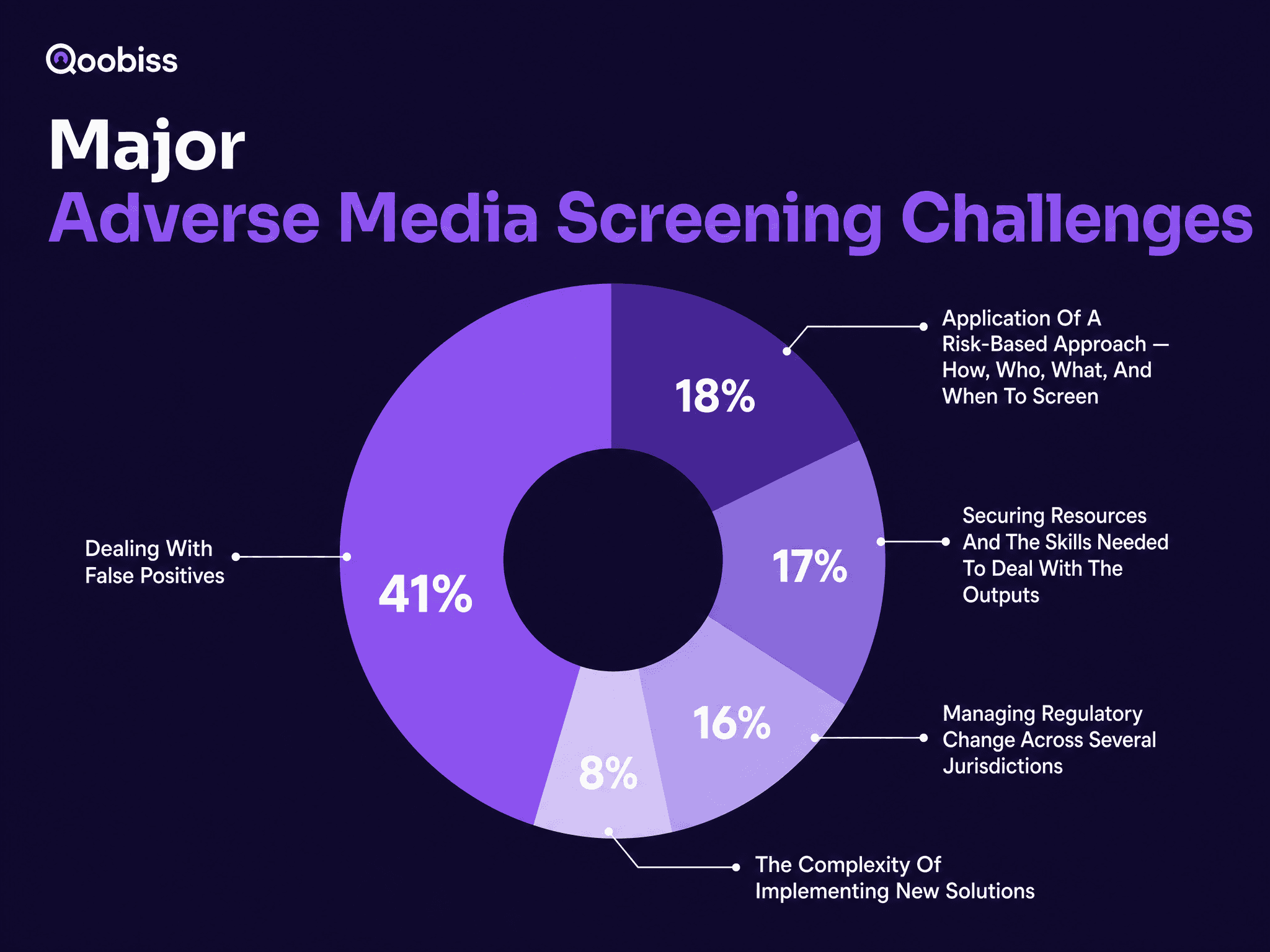
The main obstacle is not access to information, but filtering it. With thousands of articles published daily, teams face volume, noise, duplicate and contradictory reports, multilingual content, and questions of source credibility.
The biggest cost is false positives: matches that turn out to be irrelevant or about a different person. By some estimates, unfiltered online searches can return up to 90% false positives (Thomson Reuters), overwhelming analysts.
Reducing false positives depends on disambiguation and relevance scoring:
Secondary identifiers: confirming date of birth, nationality, or address to separate the real subject from a namesake.
Entity resolution: linking mentions across sources to the correct individual or entity.
Relevance and severity scoring: ranking hits by how credible, recent, severe, and closely connected to the subject they are.
Deduplication: collapsing the same story repeated across many outlets into a single alert.
How Automation and AI Help
Manual screening is slow, inconsistent, and hard to scale. Modern tools apply natural-language processing to read unstructured content in real time, extract the entities and events in a story, match them to the right subject, and score relevance so analysts see the hits that matter first.
Machine learning cuts the noise that drives false positives and can help decide who should be re-screened and how often. The goal is not to remove human judgment but to focus it: analysts spend their time on genuinely material alerts, backed by an auditable record. This pairs naturally with transaction monitoring and the rest of an AML program.
Qoobiss brings adverse media, sanctions, and PEP screening together with identity verification and ongoing monitoring in one AML and screening workflow, with relevance scoring to cut false positives and a full audit trail. Book a demo.
Frequently Asked Questions
What is adverse media screening?
What is an example of adverse media?
Is adverse media screening part of CDD?
What is the difference between adverse media and sanctions screening?
How often should adverse media screening be done?
Is adverse media the same as negative news?