Politically Exposed Person (PEP): Definition, Who Qualifies, and How to Screen


When compliance teams assess customer risk, few classifications carry as much weight, or generate as much confusion, as "politically exposed person." The label applies to a far broader group than most people expect, it triggers specific regulatory obligations, and getting the screening wrong can lead to enforcement actions running into the millions. Yet, there is no single, universally agreed definition, and the criteria shift depending on jurisdiction, institution, and the regulatory framework in play.
This guide unpacks the politically exposed person meaning from the ground up: who qualifies, what the different PEP categories look like, how screening works, and why the distinction between a PEP and a sanctioned individual matters more than many compliance programs acknowledge.
What Is a Politically Exposed Person?

A politically exposed person is an individual who holds, or has recently held, a prominent public function that carries significant political influence, decision-making authority, or access to state resources. The term, commonly written as PEP, originated in anti-money laundering (AML) frameworks as a way to flag individuals whose positions make them statistically more susceptible to involvement in bribery, corruption, and financial crime.
The politically exposed person definition is important to understand correctly: being classified as a PEP does not imply guilt or criminal conduct. It signals elevated risk. A sitting government minister, a supreme court judge, and a senior military commander all occupy roles where the potential for misuse of power, whether through personal corruption or as a target for illicit actors, is inherently higher than for an average banking customer. Financial institutions are expected to recognize that elevated risk and apply proportionate measures.
So what does politically exposed person mean in day-to-day compliance? It means that when a PEP, or someone closely connected to one, opens an account, applies for credit, or initiates a significant transaction, the institution must apply enhanced due diligence (EDD) rather than standard customer checks. This typically involves deeper investigation into the source of wealth and source of funds, senior management approval for the relationship, and intensified ongoing monitoring.
PEP Definition Criteria: Who Qualifies?
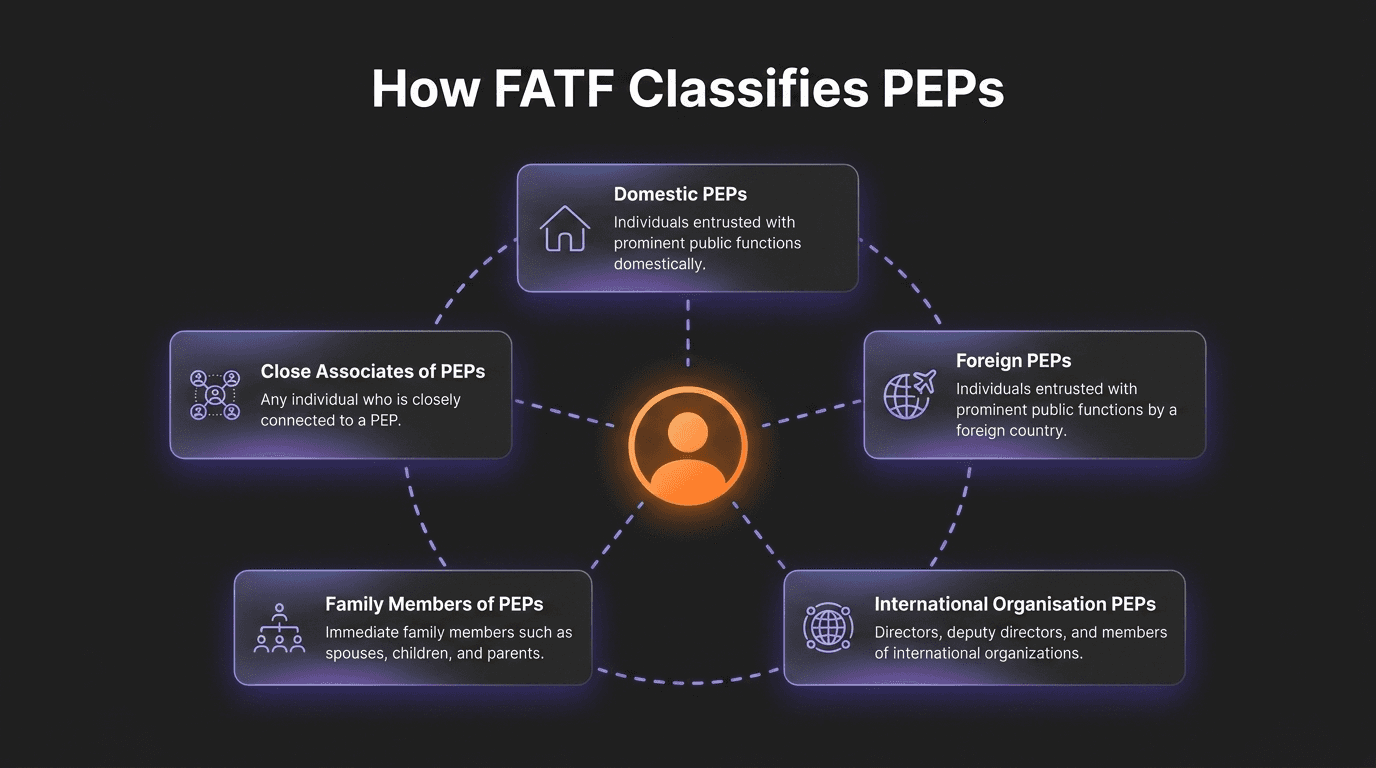
The politically exposed person definition criteria vary by jurisdiction, but the Financial Action Task Force (FATF) provides the baseline that most national regulators build on. FATF identifies three primary categories plus two extended groups:
PEP Category | Who It Includes | Examples |
Domestic PEPs | Individuals holding prominent public functions within their own country | Heads of state, cabinet ministers, senior judges, central bank governors, military generals |
Foreign PEPs | Individuals holding prominent public functions in a foreign country | Ambassadors, consuls, foreign heads of state, foreign ministers |
International Organization PEPs | Senior figures in international bodies | UN directors, NATO officials, World Bank executives, IMF board members |
Family Members | Close relatives of any PEP | Spouse, children, parents, siblings — scope varies by jurisdiction |
Close Associates | Individuals with close business or personal ties to a PEP | Business partners, joint beneficial owners, known close advisors |
Politically exposed person examples span well beyond the obvious heads of state. Senior executives of state-owned enterprises qualify in most frameworks. Members of ruling party leadership bodies, constitutional court justices, and high-ranking officers in customs or tax authorities all meet the criteria in many jurisdictions. Even members of international sporting committees, following high-profile corruption cases in organizations like FIFA, have been added to some regulators’ PEP definitions.
The breadth of coverage is intentional. Corruption and misuse of public funds rarely involve only the officeholder themselves. It flows through family members who hold assets on their behalf, business associates who launder proceeds, and intermediaries who facilitate the movement of illicit wealth.
PEP Risk Levels: Why Not All PEPs Carry the Same Risk
Classifying someone as a politically exposed person is the starting point, not the conclusion. A risk-based approach, required under both FATF recommendations and EU Anti-Money Laundering Directives, means institutions must assess each PEP relationship individually rather than applying a single set of measures uniformly.
Factors that influence the risk level include the seniority and influence of the position held, the jurisdiction’s corruption index and rule-of-law standing, the nature of the products or services the PEP is accessing, the source and volume of funds flowing through the relationship, and whether the PEP operates in sectors with historically higher corruption exposure (defense contracting, natural resource extraction, public procurement).
A municipal-level official in a low-corruption jurisdiction presents a different risk profile than a cabinet minister in a country with weak governance structures. Compliance programs that treat both identically, either by applying maximum scrutiny everywhere or by running only surface-level checks, fail the proportionality test that regulators expect.
How Long Does PEP Status Last?
One of the most misunderstood aspects of PEP classification: there is no universal expiration date. A person does not cease to be a risk the day they leave office. FATF guidance makes clear that former PEPs should continue to be assessed on a risk basis, considering how recently they left the position, the level of influence they still retain, and whether their risk profile has materially changed.
In practice, most financial institutions maintain enhanced monitoring for a minimum of 12 to 18 months after a PEP leaves office, and many extend that window considerably, some indefinitely for heads of state or individuals who held particularly sensitive roles. The European Union’s Anti-Money Laundering Directives require institutions to apply risk-based measures to former PEPs for at least 12 months, but leave room for longer periods where warranted.
The rationale is straightforward: corrupt proceeds don’t evaporate when someone steps down from a government role. Assets accumulated through illicit means during a term of office can take years to surface in financial transactions, and the networks built around a PEP often persist long after the individual’s formal authority ends.
PEP Lists: Where to Find Them and How They Work
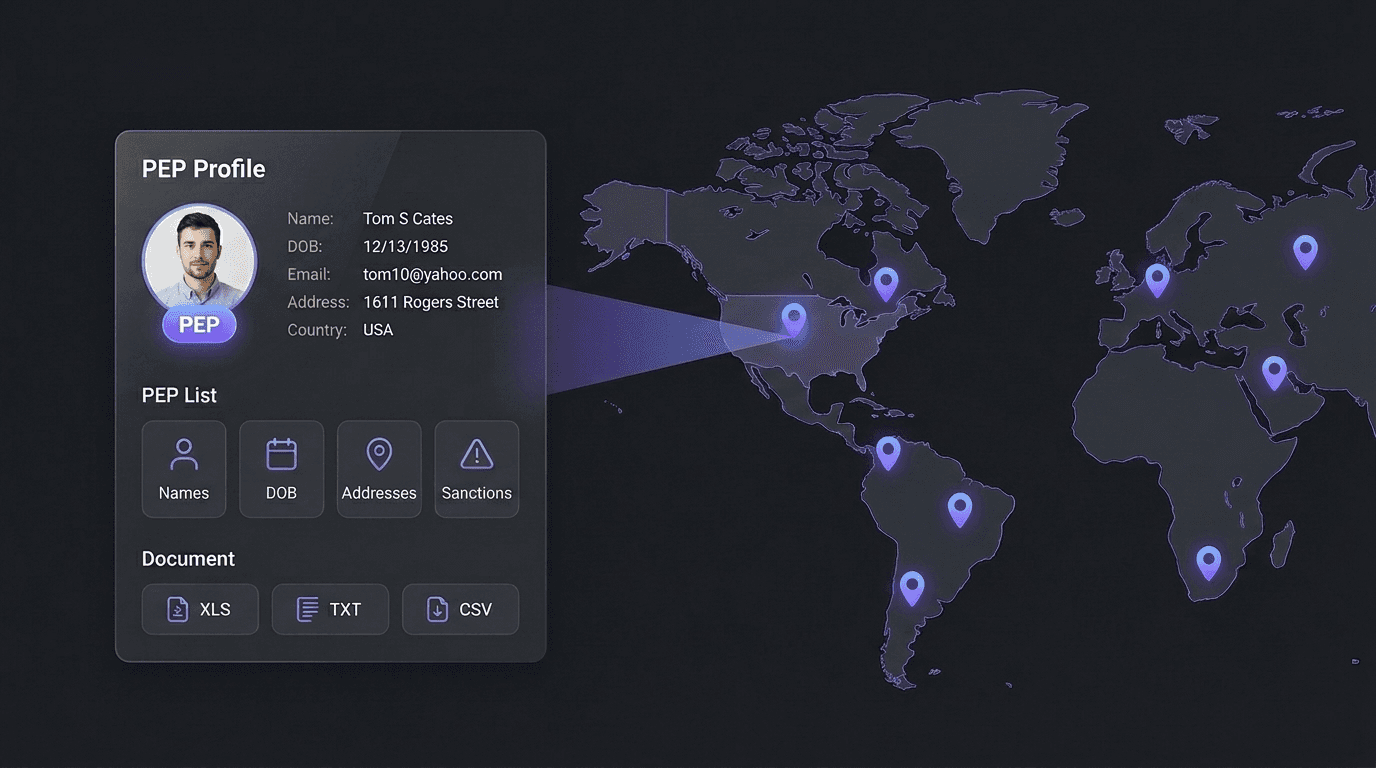
There is no single, centralized, publicly available politically exposed person list. Unlike sanctions lists, which governments publish and update on fixed schedules, PEP databases are compiled and maintained primarily by commercial data providers. Major providers include Dow Jones Risk & Compliance, Moody’s (formerly Bureau van Dijk), Refinitiv World-Check, and LexisNexis, among others.
These databases aggregate information from government gazettes, official appointments, electoral records, corporate registries, and media sources to build profiles of individuals who meet PEP criteria. Coverage, update frequency, and depth of associated data (family members, known associates, source-of-wealth indicators) vary significantly between providers.
For compliance teams conducting a politically exposed person list search, it’s worth recognizing that no single database claims complete global coverage. Gaps exist, particularly for sub-national officials, state-owned enterprise executives in smaller markets, and recently appointed figures whose public records haven’t yet been indexed. This is why screening programs typically combine commercial PEP databases with sanctions lists and adverse media monitoring to build a fuller risk picture.
How to Screen for Politically Exposed Persons
Effective politically exposed person screening follows a structured process that begins at onboarding and continues throughout the customer relationship.
Initial screening. At account opening, the customer’s name and identifying details are checked against PEP databases. This politically exposed person check should be automated to ensure consistency and should account for name variations, transliterations, and aliases, challenges that are particularly acute with names that span multiple languages or scripts.
Risk assessment. If a PEP match is confirmed, the institution assesses the risk level based on the factors outlined above. This step determines whether standard enhanced due diligence suffices or whether additional investigation is required, including a deeper look at source of wealth, source of funds, and the purpose of the business relationship.
Senior management approval. Most regulatory frameworks require senior management sign-off before establishing or continuing a relationship with a confirmed PEP. This ensures that the decision to onboard a higher-risk customer is made at an appropriate level of authority.
Ongoing monitoring. PEP status can change, a customer who was not a PEP at onboarding may be appointed to a qualifying position years later. Continuous or periodic re-screening against updated PEP databases catches these changes. Determining if someone is a politically exposed person isn’t a one-time question; it requires ongoing vigilance.
Trigger-based reviews. Material events, a PEP being named in adverse media, a change in the corruption index of their home jurisdiction, or unusual transaction patterns, should prompt an immediate review outside the regular screening cycle.Regulatory Framework: FATF, EU AMLD, and FinCEN
PEP obligations are embedded in every major AML regulatory framework, though the specifics differ.
FATF Recommendations 12 and 22 establish the international standard, requiring enhanced due diligence for foreign PEPs and, since the 2012 revision, for domestic PEPs and individuals holding senior positions in international organizations. FATF treats the risk-based approach as foundational: institutions must determine the appropriate level of measures based on the assessed risk.
The EU’s Anti-Money Laundering Directives (currently the 6th AMLD, with the AML Regulation taking effect in 2027) go further by requiring EDD for all categories of PEPs, domestic, foreign, and international, without distinction. The upcoming AML Regulation will harmonize PEP definitions across all EU member states.
In the United States, BSA/AML regulations do not define the term “politically exposed person” directly. Instead, FinCEN uses “Senior Foreign Political Figure” (SFPF), a narrower designation focused on foreign individuals. However, the FFIEC examination manual makes clear that examiners expect banks to have risk-based policies for identifying and managing PEP relationships, and the practical expectation in the US market is that institutions screen for PEPs broadly.
Enforcement is real. Institutions that fail to conduct adequate politically exposed person AML checks face significant penalties, both regulatory fines and reputational damage that can prove equally costly.
Automated PEP Screening: How Technology Is Changing Compliance
Manual PEP screening, comparing customer names against spreadsheets or running individual database queries, is neither scalable nor reliable. Name matching alone introduces complexity: a single individual may appear under multiple transliterations, maiden names, or aliases, and common names generate high volumes of false positives that overwhelm compliance teams.
Modern politically exposed person verification methods address these challenges through several capabilities. AI-powered entity resolution analyzes multiple data points beyond the name, date of birth, nationality, associated entities, to produce more accurate matches and reduce false-positive rates.
Real-time API-driven screening integrates PEP checks directly into digital onboarding workflows, eliminating the delay of batch-processed manual reviews. Continuous monitoring automatically re-screens the entire customer base against updated PEP databases at defined intervals, catching status changes without manual intervention.
And consolidated risk dashboards aggregate PEP screening results alongside sanctions hits and adverse media flags, giving compliance officers a unified view of each customer’s risk profile.
The shift from manual to automated PEP screening isn’t just about efficiency, it produces more consistent outcomes, stronger audit trails, and faster response times when regulators ask how a specific PEP relationship was identified, assessed, and managed.
Frequently Asked Questions
What is a PEP in AML?
Is being a PEP the same as being on a sanctions list?
Who counts as a PEP family member?
How to check if someone is a politically exposed person?
Does PEP status expire?
What happens if a business fails to screen for PEPs?