Sanctions Lists Explained: OFAC, UN, EU & HMT


Doing business with the wrong person can be a crime, even by accident. Governments and international bodies publish sanctions lists naming the individuals, companies, and countries that businesses are restricted or prohibited from dealing with.
Checking customers and transactions against these lists, known as sanctions screening, is a legal obligation for banks, fintechs, and many other regulated firms.
This guide explains what a sanctions list is, the different types of sanctions, the four major list-issuing regimes (OFAC, UN, EU, and the UK/HMT), how the lists relate to each other, and how screening works in practice. It is written for compliance and risk teams.
What Is a Sanctions List?
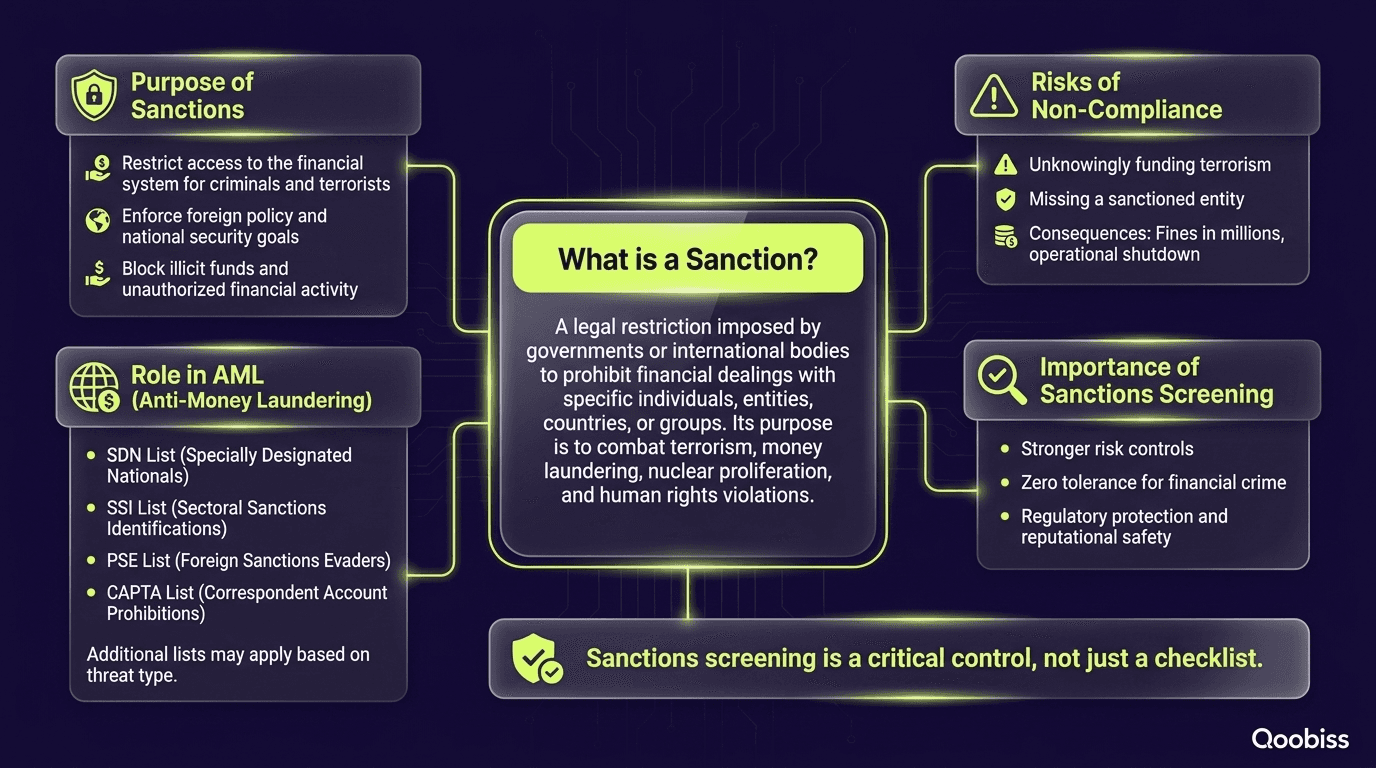
A sanctions list is an official register of individuals, companies, organisations, vessels, aircraft, or countries that have been placed under legal or financial restrictions by a government, regulator, or international body. These restrictions may prohibit or limit the business that other parties can conduct with the listed subject.
Sanctions lists usually include identifying information such as names, aliases, dates of birth, nationalities, addresses, passport numbers, registration details, and vessel identifiers. They also specify the restrictions that apply, which may include asset freezes, travel bans, trade restrictions, limits on financial services, or prohibitions on making funds and economic resources available.
Sanctions are used as a foreign-policy and national-security tool. Their purpose may be to change behaviour, apply economic pressure, disrupt financing, or restrict access to international markets. Common targets include terrorism, weapons proliferation, organised crime, corruption, human-rights abuses, cyberattacks, and armed aggression.
Some sanctions apply to specifically named persons or entities, while others target entire countries, regions, industries, or types of activity. Because sanctions programmes can change frequently, businesses must ensure that the data they use is accurate and up to date.
For regulated organisations, sanctions lists provide the reference data behind sanctions screening. This process compares customers, beneficial owners, counterparties, and transactions against relevant lists during onboarding and throughout the business relationship. Potential matches must then be reviewed to determine whether they are genuine matches or false positives before any appropriate action is taken.
Types of Sanctions
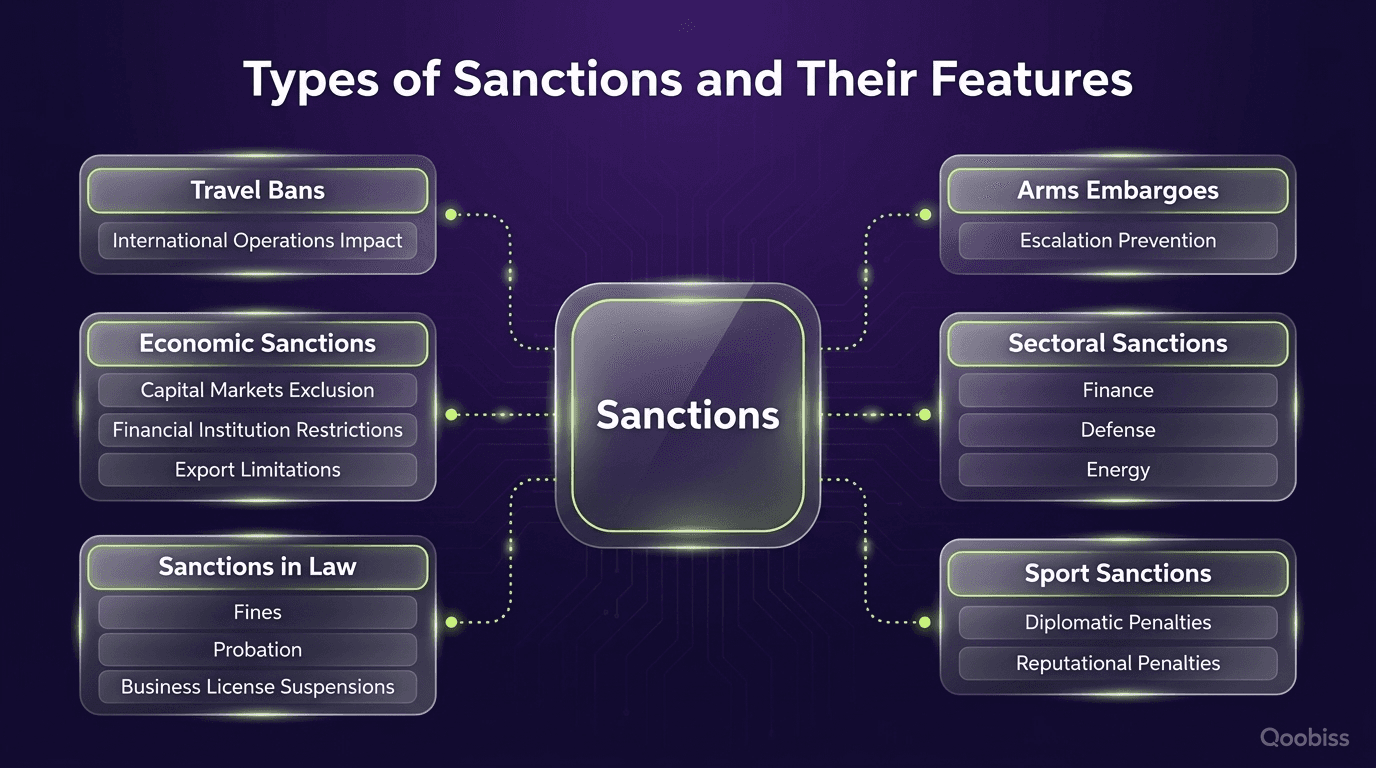
Sanctions can take different forms depending on their purpose, target, and legal scope. Some focus on specific individuals or organisations, while others restrict entire sectors, regions, or types of economic activity. The main types include:
Type | What it does |
|---|---|
Comprehensive sanctions | Broad restrictions on nearly all dealings with an entire country or region |
Targeted (smart) sanctions | Restrictions aimed at specific individuals, entities, or sectors, not a whole population |
Asset freezes | Blocking access to funds and economic resources of a listed party |
Travel bans | Prohibiting listed individuals from entering certain countries |
Arms embargoes | Banning the supply of weapons and related material |
Sectoral sanctions | Restricting specific industries such as energy, finance, or defense |
Trade / export controls | Limiting or banning trade in certain goods and technologies |
Secondary sanctions | Penalizing non-US parties that deal with sanctioned entities |
The Major Sanctions Lists: OFAC, UN, EU & HMT
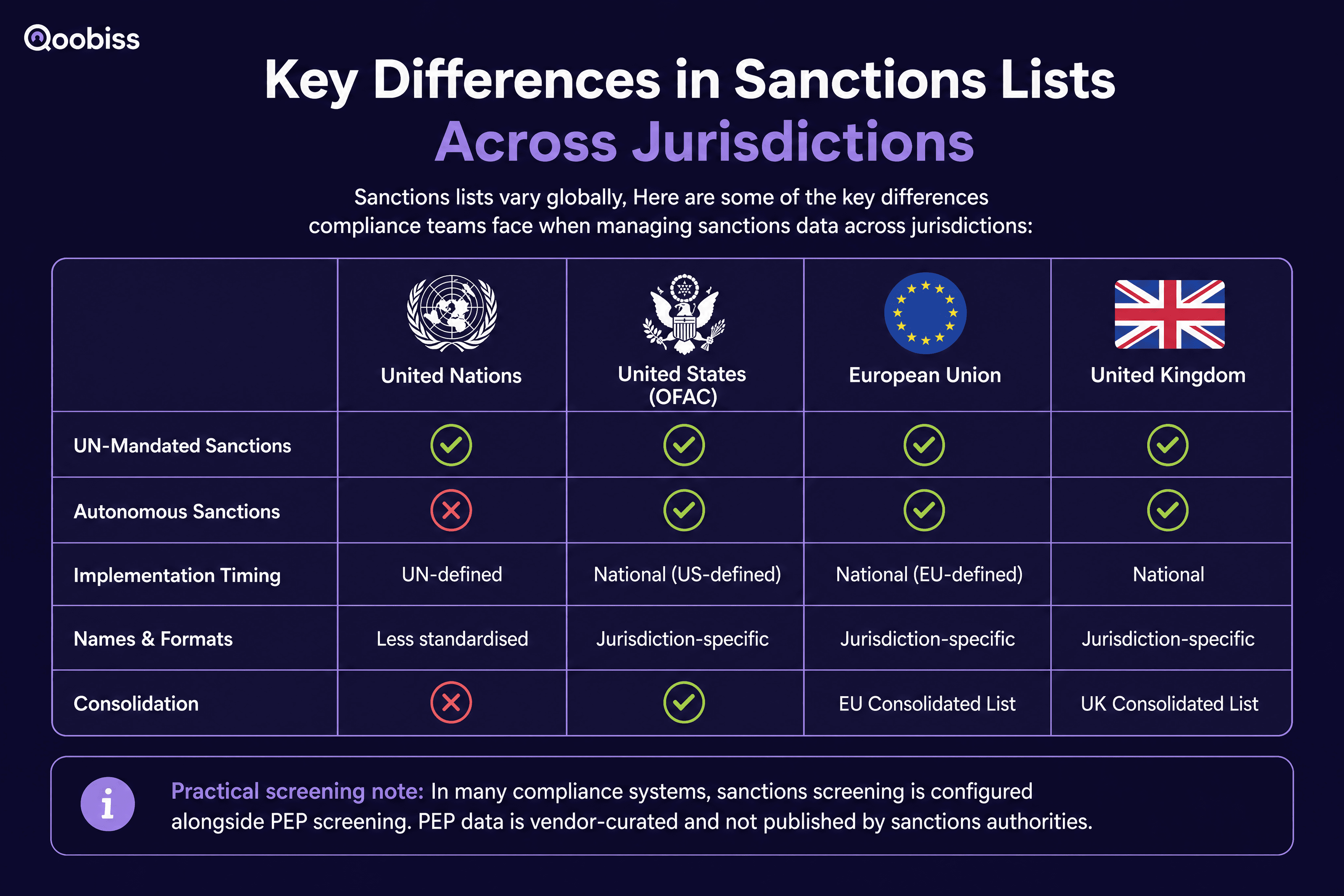
Four regimes issue the sanctions lists most firms must screen against. Many businesses have to check several at once.
Regime | Issuing body | Primary list(s) | Legal basis |
|---|---|---|---|
Office of Foreign Assets Control, US Treasury | SDN List and the Consolidated (non-SDN) Sanctions List | IEEPA and related US law | |
United Nations Security Council (via sanctions committees) | UN Security Council Consolidated List | UN Charter, Chapter VII, Article 41 | |
Council of the EU; European Commission publishes | EU Consolidated List of financial sanctions | Common Foreign and Security Policy | |
HM Treasury via OFSI; FCDO designates | UK Sanctions List and the OFSI Consolidated List | Sanctions and Anti-Money Laundering Act 2018 |
OFAC (United States)
The Office of Foreign Assets Control, part of the US Treasury, administers US sanctions. Its best-known list is the Specially Designated Nationals and Blocked Persons List (SDN List), which names individuals, entities, vessels, and aircraft whose assets are blocked and with whom US persons generally may not deal.
OFAC also publishes a Consolidated Sanctions List of non-SDN lists, and delivers all of this data through its Sanctions List Service (SLS). Because OFAC applies broad jurisdiction, its lists matter far beyond the US.
OFAC's main lists include:
List | Purpose |
|---|---|
SDN List | Blocked persons and entities; assets frozen, dealings prohibited |
Consolidated (non-SDN) List | A bundle of the non-SDN lists below, for easier screening |
Sectoral Sanctions Identifications (SSI) List | Entities in targeted sectors (e.g. finance, energy) |
Foreign Sanctions Evaders (FSE) List | Parties that have evaded or helped evade US sanctions |
NS-MBS, NS-CMIC, NS-PLC, CAPTA lists | Menu-based, military-industrial, and correspondent-account restrictions |
United Nations
The UN Security Council imposes sanctions under Chapter VII of the UN Charter. Each sanctions regime is run by a dedicated committee, and designations are compiled in the UN Security Council Consolidated List. UN sanctions are binding on all member states, which then implement them through their own national or regional lists. This is why the EU and UK lists include UN designations alongside their own.
European Union
EU sanctions are adopted by the Council of the EU under the Common Foreign and Security Policy, and the European Commission publishes the EU Consolidated List of persons, groups and entities subject to financial sanctions. The EU implements UN measures and adds its own autonomous ones, organized by country and thematic regime. Only the version published in the Official Journal of the European Union is legally authentic.
United Kingdom (HMT / OFSI)
Since leaving the EU, the UK runs its own regime under the Sanctions and Anti-Money Laundering Act 2018. The Foreign, Commonwealth and Development Office designates targets on the UK Sanctions List, while His Majesty's Treasury, through the Office of Financial Sanctions Implementation (OFSI), maintains the OFSI Consolidated List of Financial Sanctions Targets that firms screen against.
The OFAC 50 Percent Rule
A critical trap: a company can be blocked even if its name never appears on any list. Under OFAC's 50 Percent Rule, any entity owned 50% or more, directly or indirectly, in aggregate, by one or more sanctioned persons is itself treated as sanctioned.
This means effective screening has to look through ownership structures, not just match names. Similar ownership-and-control principles apply under EU and UK rules.
Which Countries Are Sanctioned?
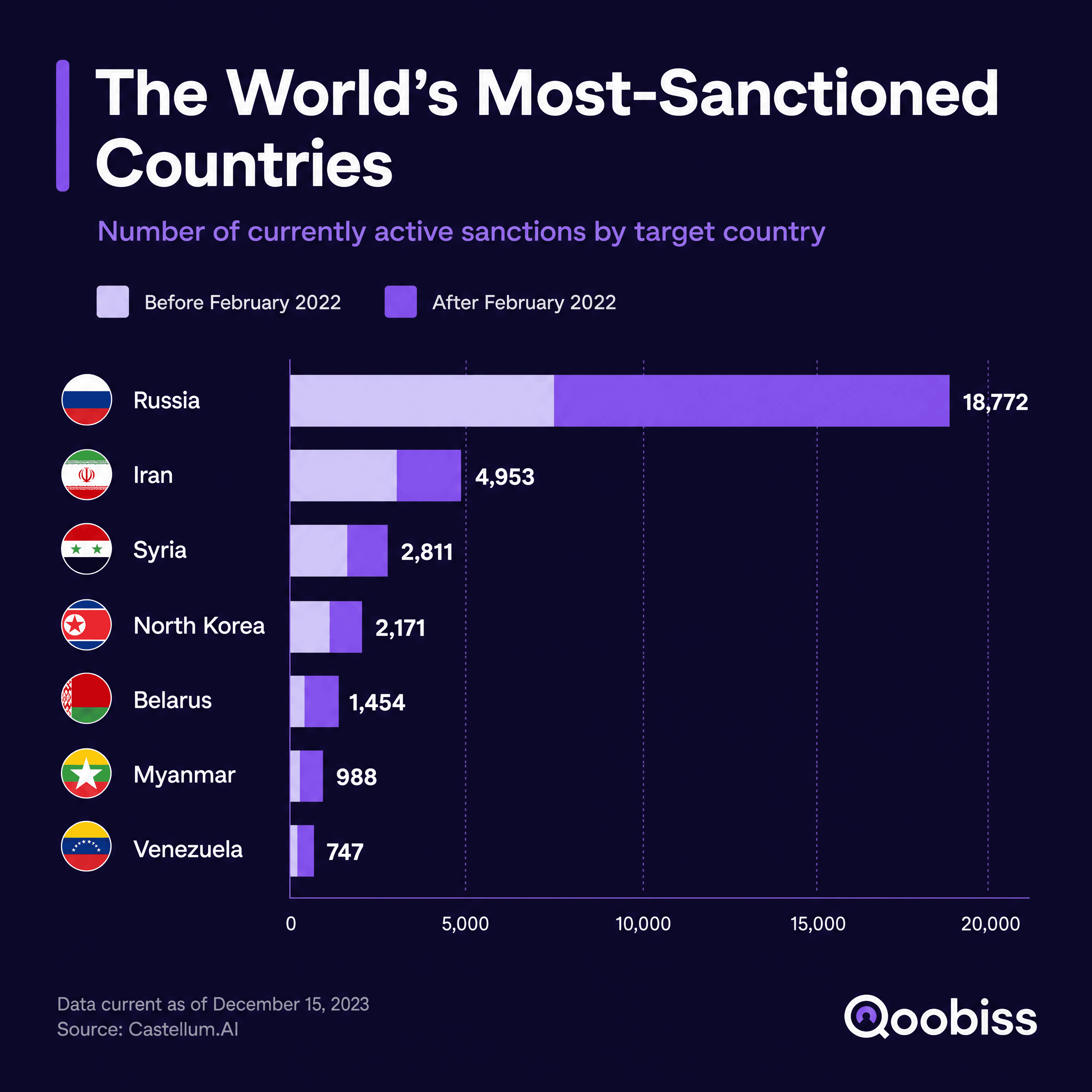
There is no single universal list of “sanctioned countries.” Sanctions vary by jurisdiction and may apply to an entire country, a specific region, certain industries, or designated individuals and organisations.
As of 2026, the broadest US restrictions continue to apply to Cuba, Iran, and North Korea, as well as Crimea and the Donetsk and Luhansk regions of Ukraine. Russia is also subject to extensive financial, trade, energy, technology, and individual sanctions, although not every Russia-related transaction is automatically prohibited.
The EU, UK, UN, and other authorities maintain separate programmes covering countries such as Russia, Belarus, Iran, Myanmar, Libya, Venezuela, Yemen, Sudan, and North Korea, alongside sanctions related to terrorism, cybercrime, corruption, and human-rights abuses.
For businesses, the key issue is not simply whether a country is sanctioned, but whether a specific person, entity, transaction, sector, or region is restricted. Because sanctions change frequently, organisations should always check the latest official lists rather than rely on a static country list.
Who Must Comply, and How Far Sanctions Reach
Sanctions compliance is not optional and often reaches beyond the issuing country's borders. Businesses generally must comply if they operate in the issuing jurisdiction, but US sanctions in particular can apply to non-US firms through several routes: transactions in US dollars that clear through US banks, dealings involving US persons or US-origin goods, and secondary sanctions that target foreign parties for doing business with sanctioned entities.
In practice, most banks, payment firms, and international businesses screen against OFAC, UN, EU, and UK lists together.
Why Sanctions Screening Matters
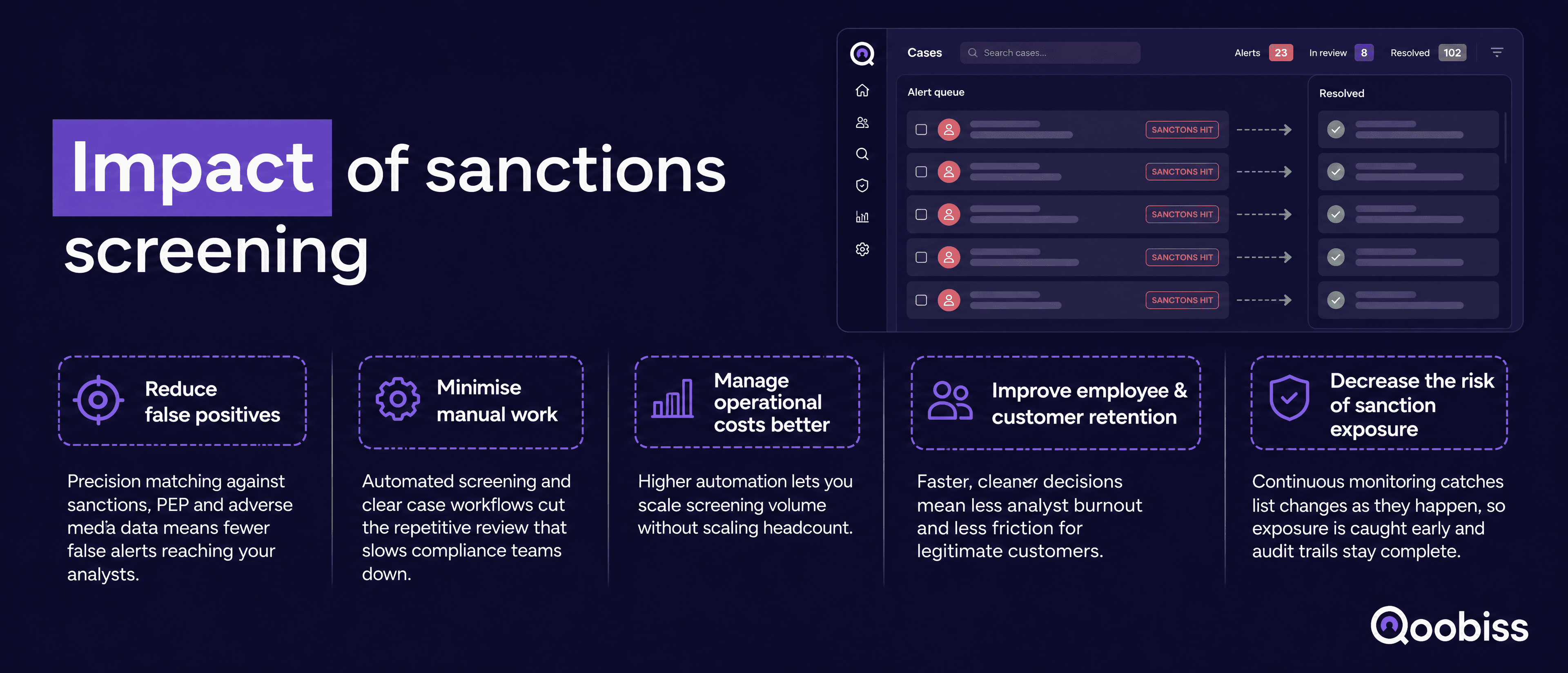
Breaching sanctions carries some of the heaviest consequences in financial crime. OFAC in particular applies a strict liability standard for civil enforcement, meaning a business can be penalized even if it did not intend or know it was dealing with a sanctioned party.
Violations can bring substantial civil and criminal penalties, loss of banking access, and severe reputational damage. That is why sanctions screening is a mandatory part of AML compliance and is performed at onboarding and continuously thereafter.
How Sanctions Screening Works
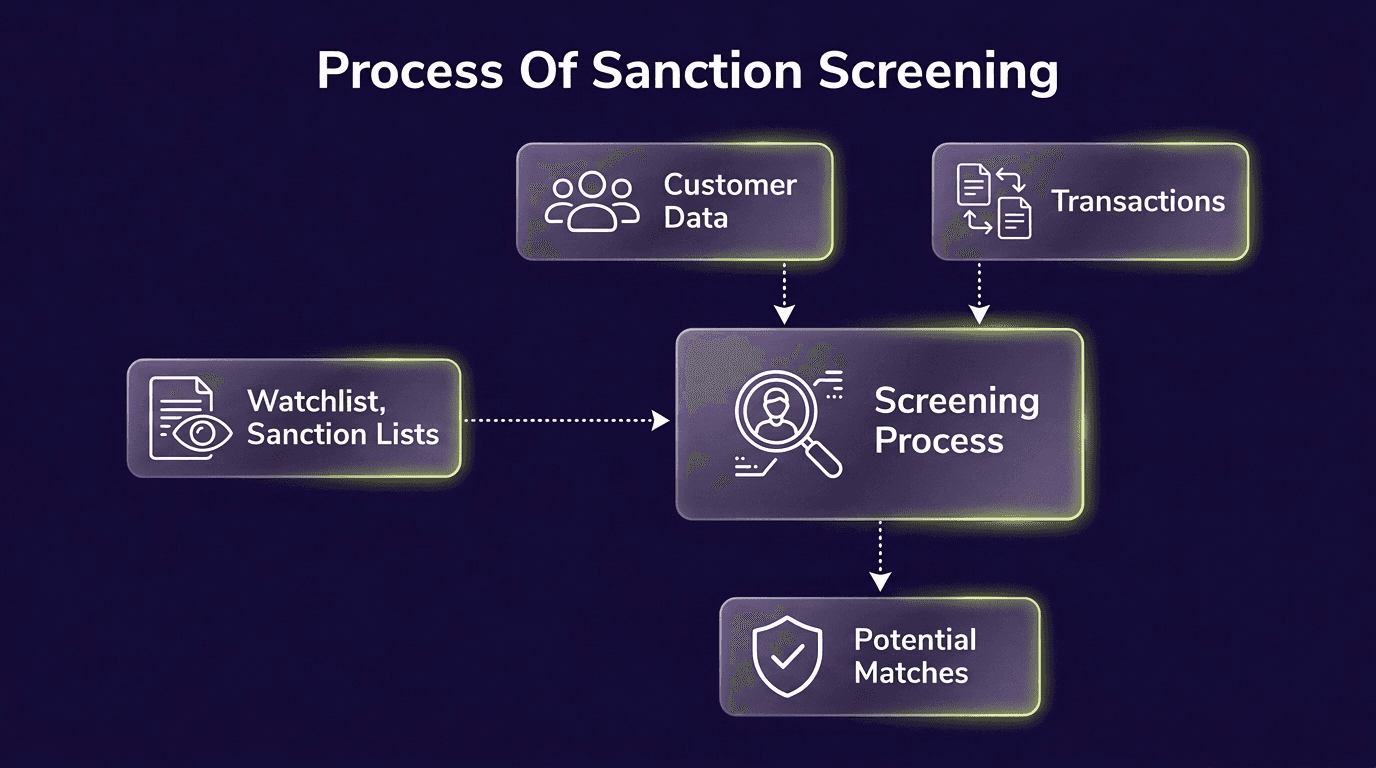
Screening matches your customers and transactions against sanctions list data. A typical process:
Collect and normalize data. Gather the names, dates of birth, nationalities, and other identifiers of the party being screened.
Match against lists. Compare against current sanctions data using exact and fuzzy matching, since names vary by spelling, transliteration, and alias.
Review alerts. Assess each potential match. Many are false positives, for example a namesake or a weak alias, and must be cleared or confirmed.
Escalate true matches. Block or freeze as required, and report to the relevant authority.
Screen continuously. Lists change constantly, so re-screen existing customers and monitor transactions in real time using updated data feeds.
The biggest operational challenge is false positives: common names and weak aliases generate large volumes of alerts. Good screening tools use fuzzy matching combined with secondary identifiers and scoring to separate real hits from noise.
Sanctions vs PEP vs Adverse Media Screening
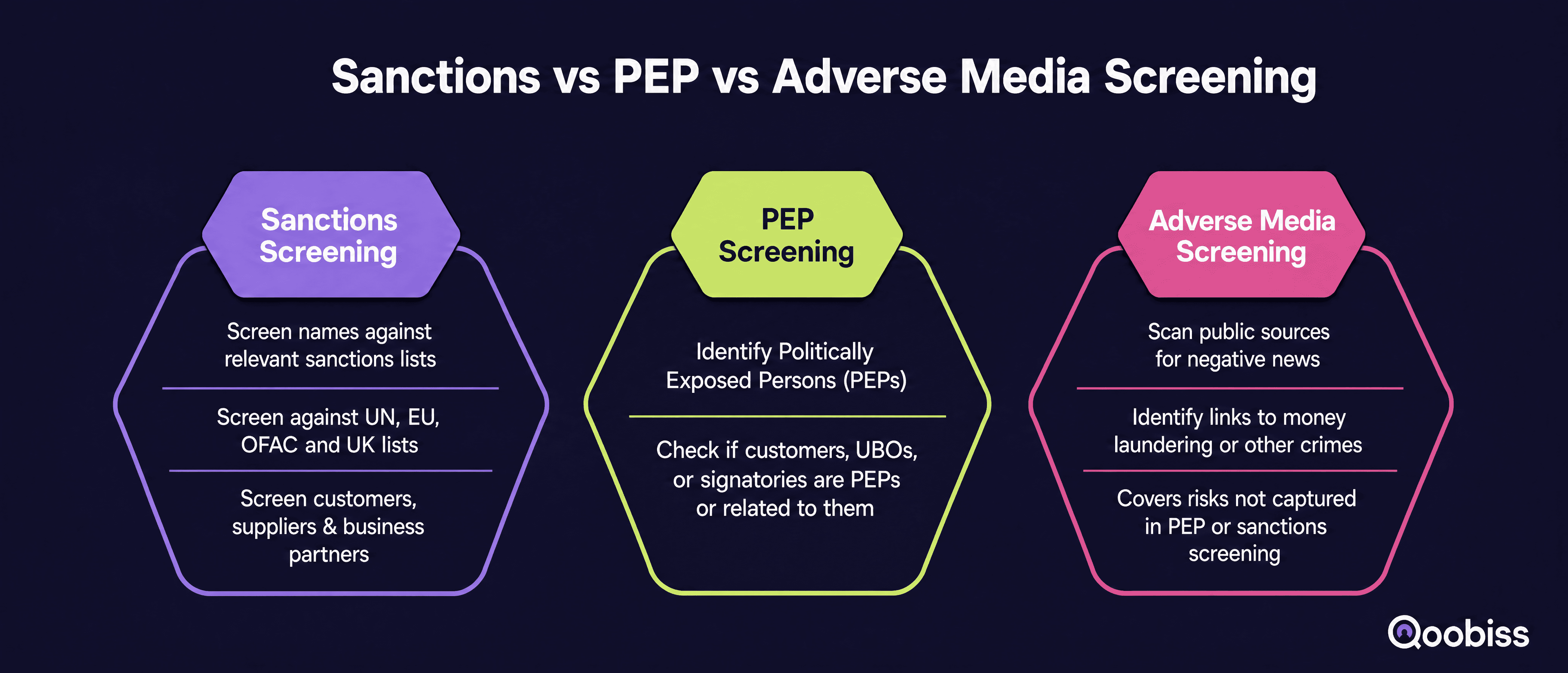
Sanctions screening is one of three complementary checks:
Check | What it screens | Nature |
|---|---|---|
Sanctions screening | Official government and international sanctions lists | Definitive: a match is a legal restriction |
PEP screening | Lists of politically exposed persons | Status-based: flags heightened risk, not wrongdoing |
Adverse media | News and public sources for negative information | Signal-based: early, unofficial indications of risk |
See our guides to politically exposed persons and adverse media screening for the other two layers.
Sanctions Screening with Qoobiss
Qoobiss screens customers and transactions against OFAC, UN, EU, and UK sanctions lists, together with PEP and adverse media checks, inside one identity and AML workflow. Fuzzy matching with relevance scoring cuts false positives, ownership look-through supports the 50 percent rule, and continuous monitoring keeps you current as lists change, all with a full audit trail.
Frequently Asked Questions
What is a sanctions list?
What is the difference between the SDN List and the Consolidated List?
What are the main sanctions lists?
What is the OFAC 50 percent rule?
Is sanctions screening required outside the US?
What is a false positive in sanctions screening?