Source of Funds vs Source of Wealth: Definitions, Documents & Checks


When a customer moves a large or unusual sum of money, compliance teams have to answer two related but distinct questions: where did this specific money come from? and how did this person become wealthy enough to have it in the first place?
The first is Source of Funds (SOF). The second is Source of Wealth (SOW). Confusing the two, or collecting the wrong evidence for each, is one of the most common weaknesses regulators find in anti-money-laundering programs.
This guide defines both terms with plain-English examples, sets out exactly which documents prove each, explains when SOF and SOW checks are legally required, and walks through how verification works in practice. It is written for compliance officers and risk teams building or refining AML and KYC procedures.
What Is Source of Funds (SOF)?
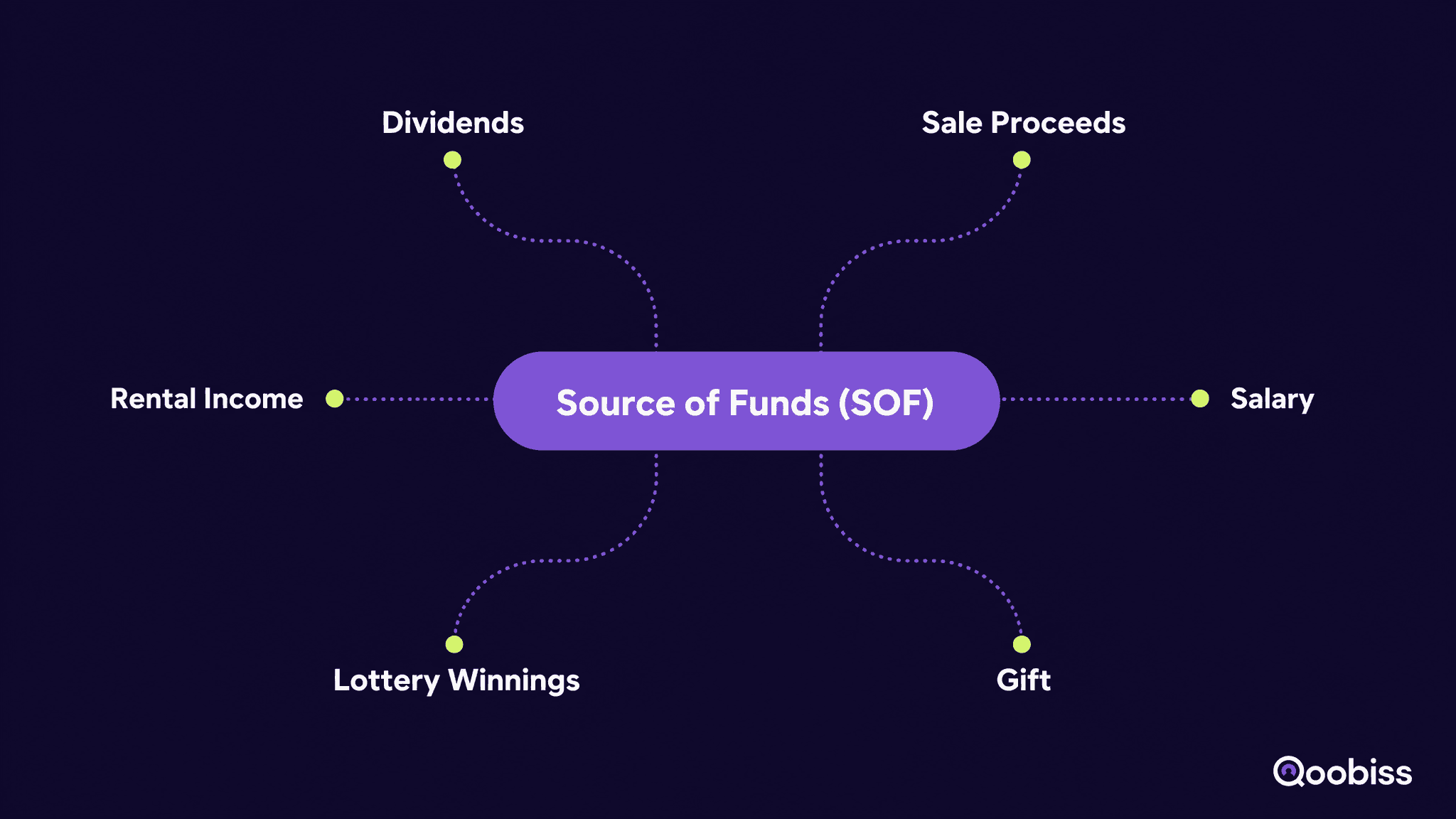
Source of Funds is the origin of the specific money used in a particular transaction or business relationship. Establishing SOF means understanding not just which account the money was transferred from, but the activity that generated it, a salary, the sale of a property, a business dividend, a loan, or an inheritance payout. The Financial Action Task Force (FATF) frames SOF as a core part of customer due diligence: firms should know the origin and legitimacy of funds before they are used.
Typical examples of source of funds:
Salary or wages from employment
Business income, profits, or dividends
Proceeds from selling a property, vehicle, or investment
Inheritance or a documented gift
A loan or mortgage drawdown
Pension or retirement-fund release
Investment returns, including dividends and capital gains
Lottery, betting, or gambling winnings
What Is Source of Wealth (SOW)?
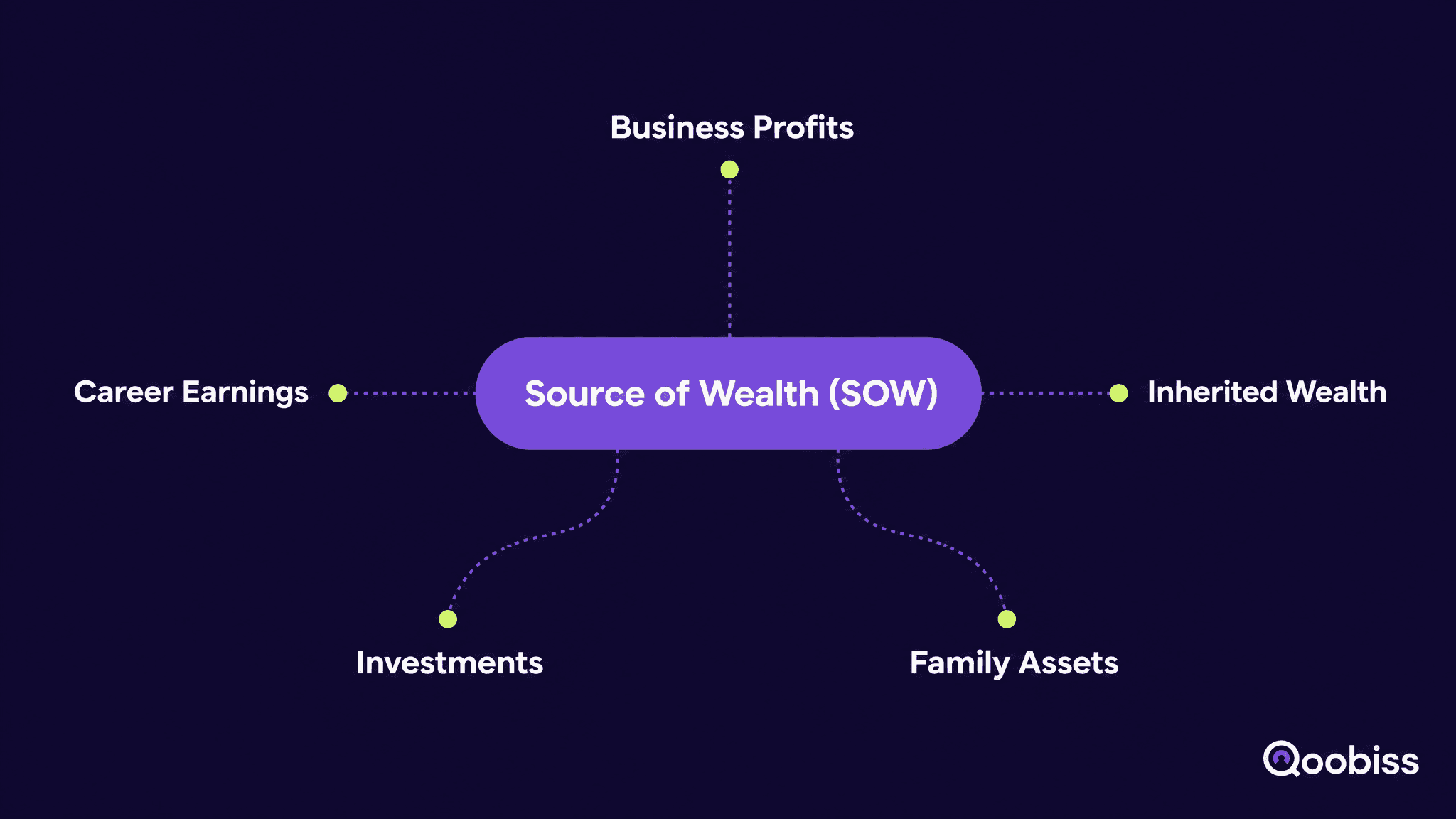
Source of Wealth is the origin of a person's entire body of assets, how they accumulated their total net worth over time. Where SOF zooms in on one transaction, SOW zooms out to a customer's whole financial history: a multi-decade career, a business they founded and sold, inherited family wealth, or a portfolio of investments built up over years. SOW answers the question “why does this customer have the assets they do, and how did they get them?”
The one-line distinction: Your monthly salary is the source of funds behind a €20,000 deposit. The 30-year career, business sale, and inheritance that together built your €2 million net worth is your source of wealth. SOF explains one payment; SOW explains the whole person.
Source of Funds vs Source of Wealth: Key Differences
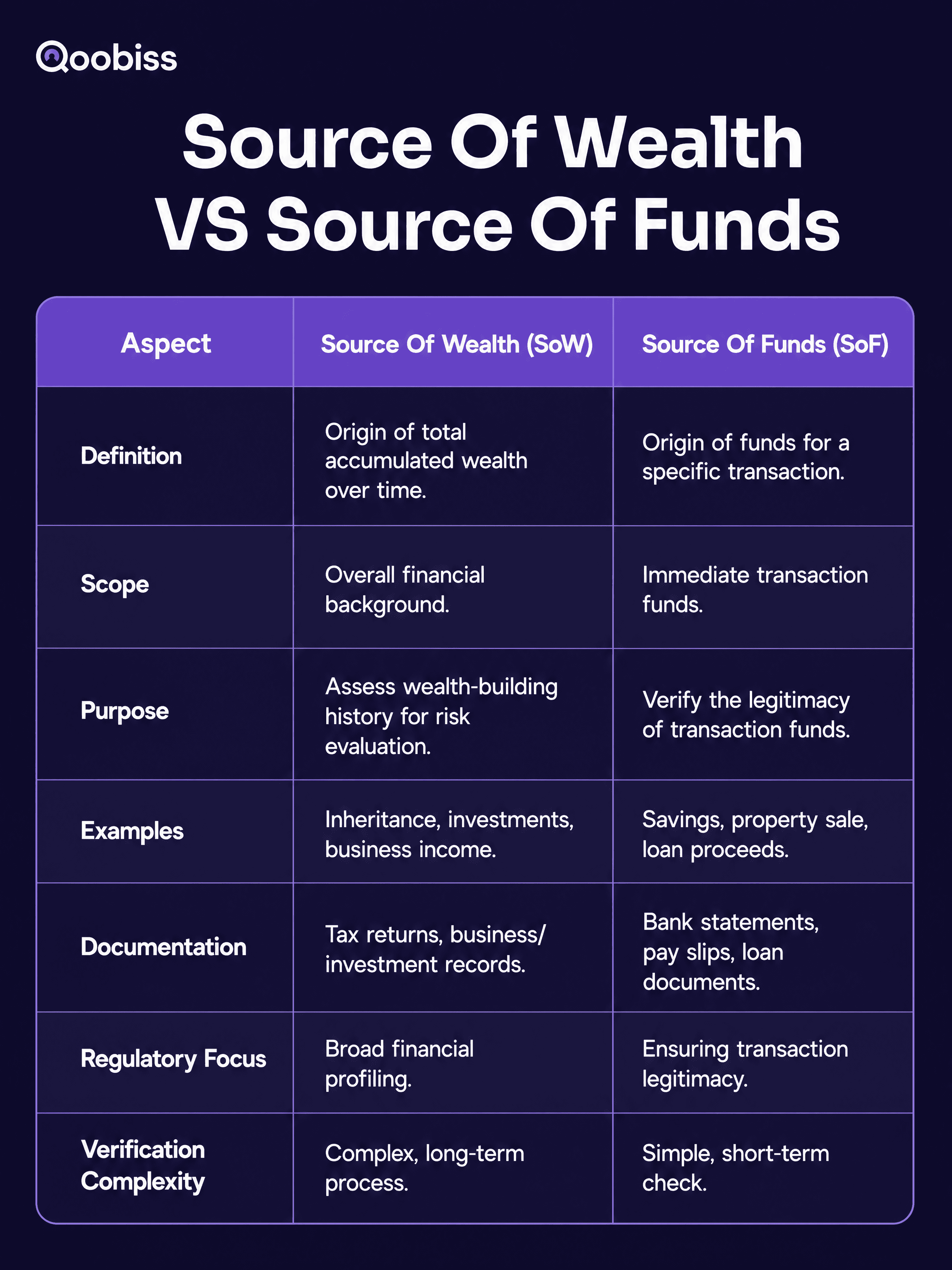
Although Source of Funds and Source of Wealth are closely related, they serve different purposes within AML and customer due diligence.
SOF focuses on the origin of money used in a specific transaction, while SOW examines how a customer accumulated their overall assets over time.
Understanding this distinction helps compliance teams apply the right level of scrutiny and request the most relevant evidence.
Dimension | Source of Funds (SOF) | Source of Wealth (SOW) |
|---|---|---|
Question answered | Where did the money for this transaction come from? | How did the customer build their total wealth? |
Scope | A single transaction or deposit | The customer's entire financial history |
Depth of check | Focused and often lighter | Broad, deeper, and more investigative |
When applied | Most CDD, plus higher-risk activity | Usually EDD, high-risk customers, PEPs, very large sums |
Typical evidence | Payslip, bank statement, sale contract, loan agreement | Tax returns, employment history, business-sale records, inheritance and investment documents |
Goal | Confirm one payment is legitimate | Confirm overall wealth is plausible and lawful |
Why Source of Funds and Source of Wealth Matter for AML
The United Nations Office on Drugs and Crime (UNODC) estimates that 2-5% of global GDP, roughly $800 billion to $2 trillion, is laundered every year. SOF and SOW checks are a primary line of defense: by forcing a launderer to evidence a legitimate origin for their money, they make it far harder to place illicit proceeds into the financial system.
Done well, these checks help firms detect money laundering: terrorist financing, sanctions evasion, and proceeds of fraud or corruption, and provide the audit trail regulators expect to see.
Where SOF and SOW Fit in CDD and EDD
Source of funds and source of wealth are not standalone tasks, they sit inside the due-diligence hierarchy:
Simplified Due Diligence (SDD):low-risk customers; SOF is rarely investigated beyond a basic declaration.
Standard Customer Due Diligence (CDD): SOF is established where a transaction is large, unusual, or inconsistent with the customer's profile.
Enhanced Due Diligence (EDD): both SOF and SOW are required, for high-risk customers, politically exposed persons (PEPs): funds from high-risk jurisdictions, and very high-value relationships.
When Are Source of Funds and Source of Wealth Checks Required?
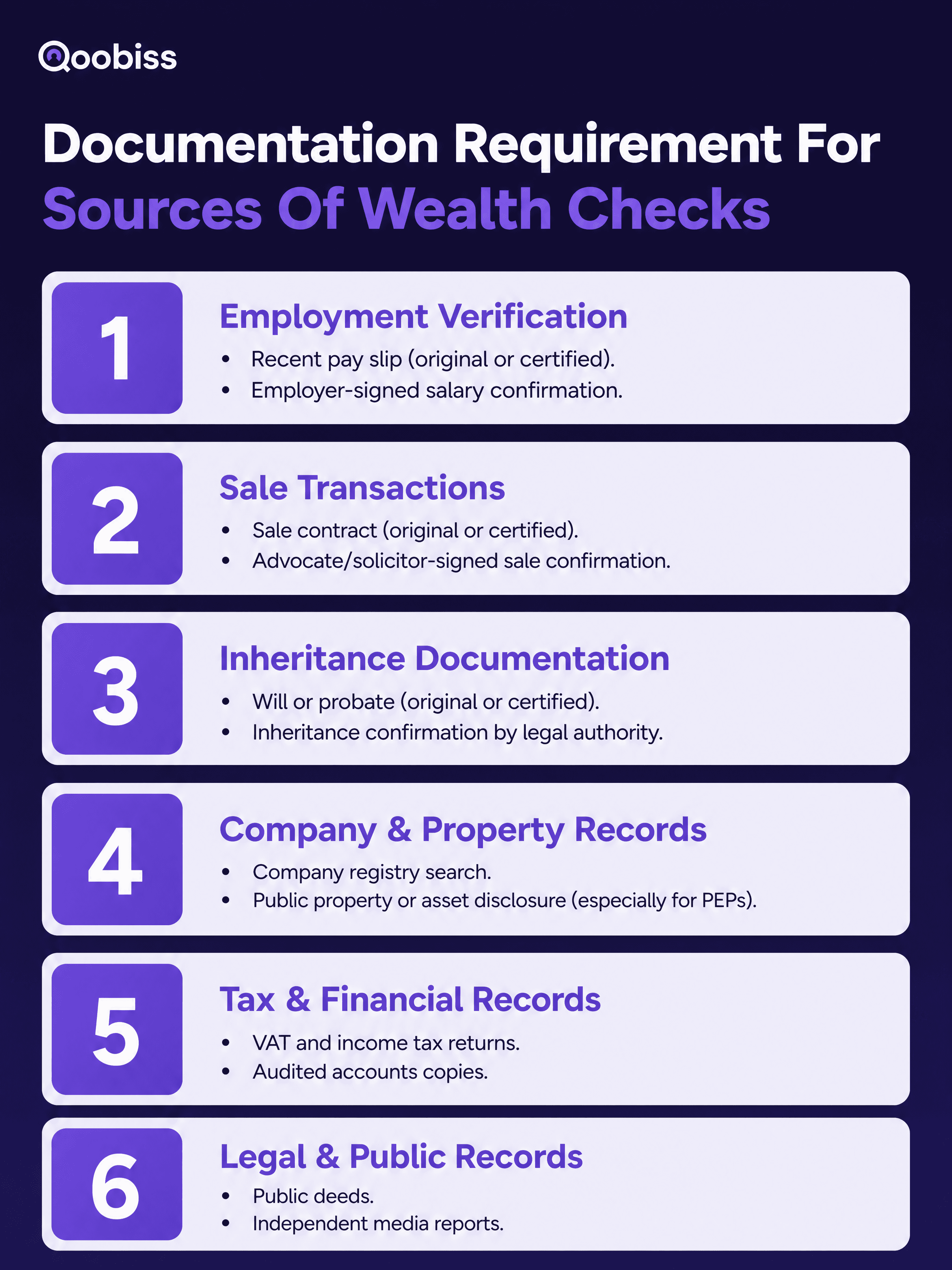
Source of Funds and Source of Wealth checks are not applied equally to every customer or transaction. Under a risk-based approach, the level of verification should reflect the customer’s profile, the nature and value of the transaction, and any identified red flags.
As risk increases, firms are expected to collect more detailed evidence and carry out deeper checks.
Under the risk-based approach, checks scale with risk. Common triggers include:
Enhanced Due Diligence on high-risk customers and relationships
Politically exposed persons (PEPs), their families, and close associates
Large, unusual, or rapid transactions inconsistent with the customer's profile
Funds originating from or routed through high-risk jurisdictions
High-value cash or crypto transactions above reporting thresholds
Higher-risk sectors: banking, gambling, real estate and conveyancing, legal services, and investor-residence (“golden visa”) schemes
Note: not every red flag warrants a full SOF investigation. Where the concern is an identity discrepancy rather than the money itself, broader EDD measures may be the better response.
Illustrative trigger thresholds (vary by firm and jurisdiction):
Context | Typical trigger |
|---|---|
Straightforward SOF (e.g. salary-funded deposit) | Lower sums explainable with payslip + bank statement |
Escalation to SOW (accumulation must be explained) | Large deposits inconsistent with known income (e.g. six-figure sums) |
High-value cash transactions | Above local reporting thresholds set by the regulator |
PEPs and high-risk customers | Any significant relationship, regardless of amount |
Source of Funds and Source of Wealth Documents (Checklist)
The right evidence depends on the type of income or wealth. Below are the documents most commonly accepted, organized by category. For higher-risk cases, firms should corroborate declarations with independent, verifiable evidence.
Source of Funds documents, by income type
Income type | Acceptable documents |
|---|---|
Employment / salary | Recent payslips (often last 3 months), employment contract, employer confirmation of salary |
Business income | Audited financial statements, dividend vouchers, company accounts, tax returns |
Sale of property or asset | Signed sale contract, completion/settlement statement, bill of sale |
Inheritance | Grant of probate, will, solicitor/executor letter, tax-clearance documents |
Gift | Signed donor declaration, proof of the donor's own source of funds, evidence of transfer |
Loan | Loan or mortgage agreement, lender statement showing drawdown |
Investments | Brokerage/investment statements, dividend statements, capital-gains records |
Pension / retirement | Pension release statement or annuity documentation |
Lottery / gambling | Official winnings receipt and payout documentation |
Crypto | Exchange transaction history, wallet records, blockchain-analytics provenance report |
Source of Wealth documents, broader picture
Source of Wealth verification requires a broader view of the customer’s financial background. Because total wealth is usually built through multiple sources over many years, firms typically combine several documents to confirm that the customer’s overall net worth is both plausible and legitimate.
Multi-year tax returns and accounts
Full employment history and salary/bonus confirmations
Business ownership and company-sale records (contract of sale, valuation, registry records)
Investment and securities portfolio statements
Inheritance documentation (deceased's name, date, amount, solicitor details, tax records)
Property registers and evidence of title; trust deeds
Public-record and media searches corroborating the wealth narrative
SOF and SOW vs. Proof of Funds, Proof of Income, and Proof of Address
These terms are frequently confused. They are not interchangeable:
Term | What it confirms |
|---|---|
Source of Funds (SOF) | The origin of the money used in a specific transaction |
Source of Wealth (SOW) | How a person accumulated their total net worth over time |
Proof of Funds (POF) | That the money currently exists and is available (e.g. a bank letter in a property purchase) |
That a person earns a stated income (payslips, tax returns) | |
Where a person lives (utility bill, bank statement) |
For more on the adjacent checks, see our guides to Proof of Income and Proof of Address.
Regulations: How SOF and SOW Requirements Differ by Region
FATF Recommendation 10 (CDD) and its PEP provisions establish the global baseline, but the specific rules differ by jurisdiction:
Region | Key frameworks | What they require on SOF / SOW |
|---|---|---|
United States | Bank Secrecy Act (BSA), USA PATRIOT Act, FinCEN CDD Rule | Detect and report suspicious activity; verify funds for higher-risk customers; SAR filing where origin can't be established |
United Kingdom | Money Laundering Regulations 2017 (MLR 2017), JMLSG guidance, FCA supervision | Due diligence on SOF and SOW for higher-risk clients and PEPs, with evidence proportionate to risk |
European Union | AML Directives (incl. 6AMLD), the new AML Authority (AMLA), MiCA for crypto | SOF/SOW for EDD, investor-residence schemes, and crypto-asset service providers; UBO identification |
Asia-Pacific | AUSTRAC (Australia), MAS Notice 626 (Singapore), BNM (Malaysia) | Risk-based SOF verification for EDD and high-value transactions; independently verifiable evidence |
Penalties for failure are severe: under the EU's 6AMLD, sanctions can include fines and custodial sentences, alongside the reputational damage of an enforcement action.
Source of Funds Red Flags
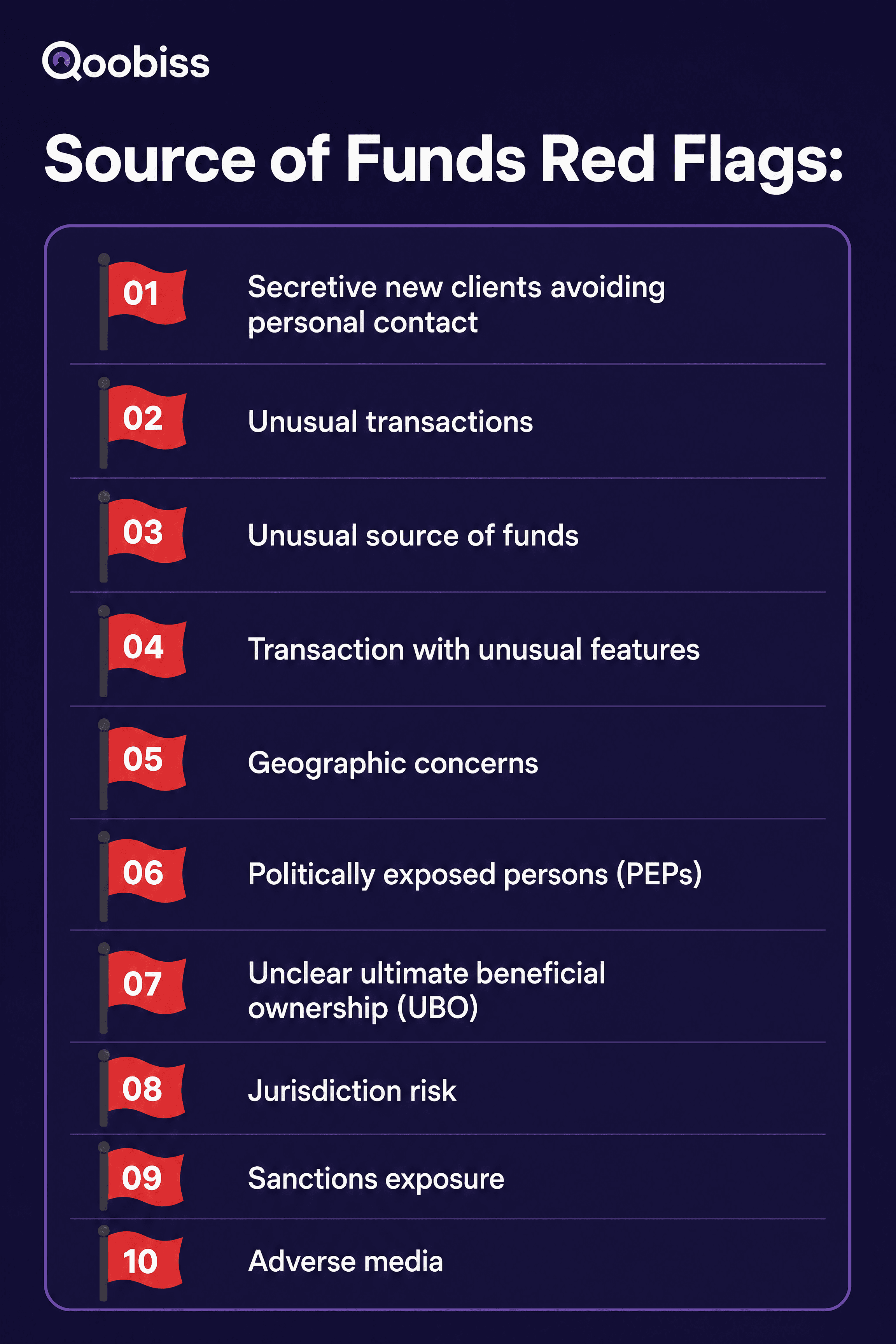
Source of Funds red flags do not automatically prove financial crime, but they indicate that additional review may be necessary. Compliance teams should assess whether the customer’s explanation, supporting documents, transaction activity, and overall financial profile are consistent and credible.
Unverifiable or vague origin: “gifts” from unregistered businesses, or funds with no clear paper trail.
Inconsistency with profile: sums that are large relative to the customer's known income with no logical explanation.
Unusual structuring: money drawn from multiple accounts or numbered companies without reason, or disproportionate use of cash, bank drafts, or complex crypto assets.
High-risk routing: funds from a foreign bank with no connection to the client, or from a high-risk jurisdiction.
Reluctance or tampering: unwillingness to provide documents, or clear signs that documents have been altered.
Non-bank financing: lending from an unusual source with no economic justification.
How to Verify Source of Funds and Source of Wealth
Effective Source of Funds and Source of Wealth verification requires more than collecting a customer declaration. Firms should follow a consistent, risk-based process that gathers appropriate evidence, independently corroborates the customer’s explanation, assesses whether it aligns with their financial profile, and clearly documents the final decision.
Collect a declaration. Ask the customer to state the origin of the funds (and, for EDD, their wealth) at onboarding or before the transaction.
Gather documentary evidence. Request the appropriate documents for the stated income type, scaled to the customer's risk profile.
Corroborate independently. Confirm the story against reliable, independent sources, bank data, public registers, tax records, and media checks, rather than relying on the declaration alone.
Assess consistency. Check that documents are internally consistent and match the customer's overall profile and transaction behavior.
Document and decide. Record every step and the rationale; if concerns remain unresolved, escalate, file a report, or decline the relationship.
Monitor on an ongoing basis. Wealth and funding change over time; refresh SOF/SOW for high-risk customers through perpetual monitoring and event-driven reviews.
Source of Funds for Crypto and DeFi
Crypto introduces challenges traditional SOF checks were not designed for. Funds may arrive from exchanges, self-custody wallets, staking or airdrops, NFT sales, or, a major red flag, mixers and tumblers designed to obscure provenance.
Verifying crypto SOF combines conventional evidence (exchange KYC records, fiat on-ramp statements) with on-chain analysis: blockchain-analytics tools trace a wallet's transaction history and flag exposure to sanctioned addresses, darknet markets, or high-risk services. Under the EU's MiCA regime, crypto-asset service providers must apply AML/KYC procedures, including SOF checks where appropriate.
Automating Source of Funds Checks
Manual SOF/SOW review is slow, inconsistent, and hard to audit. Modern compliance stacks automate the mechanics: document-AI and OCR extract and validate uploaded evidence; open-banking and bank-data aggregation corroborate income and balances directly; transaction monitoring flags when a payment is inconsistent with a customer's stated profile; and risk scoring decides when to escalate from CDD to EDD. Crucially, a source-of-funds issue that is never flagged at monitoring never reaches the verification stage, so SOF is as much a transaction-monitoring question as a KYC one.
Qoobiss brings source-of-funds and source-of-wealth checks into one automated AML and screening workflow, document verification, risk scoring, PEP and sanctions screening, and ongoing monitoring, so your team collects the right evidence, corroborates it, and keeps a clean audit trail. Book a demo.
Frequently Asked Questions
What is the difference between source of funds and source of wealth?
What does source of funds mean?
What documents are accepted as proof of source of funds?
When is source of funds verification required?
Why do banks ask for source of funds?
Is source of wealth the same as proof of funds?