Smurfing & Structuring: How Money Launderers Avoid Detection


A criminal sitting on a suitcase of cash has a problem: depositing it in one go triggers an automatic report to the authorities. So instead of one large, conspicuous deposit, they break the money into dozens of small, forgettable ones, spread across many people, accounts, and branches.
That technique is called smurfing, and it is one of the oldest and most common ways dirty money slips into the financial system.
This guide explains what smurfing means in money laundering, how it differs from the closely related term structuring, where it sits in the laundering process, how schemes like cuckoo smurfing and money mules work, the red flags compliance teams watch for, and how modern transaction monitoring catches it. A short note first, because the word has three different meanings.
Smurfing Has Three Meanings
If you searched “smurfing,” you may have landed on one of three unrelated topics. This article is about the first:
Money laundering: splitting illicit funds into many small transactions to avoid reporting thresholds. This is the financial-crime meaning covered here.
Gaming: a skilled player using a new, low-ranked account to play against weaker opponents. The term comes from two Warcraft II players who made alternate accounts named “PapaSmurf” and “Smurfette” in the 1990s.
Networking: a “Smurf attack” is a type of distributed denial-of-service (DDoS) attack that floods a target with spoofed network traffic.
What Is Smurfing in Money Laundering?
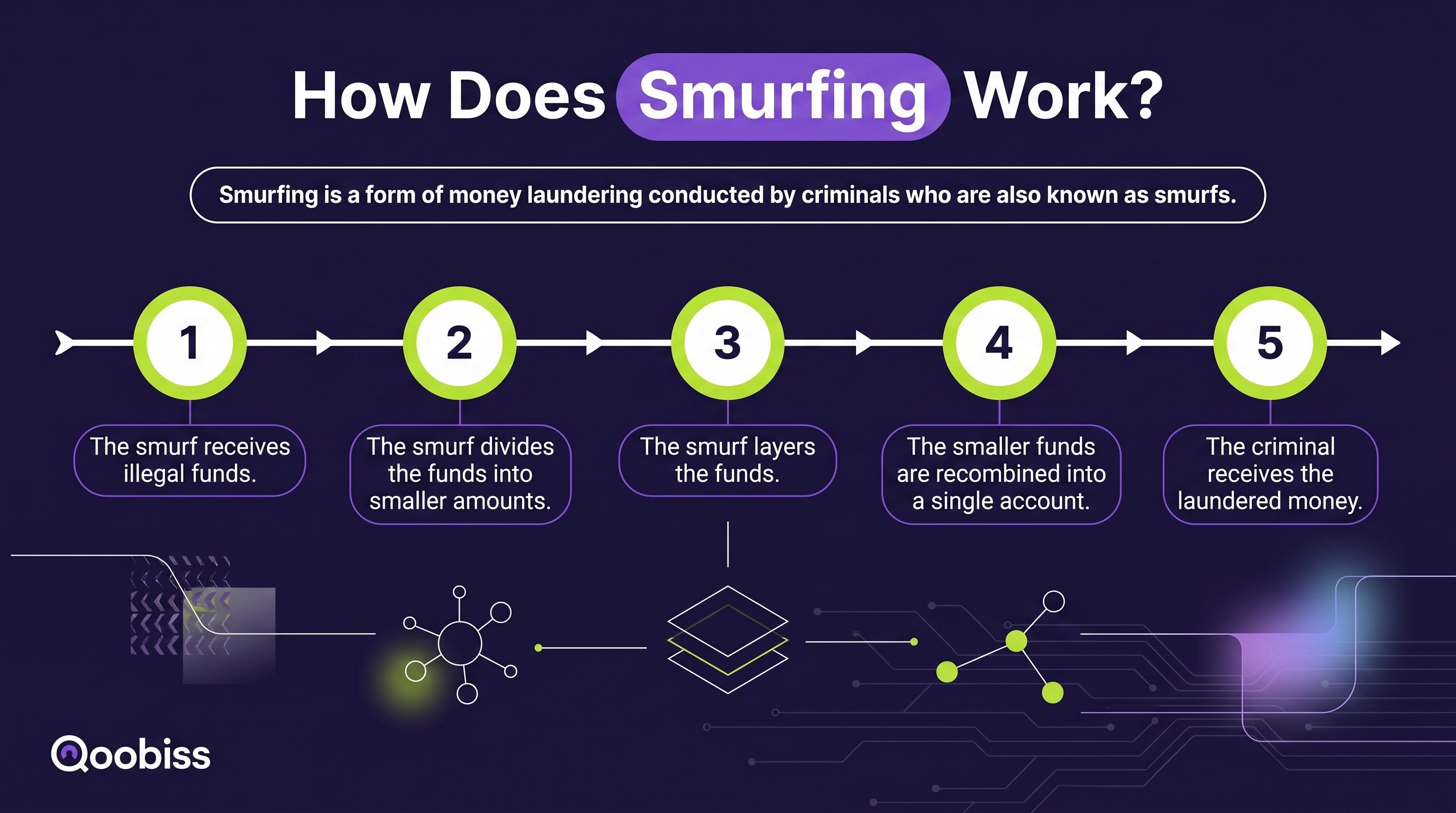
Smurfing is a money-laundering technique in which a large sum of illegally obtained cash is broken into many smaller deposits, each kept below the threshold that would force a bank to report it.
The people who carry out the individual deposits are called “smurfs.” They may be knowing accomplices or unwitting participants recruited through job scams or romance fraud.
Because each transaction looks small and ordinary, the scheme blends illicit money into normal banking activity and obscures its criminal origin.
Where the name comes from. The term references the Smurfs cartoon, a large group of small characters who each handle a tiny piece of a much bigger task. It is widely believed to have entered AML vocabulary in 1980s Miami, then the money-laundering capital of the world, and it shares a root with the “smurfing” used to describe buying restricted drug ingredients in small amounts from many stores.
Smurfing vs Structuring: What Is the Difference?
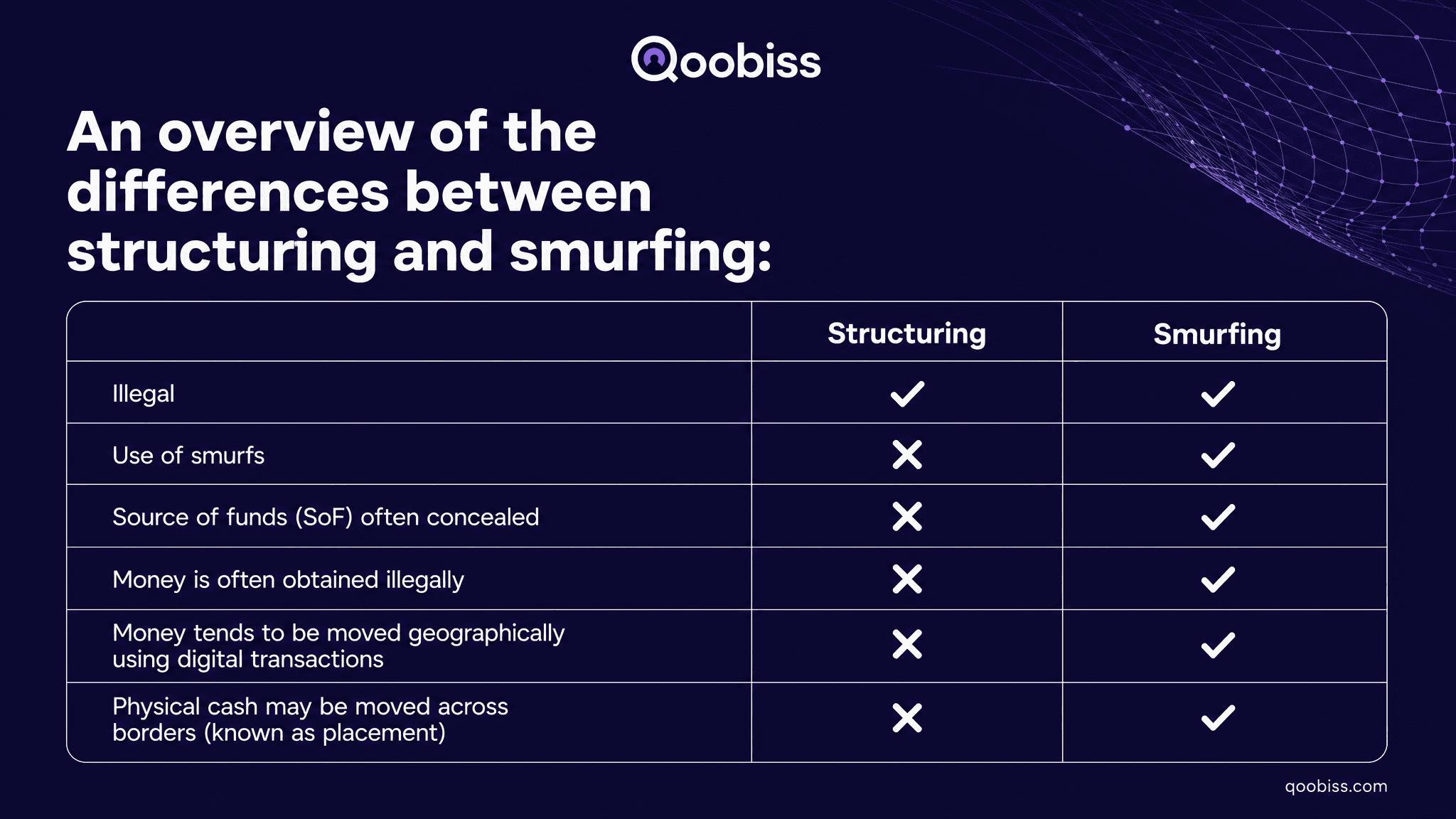
The two terms are often used interchangeably, and under the law they are usually treated the same. “Structuring” is the formal legal term; “smurfing” is the industry slang. Where practitioners do draw a line, it usually comes down to how many people are involved and whether the money is dirty:
Dimension | Structuring | Smurfing |
|---|---|---|
Term type | Formal legal term used in statutes and courts | Colloquial industry term |
Participants | Usually one person making multiple transactions | Often many people (“smurfs”) acting together |
Origin of funds | Can involve legitimately earned money | Almost always proceeds of crime |
Primary intent | Avoid the reporting requirement | Hide the illegal source and avoid reporting |
Scope | Splitting one large transaction | Broader networks of accounts and people |
Legal status | Illegal in itself, even with clean money | Illegal, and tied to an underlying crime |
Important: structuring is a crime on its own. In the United States it is prohibited under 31 U.S.C. § 5324, and splitting deposits to dodge reporting is illegal even when the underlying money was earned legally.
Which Stage of Money Laundering Is Smurfing?
Money laundering is usually described in three stages. Smurfing happens mainly in the first:
Placement: dirty cash first enters the financial system. This is where smurfing is most common, because cash deposits are the riskiest moment for a launderer.
Layering: funds are moved through transfers, purchases, and cross-border hops to obscure the trail. Smurfing can support this stage too.
Integration: the “cleaned” money returns to the economy as apparently legitimate income, investments, or assets.
How Smurfing Works: A Step-by-Step Example
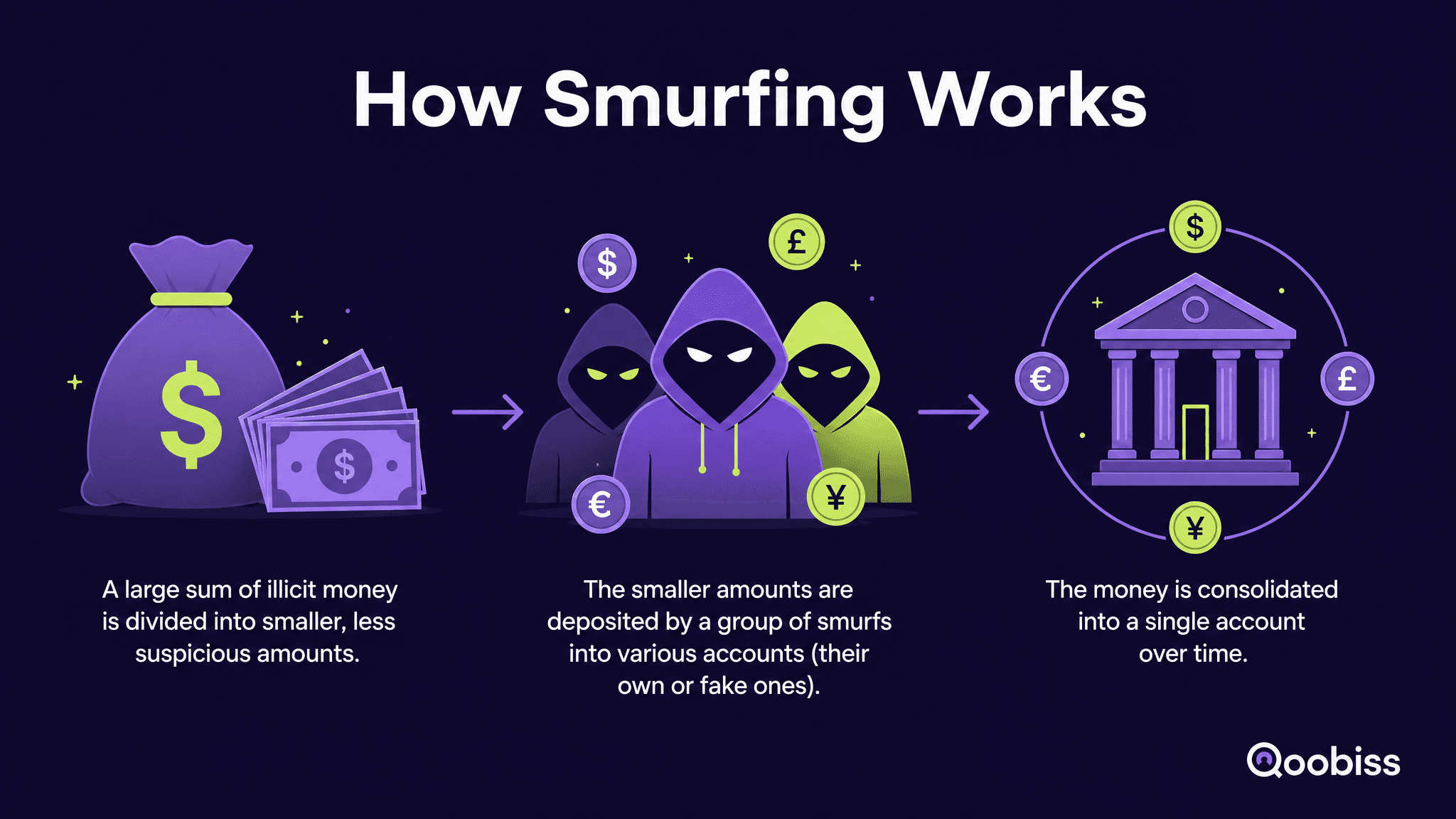
Consider a criminal group holding $1 million in cash they need to bank without raising alarms:
Recruitment. The organizers enlist a network of smurfs, some knowing, some deceived, to make deposits on their behalf.
Division. The $1 million is broken into roughly 100 portions of around $9,000 each, deliberately below the $10,000 reporting threshold.
Distribution. Each smurf receives cash plus instructions on where, when, and how much to deposit.
Execution. Deposits are spread across different branches, banks, and cities over days or weeks to avoid pattern detection.
Consolidation. The funds are funneled back together through transfers and now appear to be ordinary business revenue or personal savings.
Common smurfing methods include:
Sub-threshold cash deposits across multiple accounts and branches
Buying and reselling high-value goods such as jewelry, electronics, or prepaid cards
Casino chip purchases later cashed out as “winnings”
Many small wire transfers to offshore accounts
Spreading withdrawals and deposits across ATMs and online payment platforms
What Is Cuckoo Smurfing?

Cuckoo smurfing is a more advanced variant, named after the cuckoo bird that lays its eggs in another bird's nest. Criminals hijack a legitimate incoming transfer, often an international remittance.
With the help of a complicit remittance agent or insider, the launderer deposits their own dirty cash into the innocent recipient's account, while keeping the clean funds the recipient was actually owed.
The victim receives the money they expected and is none the wiser, which makes cuckoo smurfing especially hard to detect. Regulators such as Australia's AUSTRAC have treated it as a major enforcement priority.
Smurfs and Money Mules
Many smurfs are money mules: people who move illicit funds through their own accounts on behalf of criminals, often without realizing they are committing a crime. Mules are recruited through fake job offers (“payment processing agent”), romance scams, and ads targeting people in financial distress.
They may let criminals use their account, open new accounts to order, or receive and forward money by wire, card, or crypto. Strong KYC and ongoing monitoring are the main defenses against mule-account creation.
Crypto Smurfing
Smurfing has moved on-chain. Instead of bank deposits, launderers split funds into many small crypto transactions, spread them across multiple wallets and exchanges, and use chain-hopping (swapping between coins) or stablecoins to break the trail.
The same logic applies: keep each transfer small enough to avoid triggering an exchange's transaction-monitoring rules or KYC review. Blockchain analytics counter this by clustering related wallets and scoring exposure to illicit sources, but crypto smurfing remains a fast-evolving challenge for AML compliance teams.
Reporting Thresholds and Regulations
Smurfing exists to dodge mandatory reporting, so the thresholds matter. In the US, the Bank Secrecy Act requires a Currency Transaction Report (CTR) for cash transactions over $10,000, and banks file Suspicious Activity Reports (SARs) when they spot likely structuring.
FinCEN administers these rules, and deliberately splitting transactions to avoid them is itself an offense under 31 U.S.C. § 5324. Thresholds differ by country:
Jurisdiction | Cash reporting trigger | Framework |
|---|---|---|
United States | Over $10,000 (CTR) | Bank Secrecy Act; FinCEN; anti-structuring law 31 U.S.C. § 5324 |
European Union | EU-wide €10,000 cash payment cap under new AML rules | AML Directives and the incoming AML Regulation (AMLR) / AMLA |
United Kingdom | Risk-based; SARs to the NCA | Money Laundering Regulations 2017; Proceeds of Crime Act 2002 |
Australia | AUD 10,000 threshold transaction report | AML/CTF Act; AUSTRAC |
Canada | CAD 10,000 large cash transaction report | PCMLTFA; FINTRAC |
Globally, the Financial Action Task Force (FATF) Recommendations set the baseline standard that these national regimes implement.
Smurfing Red Flags
Compliance teams treat the following as warning signs that deposits may be smurfing:
Repeated cash deposits just below the reporting threshold (for example, recurring $9,500 deposits)
The same account funded by many different people, or at many different branches and ATMs
Sudden spikes in cash activity inconsistent with the customer's profile
Multiple new accounts opened with similar identity details (address, device, country)
Rapid movement of small amounts between accounts, especially across borders or high-risk jurisdictions
Deposits that individually stay under the limit but collectively exceed it
Transactions that are needlessly complex given simpler options, or that do not fit the customer's stated business
When these patterns appear, firms investigate the source of funds and, where warranted, file a suspicious transaction report.
How Banks Detect and Prevent Smurfing
Because no single deposit looks suspicious, detecting smurfing means analyzing patterns across many transactions, accounts, and customers. Effective programs combine:
Transaction monitoring: rules that aggregate activity to catch sub-threshold patterns, deposit velocity, and amounts that add up across an account or beneficiary.
Network and link analysis: mapping relationships between accounts, people, and devices to expose coordinated smurf networks that individual checks miss.
KYC, CDD and EDD: verifying identity at onboarding and applying enhanced due diligence to higher-risk customers stops mule and synthetic-identity accounts before any deposit is made.
AI and behavioral analytics: models that learn a customer's normal behavior and flag anomalies a static rule would miss.
Staff training and SAR processes: frontline awareness plus clear escalation so alerts become timely reports.
Qoobiss combines identity verification, customer due diligence, PEP and sanctions screening, and real-time transaction monitoring in one platform, so smurf and mule accounts are caught at onboarding and suspicious deposit patterns are flagged as they happen. Book a demo.
Frequently Asked Questions
What is smurfing in simple terms?
What is the difference between smurfing and structuring?
What stage of money laundering does smurfing occur in?
What is cuckoo smurfing?
Why is it called smurfing?
Is smurfing illegal?