What Is a Shell Company? Meaning, Legitimate Uses, and Red Flags

A shell company is a business that exists on paper but has little or no real activity behind it: no significant assets, no employees, and no day-to-day operations. It is, quite literally, a shell with nothing inside.
That does not make it illegal. Shell companies are a normal part of corporate life, used every day for mergers, holding assets, and taking businesses public.
The problem is that the same anonymity that makes them useful also makes them the vehicle of choice for hiding money, evading tax, and disguising who really owns what.
The scale is enormous. Analysts at Moody's have flagged roughly 5 million potentially suspect companies in the UK alone and around 4 million across the EU, and about 1 percent of the EU's GDP is linked to suspicious financial activity. This guide explains what a shell company is, whether it is legal, its legitimate and illicit uses, how it differs from similar structures, the warning signs, and how compliance teams uncover the real people behind the shell.
What Is a Shell Company?
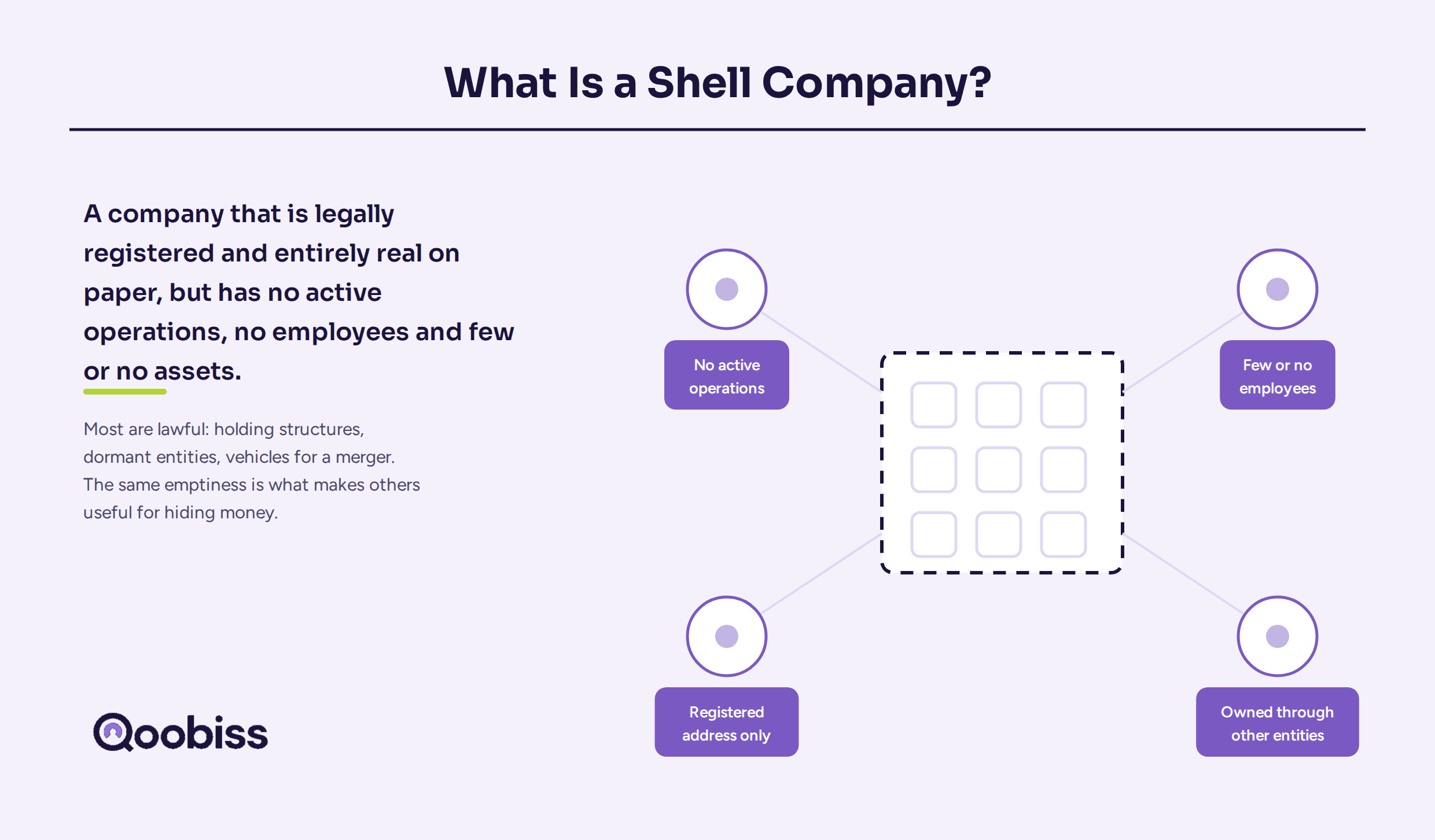
A shell company is a legal entity that has no significant business assets or operations of its own. It is properly registered, can hold a bank account, sign contracts, own property, and move money, but it does not produce goods or deliver services in any meaningful way.
Regulators define it in similar terms: the UK's Financial Conduct Authority, for example, treats a shell company as an issuer whose assets are solely or predominantly cash, or whose main purpose is to carry out an acquisition or merger.
Most shell companies share a recognizable set of traits, and spotting several of them together is often the first clue that an entity is a shell:
Little or no business activity, revenue, or physical premises.
Few or no employees.
Management or owners located in a different country.
Registration through a registered agent, often with a nominee director or shareholder.
Incorporation in a low-tax or secrecy-friendly jurisdiction.
Is a Shell Company Illegal?
No. A shell company is not illegal in itself. Forming and owning one is perfectly lawful in most countries, and countless legitimate businesses use them.
What determines legality is how the shell is used. Using one to hold assets or complete a merger is ordinary corporate practice, while using one to launder criminal proceeds, evade tax, or hide a sanctioned owner is a crime. The entity is neutral; the intent behind it is what matters.
Legitimate Uses of Shell Companies

Far from being inherently shady, shell companies serve many genuine business purposes. Understanding these legitimate uses is important, because it is exactly what makes the illicit ones so hard to spot. Common lawful uses include:
Taking a company public. A private business can list by merging with an existing public shell in a reverse merger, or through a special-purpose acquisition company (SPAC).
Holding assets. A shell can hold real estate, intellectual property, or investments, ring-fencing them from an operating business.
Facilitating mergers and acquisitions. Shells are routine vehicles for structuring deals and reorganizations.
Entering a new market. A company expanding abroad may set up a local entity before it has real operations there.
Managing tax and risk. Legitimate tax planning and liability protection, provided everything is properly disclosed.
Illicit Uses of Shell Companies
The same features that make shell companies useful, low cost, easy to form, and capable of hiding ownership, also make them a favorite tool of criminals. When abused, a shell becomes a way to put distance between illegal money and the person controlling it. The most common illicit uses are:
Money laundering. Layering criminal proceeds through shell transactions to obscure their origin.
Tax evasion. Hiding income or assets from tax authorities behind an opaque structure.
Hiding beneficial ownership. Concealing who really owns or controls assets, often behind nominee directors.
Sanctions evasion. Moving money or goods on behalf of a sanctioned person or country.
Fronting for crime. Disguising the proceeds of activities such as fraud, corruption, or human trafficking as legitimate revenue.
Legitimate vs. Illicit Use at a Glance
Because the line between a legitimate and an abusive shell comes down to transparency and intent, it helps to see the two side by side:
Feature | Legitimate shell | Illicit shell |
|---|---|---|
Ownership | Owners are identifiable and disclosed | Real owner is hidden behind nominees or layers |
Purpose | A clear, lawful business reason | No economic rationale for its transactions |
Documentation | Records match the stated activity | Paperwork is inconsistent or missing |
Transparency | Cooperates with due diligence | Evasive, opaque, or resists disclosure |
Shell vs. Shelf vs. Holding vs. Front Company
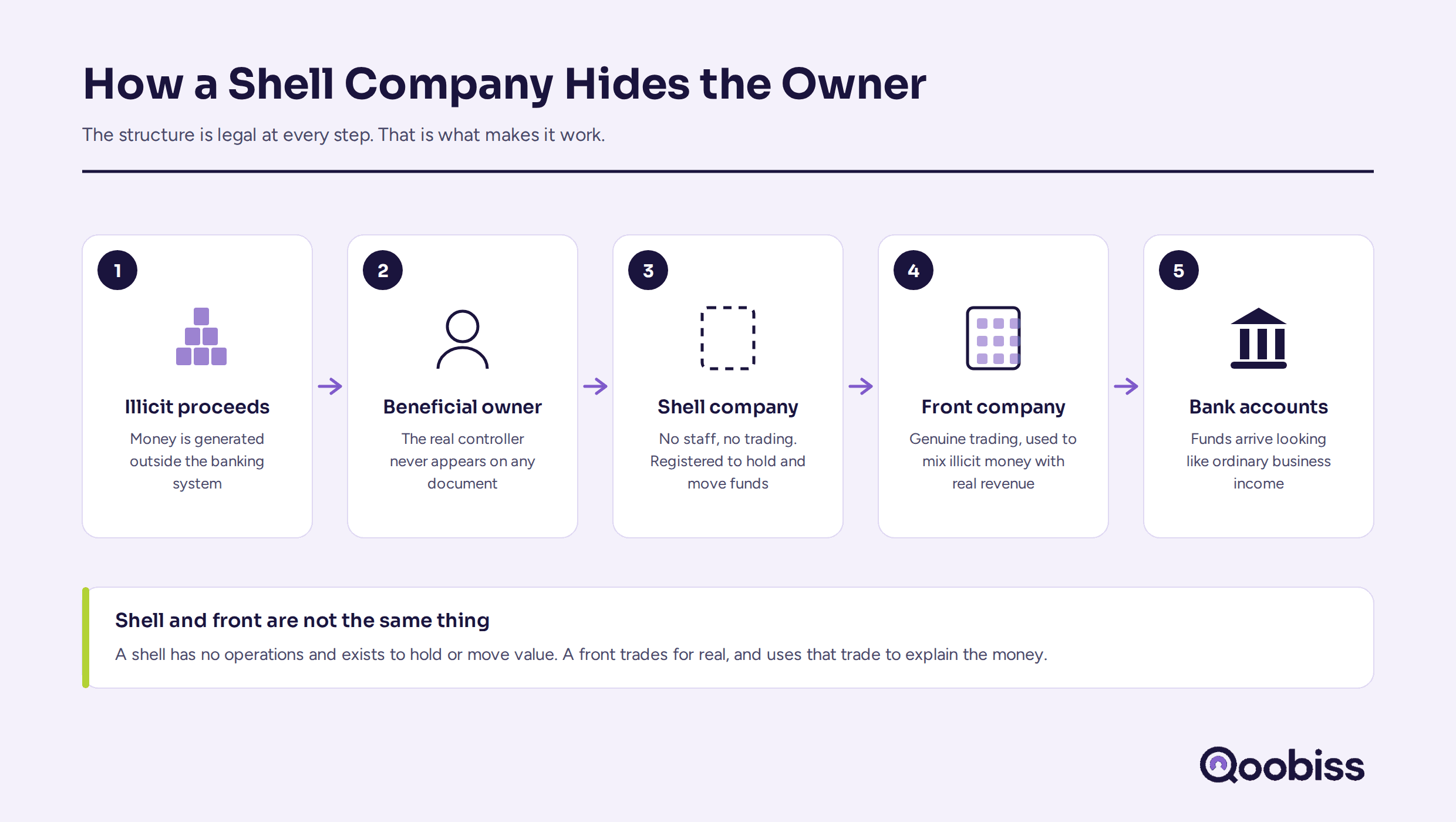
Several similar-sounding structures are often confused with shell companies, but each is distinct, and the differences matter for compliance. The table below sets them apart:
Structure | What it is |
|---|---|
Shell company | A registered entity with no significant assets or operations, used as a vehicle rather than a business. |
Shelf company | A company incorporated and left dormant so it can be sold later with an established registration date. |
Holding company | A parent that owns and controls other operating companies; it has real assets in the form of those subsidiaries. |
Front company | A business with some real activity used to disguise and launder the proceeds of crime. |
How Shell Companies Are Used in Money Laundering
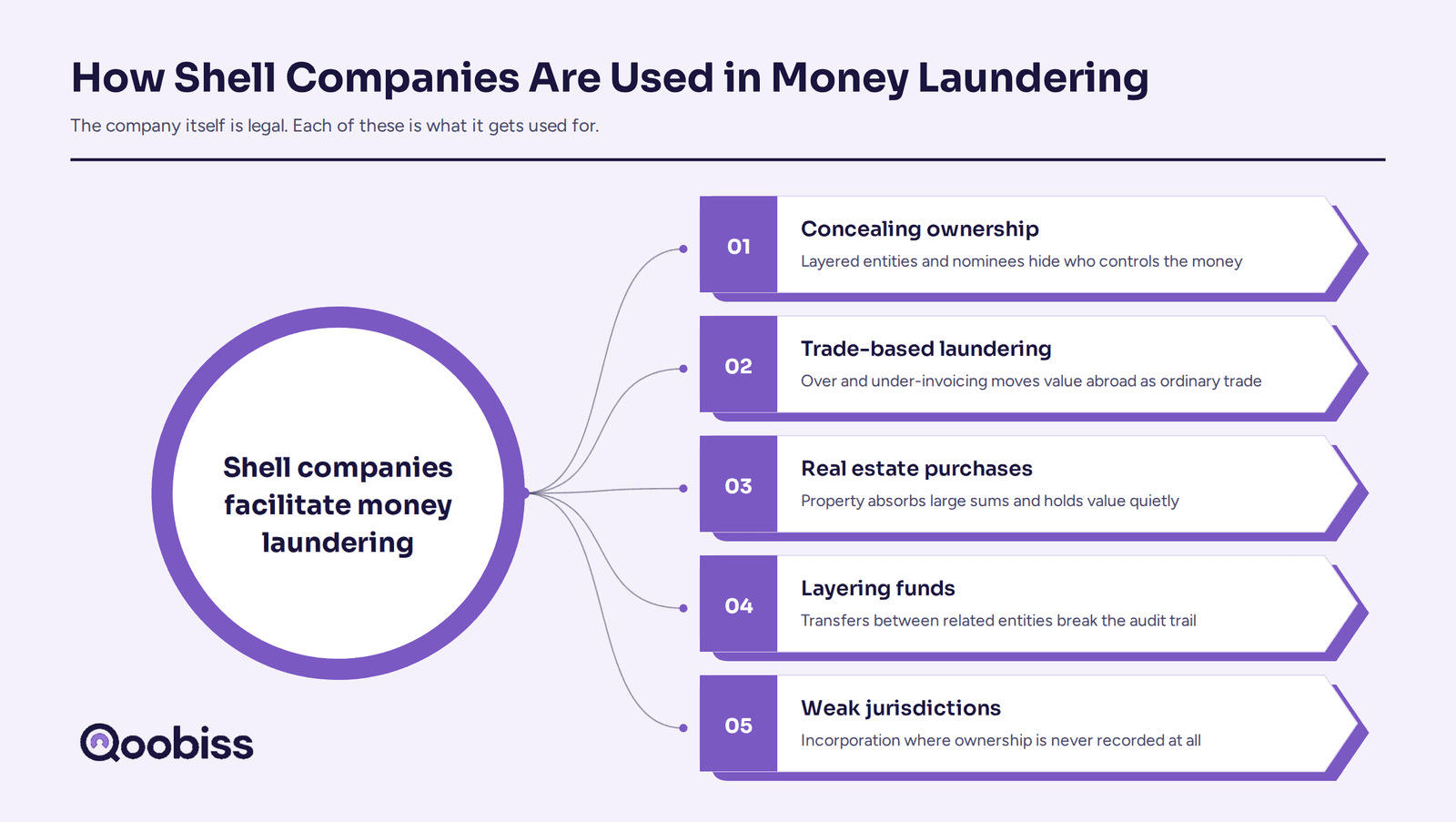
Shell companies are a classic instrument at the layering stage of money laundering, where the goal is to separate criminal proceeds from their source. A launderer might move funds between several shells in different countries, issue invoices for services that were never delivered, or route money in and out of an account to create the appearance of legitimate business.
Nominee directors sign the paperwork, and one shell often lists another shell as its owner, creating a tangle of layered ownership that investigators struggle to unwind.
Techniques such as smurfing and structuring are frequently combined with shells to keep individual transactions below reporting thresholds. The end result is dirty money that emerges looking clean.
Famous Shell Company Cases

Shell companies moved from obscure corporate plumbing to front-page news through a series of major leaks and scandals. The best-known examples show both the global scale of the problem and how ordinary the abuse can look:
The Panama Papers (2016). A leak from law firm Mossack Fonseca exposed how the wealthy and powerful used offshore shells to hide assets and avoid tax.
The Paradise Papers (2017). A second major leak revealed further offshore structures and the secrecy of beneficial ownership.
The Danske Bank scandal. Around 200 billion euros of suspicious funds flowed through the bank's Estonian branch, much of it via shell companies.
The absurd side of weak oversight is just as telling. Investigations have found company directors implausibly registered as under five years old, and more than 22,000 firms registered to the address of the Great Pyramids in Egypt, signs of registries that accept data no one ever verifies.
Red Flags: How to Spot a Shell Company

For a compliance team, no single indicator proves an entity is an illicit shell, but a cluster of them is a strong signal that closer scrutiny is needed. The most common warning signs include:
No identifiable beneficial owner, or ownership that changes repeatedly without a business reason.
Hundreds or thousands of companies registered to the same address.
Incorporation in a known secrecy or tax-haven jurisdiction with no local activity.
Use of nominee directors or shareholders who appear on many unrelated companies.
Transactions with no clear economic purpose, or volumes that do not match any real business.
Rapid registration and deregistration, or multiple quick transfers of ownership.
The Rules: US and EU Frameworks

Governments have responded to shell-company abuse by forcing more transparency about who really owns companies. The main frameworks a compliance team needs to know are moving in the same direction, toward verified beneficial ownership:
Framework | What it does |
|---|---|
US Corporate Transparency Act | Requires beneficial-ownership reporting to FinCEN; after a March 2025 rule, US-formed entities are currently exempt and only foreign entities registered in the US must report. |
EU AMLR and AMLA | A single EU AML rulebook applying from 10 July 2027, overseen by the new AMLA authority, which began operating in 2025 and will directly supervise the highest-risk firms. |
EU beneficial ownership registers | Member States maintain UBO registers; since a 2022 EU court ruling, access runs through a legitimate-interest test rather than being open to all. |
FATF standards | Recommendations 24 and 25 require countries to keep adequate, accurate, and current beneficial-ownership information on companies and trusts. |
How Compliance Teams Detect Shell Companies
Rules on paper only work if obliged entities can actually see through a shell at onboarding and afterward. That means going beyond the company's own paperwork to verify the real people behind it. An effective program layers several controls:
Business verification. Thorough KYB checks confirm the entity is real and map its corporate structure.
Beneficial ownership discovery. Unwrapping layered ownership to identify and verify every ultimate beneficial owner, not just the names on a register.
Screening. Running AML screening against sanctions, PEP, and adverse media data on the entity and its owners.
Source of funds and wealth. Establishing where the money comes from, using source of funds and wealth checks and enhanced due diligence for high-risk cases.
Ongoing monitoring. Continuous transaction monitoring to catch the purposeless flows that mark a shell in use.
Crucially, detection is not a one-time check. As industry experts put it, spotting shell abuse is an ongoing effort, because the goal is to keep raising the cost of hiding ownership. That is why customer due diligence has to run continuously, not just at account opening.
Uncover the Real Owner with Qoobiss
Qoobiss helps banks, fintechs, and platforms see through shell structures to the real people behind them. Its business verification traces ownership chains and identifies ultimate beneficial owners, AML screening checks entities and owners against sanctions, PEP, and adverse-media data, and Omnicheck adds ongoing transaction monitoring. See how Qoobiss supports compliant onboarding for marketplaces and digital platforms, or get in touch to see it in action.
This article is for general information only and is not legal, tax, or compliance advice. For guidance on a specific situation, consult a qualified professional.
Qoobiss Content Team
Frequently Asked Questions
Is a shell company illegal?
How can you tell if a company is a shell company?
What is an example of a shell company?
What is another name for a shell company?
What is a shell company in money laundering?
What is an offshore shell company?