What Is a UBO (Ultimate Beneficial Owner)? Meaning, Rules, and How to Identify One


A UBO, or ultimate beneficial owner, is the real human being who ultimately owns or controls a company, even when layers of other companies, trusts, or nominees sit in between.
The point of the concept is simple but powerful: no matter how complex a corporate structure looks on paper, there is always a person at the end of the chain who truly benefits, and financial-crime rules require regulated firms to find that person.
Identifying the UBO is a cornerstone of anti-money-laundering compliance, because criminals rely on opaque ownership to hide behind shell companies, as the Panama Papers made clear.
This guide explains what a UBO is, the 25 percent threshold and its exceptions, how a UBO differs from a shareholder or a beneficial owner, how to identify one step by step, and the EU and global rules, including the incoming AML Regulation, that every business needs to know in 2026.
What Is a UBO? The Meaning
The Financial Action Task Force (FATF) defines the ultimate beneficial owner as the natural person who ultimately owns or controls a customer, or the person on whose behalf a transaction is conducted. Two features of that definition do the heavy lifting, and both matter when you apply it in practice:
Always a natural person. A UBO can never be another company. The search continues up the ownership chain until it reaches a human being.
Ownership or control. A UBO qualifies through ownership, such as holding shares, or through control, such as voting rights or the power to appoint directors, even without direct shareholding.
In everyday compliance language, the UBO is the person who would truly profit if the company did well and who calls the shots behind the scenes, regardless of whose name appears on the paperwork.
The 25 Percent Threshold (and Its Exceptions)
Across most jurisdictions, the working rule is that anyone who directly or indirectly holds 25 percent or more of a company's shares or voting rights is treated as a UBO. It is a threshold, not a definition, and there are important exceptions that catch people the percentage alone would miss:
The 25 percent rule. Ownership or voting rights of 25 percent or more, whether held directly or through a chain of entities, makes someone a UBO.
Control without ownership. Someone below 25 percent can still be a UBO if they exercise significant control, for example through veto rights or the power to appoint the board.
The high-risk lower threshold. In the EU, the threshold can be dropped to a minimum of 15 percent for entities in higher-risk sectors.
The senior official fallback. If no UBO can be identified after exhausting all checks, the senior managing official, such as the CEO, is treated as the UBO.
UBO vs. Beneficial Owner vs. Shareholder
These terms are often used loosely, but in compliance they mean different things, and mixing them up leads to gaps in due diligence. The table below sets them side by side:
Term | What it means | Key point |
|---|---|---|
Shareholder | Any person or entity that holds shares in a company. | Can be another company, and can hold any percentage. |
Beneficial owner | Anyone who ultimately benefits from or has a stake in the entity. | May include intermediary parties and smaller interests. |
Ultimate beneficial owner | The final natural person who owns or controls the entity. | Always a real individual at the end of the chain, above the threshold or in control. |
The distinction matters because a company can have many shareholders and several beneficial owners, but the UBO is specifically the flesh-and-blood person a compliance team must ultimately identify and verify.
How to Identify a UBO: A Step-by-Step Checklist
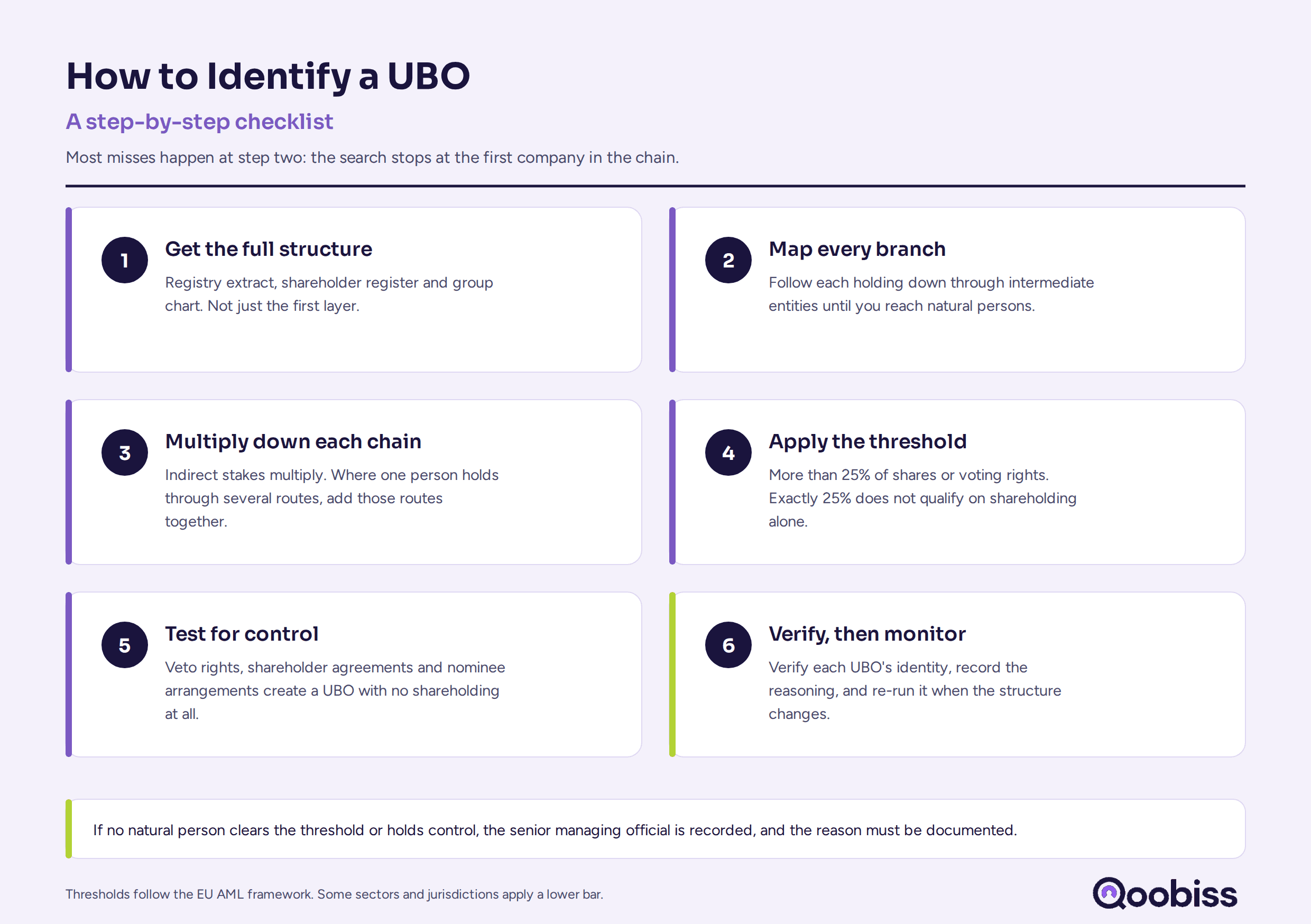
Finding the UBO of a straightforward company is easy, but real ownership is often layered across holding companies, trusts, and multiple jurisdictions. A reliable process follows the same sequence every time, no matter how complex the structure:
Collect company information. Gather the legal name, registration number, address, and current shareholder and director details from official sources.
Map the ownership chain. Trace every layer of direct and indirect ownership, following each corporate shareholder up to the individuals behind it.
Calculate beneficial interest. Multiply ownership percentages through the chain to find each person's effective stake, and check for control that bypasses ownership.
Apply the threshold and control tests. Flag anyone at or above 25 percent, plus anyone with significant control, and use the senior-official fallback if no one qualifies.
Verify the individual. Confirm the identified person's identity with document and biometric checks, not just a name on a register.
Screen and risk-score. Run sanctions, PEP, and adverse-media screening on each UBO and assign a risk rating.
Monitor for change. Re-verify when ownership changes or on a risk-based schedule, since UBOs are not static.
A Worked Example: Indirect Ownership
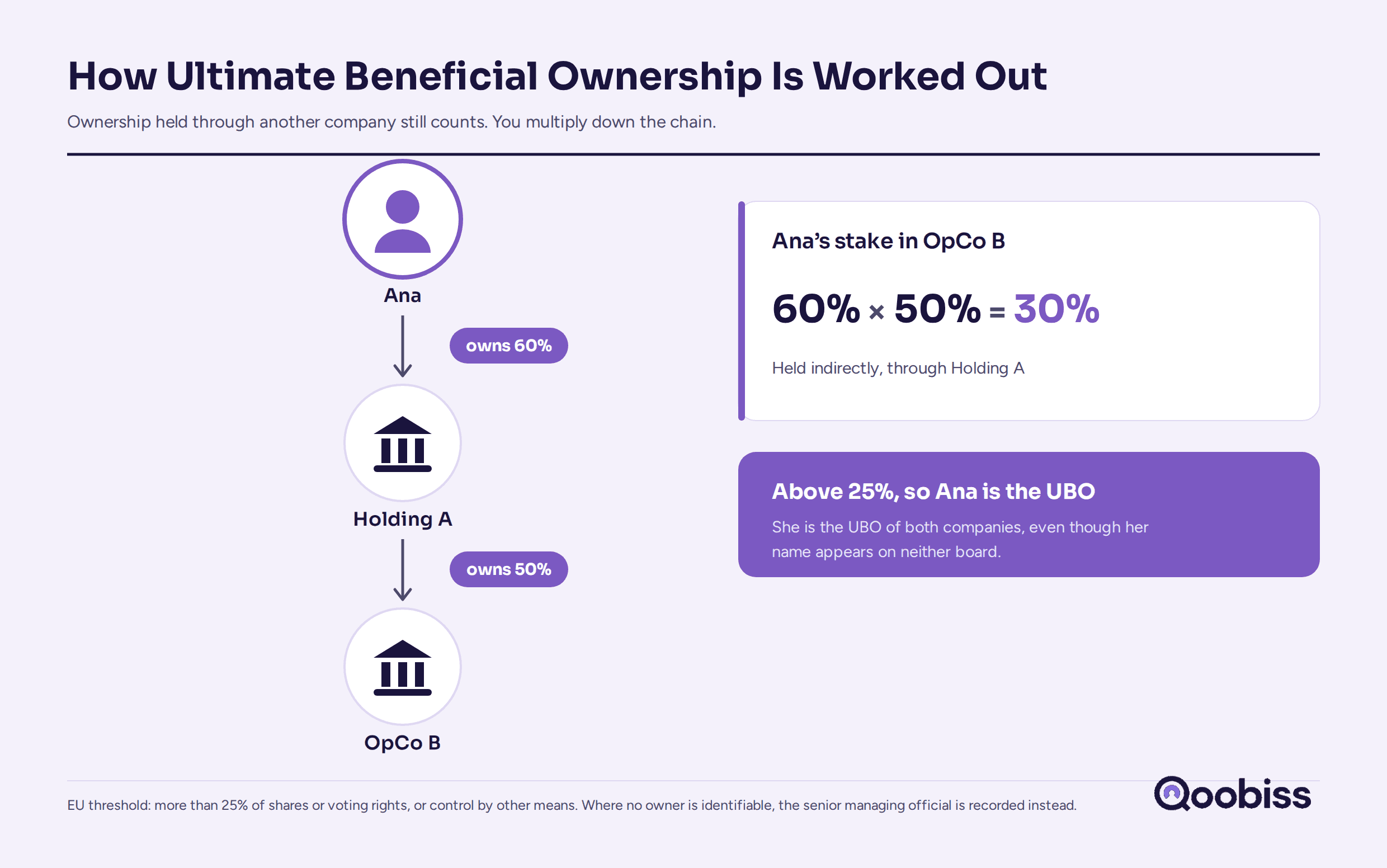
The math is what trips people up, so a simple example helps. Imagine a company being onboarded, Alpha Ltd, that is 60 percent owned by a holding company, Beta Holdings.
Beta Holdings is in turn 50 percent owned by an individual, Maria. To find Maria's effective stake in Alpha, you multiply the percentages along the chain: 60 percent multiplied by 50 percent equals 30 percent.
Because 30 percent is above the 25 percent threshold, Maria is a UBO of Alpha Ltd and must be identified, verified, and screened. If she had owned only 40 percent of Beta, her effective stake would be 24 percent, below the threshold, and you would then look for control exercised by other means before defaulting to the senior managing official.
Why UBO Identification Matters
UBO checks are not box-ticking. They exist because anonymous ownership is the engine of serious financial crime, and the stakes are measured in the trillions. The IMF estimates that money laundering alone runs to between 2 and 5 percent of global GDP each year. Identifying UBOs helps a business in several concrete ways:
It prevents money laundering. Knowing the real owner stops criminals from hiding money laundering behind shell companies.
It meets legal obligations. AML rules require obliged entities to identify UBOs as part of customer due diligence.
It exposes sanctions and PEP exposure. A hidden owner may be sanctioned or a politically exposed person, risk that only surfaces once the UBO is known.
It protects reputation. Onboarding a criminal-controlled entity invites fines, de-risking, and lasting reputational damage.
The Rules: FATF, the EU, and the US
UBO obligations come from a layered set of international and national rules that have tightened sharply in recent years. Compliance teams, especially those operating in or with the EU, should understand the main instruments and their direction of travel:
Framework | What it requires |
|---|---|
FATF Recommendation 24 | The global standard, toughened in 2022, requiring countries to hold adequate, accurate, and up-to-date beneficial-ownership information. |
EU AMLD (4, 5, and 6) | Established the 25 percent threshold, central UBO registers, and, under AMLD6, standardized definitions and register access based on legitimate interest. |
EU AMLR and AMLA | A single EU rulebook fixing the 25 percent threshold (15 percent for high-risk sectors), overseen by the new EU authority AMLA, applying from 2027. |
US Corporate Transparency Act | After a March 2025 change, US-formed entities are exempt; only foreign entities registered to do business in the US must report beneficial owners. |
Two recent developments are worth flagging. A 2022 Court of Justice of the European Union ruling struck down blanket public access to UBO registers, so access now runs through a legitimate-interest test, with journalists and civil society presumed to qualify. And the EU is moving to a single rulebook under the
AML Regulation, overseen by AMLA, which will harmonize UBO rules across member states from 2027. The direction everywhere is toward more accurate, better-verified ownership data, not less.
UBO Thresholds by Jurisdiction
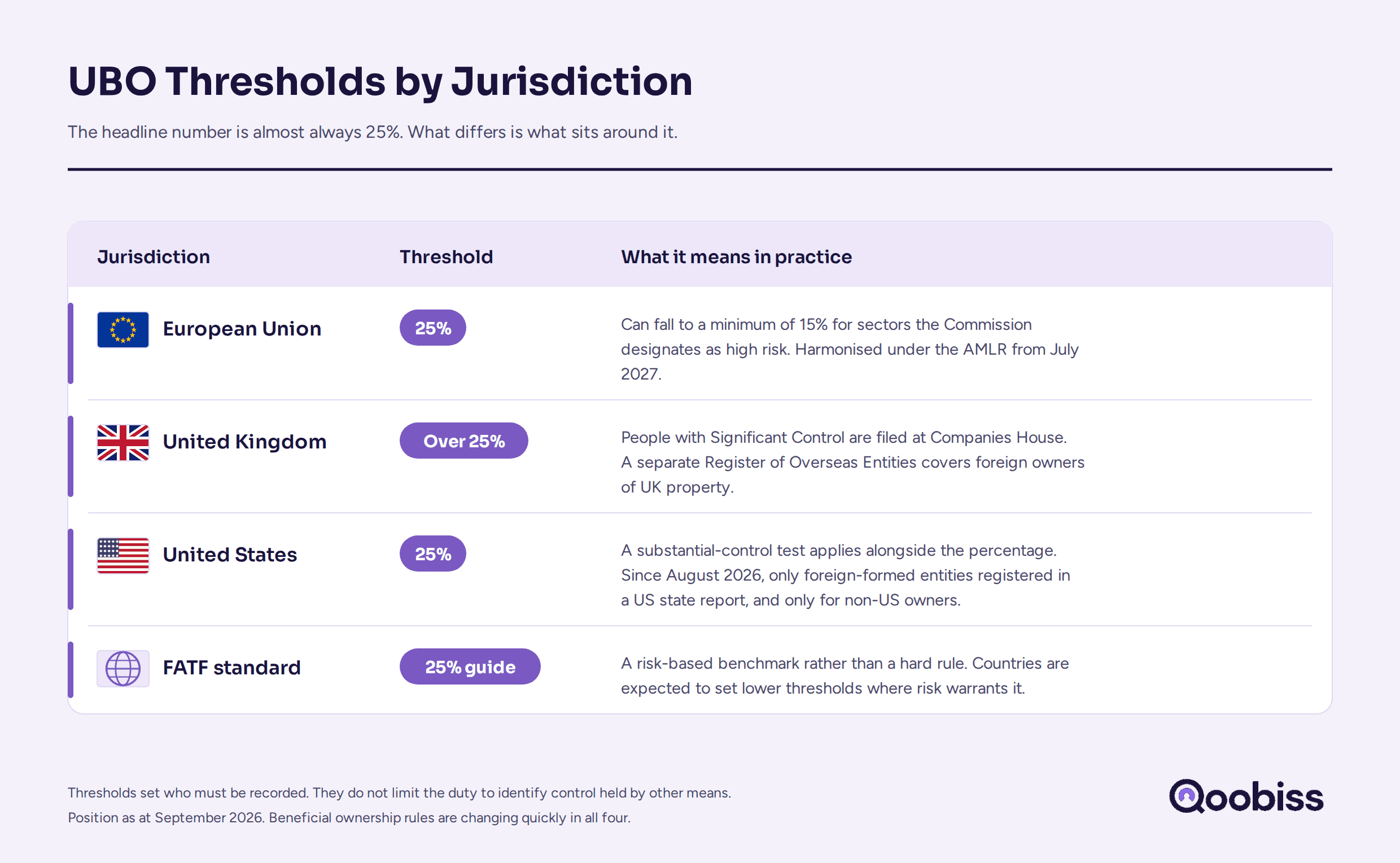
While 25 percent is the most common benchmark, the exact threshold and the emphasis on control vary from country to country. The table below summarizes where the main regimes stand:
Jurisdiction | Threshold | Notes |
|---|---|---|
European Union | 25 percent | Can drop to a minimum of 15 percent for high-risk sectors; harmonized under the AMLR from 2027. |
United Kingdom | More than 25 percent | People with significant control are recorded at Companies House; a separate register covers overseas entities. |
United States | 25 percent | Substantial-control test also applies; after March 2025, only foreign entities registered in the US report. |
FATF standard | 25 percent guide | A risk-based benchmark; countries may set lower thresholds based on risk. |
The practical lesson is that a single fixed percentage is never enough. A compliant program applies the local threshold, layers the control tests on top, and lowers the bar where the risk is higher.
Which Businesses Must Identify UBOs?

UBO identification is a legal duty for the wide range of firms that AML law calls obliged entities. If your business onboards other businesses, it almost certainly applies to you. The obligation typically covers:
Banks, lenders, and other credit institutions.
Payment firms, fintechs, and electronic-money institutions.
Crypto-asset service providers and exchanges.
Real-estate agents, notaries, and certain legal and accounting professionals.
Marketplaces and platforms that onboard business sellers or partners.
For all of these, identifying the UBO is a core part of business verification and enhanced due diligence, and it feeds directly into sanctions and adverse-media screening.
Challenges in Finding the Real Owner
Even with clear rules, identifying UBOs in practice is hard, and criminals design structures specifically to frustrate it. The recurring obstacles are worth anticipating:
Multi-layered and cross-border structures that hide ownership across several jurisdictions.
Nominee shareholders and directors who front for the real owner.
Registers with outdated, incomplete, or self-declared data that has never been verified.
Trusts and other legal arrangements where control does not follow share ownership.
How Qoobiss Helps You Identify and Verify UBOs
Qoobiss turns UBO identification from a manual investigation into an automated, auditable workflow. Its business verification and KYC tools trace ownership chains, verify the real individuals behind an entity, and run AML screening for sanctions, PEP, and adverse-media exposure, with ongoing transaction monitoring through Omnicheck. See how Qoobiss supports marketplaces and digital platforms with fast, compliant onboarding, or get in touch to see it in action.
Frequently Asked Questions
What is a UBO in simple terms?
What is the UBO threshold?
Is a UBO the same as a shareholder?
What is the difference between a beneficial owner and a UBO?
Who must identify UBOs?
What happens if no UBO can be identified?
Where can I find UBO information?