What Is a Customer Risk Assessment? A Practical Guide for 2026


A customer risk assessment is how a regulated business decides how much money-laundering and financial-crime risk a customer poses, and therefore how much scrutiny that customer needs. It is the engine of the risk-based approach that sits at the heart of every anti-money-laundering program: instead of treating everyone the same, you direct your attention and resources toward the customers most likely to be a problem, and keep friction low for everyone else.
Getting it right matters more than ever. Regulators expect a documented, defensible methodology, and in the EU the incoming AML Regulation will make customer due diligence and enhanced due diligence far more prescriptive from July 2027.
This guide explains what a customer risk assessment is, the risk factors and scoring behind it, how to run one step by step, a worked example, and the EU rules that are reshaping it, all from the perspective of a compliance team that has to make it work in practice.
What Is a Customer Risk Assessment?

A customer risk assessment, sometimes shortened to CRA or called customer risk rating, is the systematic evaluation of the money-laundering, terrorist-financing, and fraud risk that an individual or business customer represents. The output is a risk rating, usually low, medium, or high, that determines the level of due diligence you apply and how closely you monitor the relationship afterward.
It is not a one-off form. A good assessment starts at onboarding and continues for the life of the relationship, updating whenever the customer's behavior or circumstances change. It also differs from a business-wide AML risk assessment, which looks at the risk across your whole book. The customer risk assessment zooms in on one relationship at a time.
Why the Risk-Based Approach Matters

The customer risk assessment exists to deliver the risk-based approach that the Financial Action Task Force (FATF) requires. Rather than applying identical controls to every customer, you match the intensity of your checks to the actual risk. Done well, this brings three clear benefits, and getting it wrong carries real consequences:
Efficiency: low-risk customers move through onboarding quickly, while your analysts focus on the genuinely risky minority.
Compliance: a documented, consistent methodology is exactly what supervisors expect to see, and what protects you in an examination.
Effectiveness: misclassifying a high-risk customer as low-risk is how criminal funds slip through, so accurate rating is a genuine defense, not paperwork.
The stakes are large. The IMF estimates money laundering runs to between 2 and 5 percent of global GDP each year, and firms with weak assessments face fines, enforcement, and lasting reputational damage.
The Four Customer Risk Factor Categories
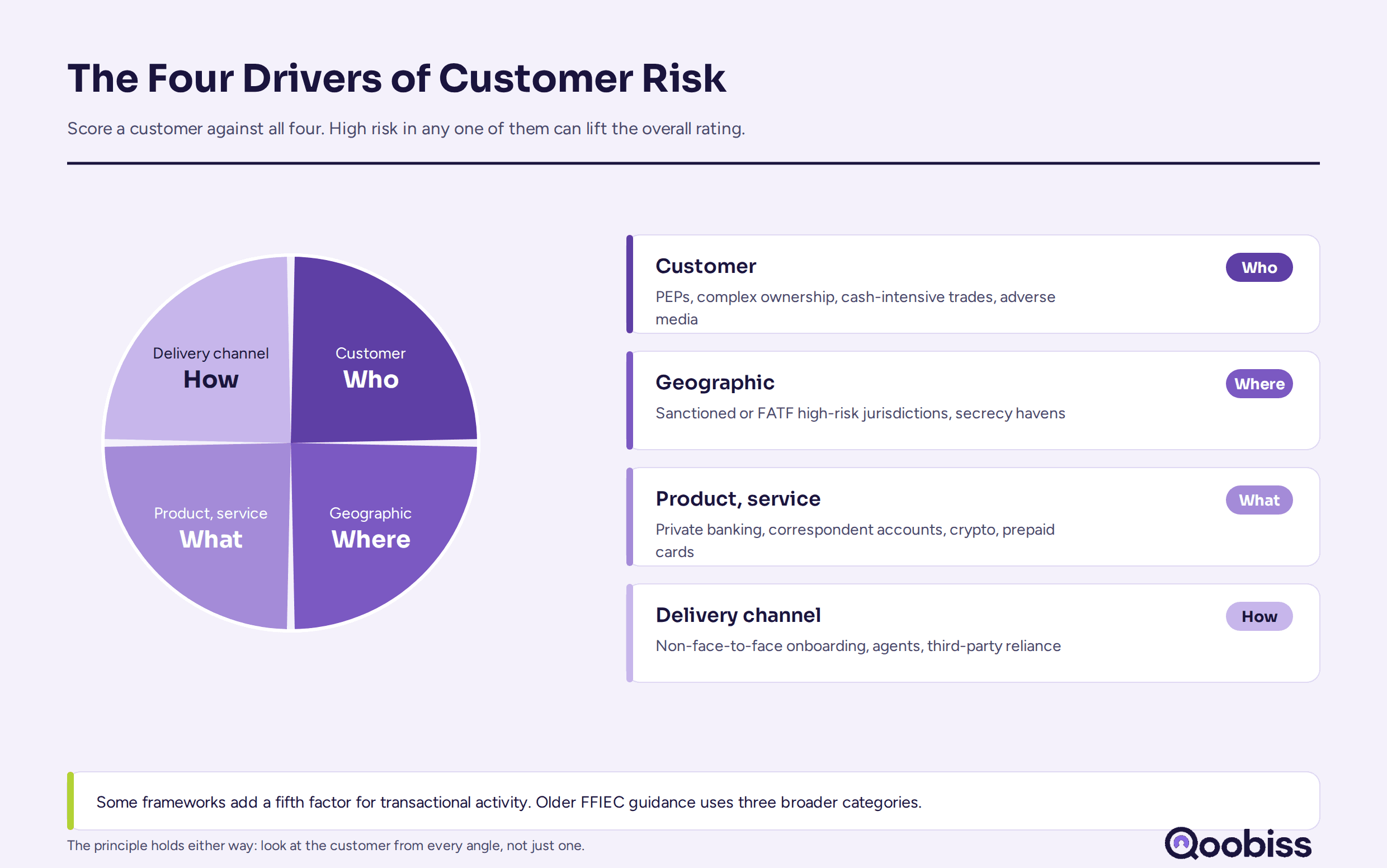
FATF and most regulators group the drivers of customer risk into four categories. A sound assessment scores a customer against all four, because risk in any one of them can raise the overall rating:
Risk factor | What it covers | High-risk examples |
|---|---|---|
Customer | Who the customer is and how they are structured | PEPs, complex ownership, cash-intensive businesses, adverse media |
Geographic | Countries the customer is linked to | Sanctioned or FATF high-risk jurisdictions, secrecy havens |
Product and service | What the customer uses | Private banking, correspondent accounts, crypto, prepaid cards |
Delivery channel | How the relationship is conducted | Non-face-to-face onboarding, agents, third-party reliance |
Some frameworks add a fifth factor for transactional activity, and older US guidance under the FFIEC uses three broad categories rather than four. The principle is the same: look at the customer from every angle, not just one.
How Customer Risk Scoring Works
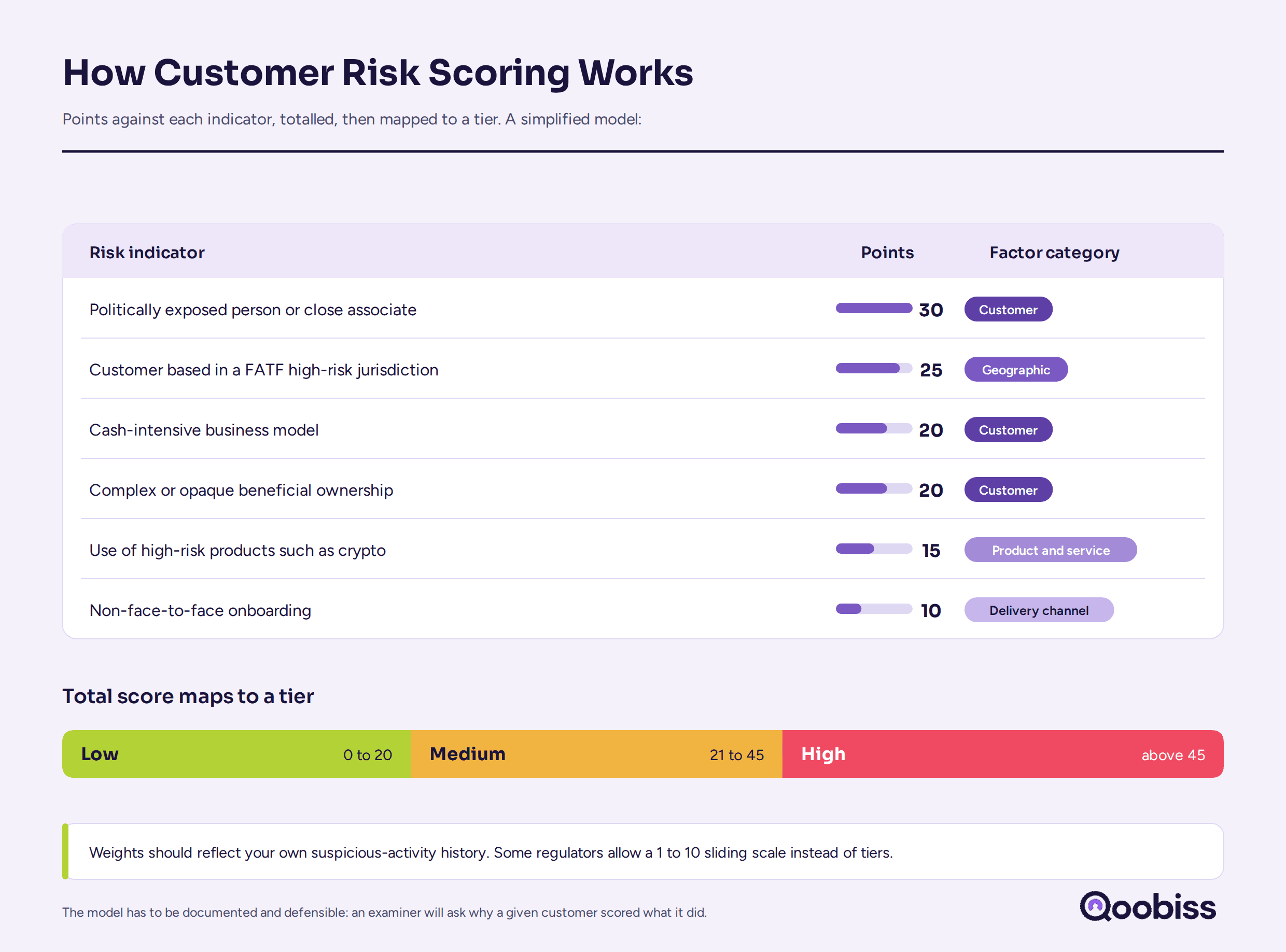
To turn these factors into a rating, most firms build a scoring model that assigns points or weights to each risk indicator, then totals them and maps the result to a tier. The exact weights should reflect how strongly each factor correlates with real money-laundering risk, informed by your own suspicious-activity history. A simplified model might look like this:
Risk indicator | Points | Factor category |
|---|---|---|
Customer based in a FATF high-risk jurisdiction | 25 | Geographic |
Politically exposed person or close associate | 30 | Customer |
Cash-intensive business model | 20 | Customer |
Complex or opaque beneficial ownership | 20 | Customer |
Non-face-to-face onboarding | 10 | Delivery channel |
Use of high-risk products such as crypto | 15 | Product and service |
The total score then maps to a risk tier, for example 0 to 20 points as low, 21 to 45 as medium, and above 45 as high. Some regulators, such as the DFSA, allow a numeric sliding scale from 1 to 10 instead of descriptive tiers. Either way, the model must be documented and defensible so you can explain to an examiner exactly why a customer received the rating they did.
A Worked Example
Consider a new business customer that operates a money-services business (a cash-intensive model, 20 points), is registered in a medium-risk jurisdiction with one owner in a FATF high-risk country (25 points), and is onboarded entirely online (10 points).
The total is 55 points. Under the tiers above, that places the customer firmly in the high-risk band, which means enhanced due diligence is required: verifying source of funds and wealth, identifying every beneficial owner, obtaining senior-management approval, and monitoring transactions more closely.
Had the same business been domestic, face-to-face, and not cash-intensive, its score would have landed in the low band with standard checks. The scoring makes the difference explicit and repeatable.
Risk Tiers and the Due Diligence They Trigger
The whole point of the rating is to decide how much due diligence to apply. Each tier maps to a level of checks, escalating with risk:
Risk tier | Due diligence level | What it typically involves |
|---|---|---|
Low | Simplified due diligence | Basic identity verification and lighter, periodic review |
Medium | Standard due diligence | Full identity verification, screening, and regular monitoring |
High | Enhanced due diligence | Source of funds and wealth, UBO checks, senior sign-off, close monitoring |
These levels connect directly to your wider program: customer due diligence for standard cases and enhanced due diligence for high-risk ones, both built on reliable identity verification.
Inherent vs. Residual Risk
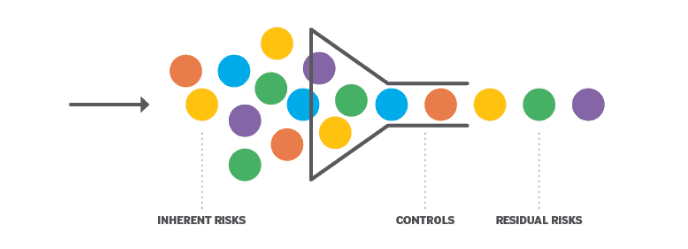
A mature assessment separates two ideas that are easy to conflate. Inherent risk is the risk a customer poses before you apply any controls.
Residual risk is what remains after your controls, such as screening, monitoring, and enhanced due diligence, have done their work.
A customer can carry high inherent risk yet acceptable residual risk if your controls are strong and evidenced, while a moderate-inherent-risk customer with weak controls can end up with elevated residual risk.
Rating on residual risk, and being able to show the controls that reduced it, is what makes an assessment defensible rather than just a score on a page.
How to Conduct a Customer Risk Assessment: Step by Step
Whatever the customer, a reliable assessment follows the same sequence. Documenting each step is as important as performing it, because the audit trail is what you will rely on under supervision:
Collect customer information. Gather identity, ownership, business activity, and expected transaction details at onboarding.
Verify the data. Confirm identity and, for businesses, beneficial ownership against independent and authoritative sources.
Score the risk factors. Assess the customer, geographic, product, and channel factors using your weighted model.
Assign a rating. Map the total score to a low, medium, or high tier, or a point on a numeric scale.
Apply the matching due diligence. Route the customer to simplified, standard, or enhanced checks based on the tier.
Screen and document. Run sanctions, PEP, and adverse-media screening, and record the decision and its rationale.
Monitor and re-rate. Watch behavior over time and refresh the rating when circumstances change or on a risk-based schedule.
Static vs. Dynamic Risk Rating
Traditionally, firms rated a customer at onboarding and revisited the score once a year. That static approach is increasingly seen as inadequate, because risk changes constantly.
A customer can become a PEP, move money to a new jurisdiction, or suddenly transact far above their expected profile.
Dynamic, or perpetual, risk rating updates the score automatically as new information arrives, driven by ongoing transaction monitoring and event triggers rather than a calendar.
It reduces the window in which a newly risky customer is misrated, and it is where regulators and modern compliance programs are heading.
The EU Rules: AMLR, AMLA, and the EBA Guidelines

For European firms, the customer risk assessment is about to become much more prescriptive, and most existing guides do not reflect this. The EU is replacing a patchwork of national rules with a single AML rulebook, backed by a new central supervisor. The key instruments to know are:
Framework | What it means for your assessment |
|---|---|
FATF Recommendation 10 | The global baseline requiring risk-based customer due diligence and beneficial-owner identification. |
EU AMLR | A single EU rulebook that applies from 10 July 2027 and sets a precise, mandatory catalogue of enhanced due diligence triggers. |
AMLA | The new EU Anti-Money Laundering Authority in Frankfurt, which will directly supervise higher-risk firms. |
EBA Risk Factor Guidelines | The operational EU standard describing the factors to weigh and how to apply due diligence to them. |
Crucially, the AMLR sets out defined circumstances that always require enhanced due diligence, including customers linked to high-risk third countries, politically exposed persons and their associates, correspondent relationships, and complex or unusually large transactions with no clear economic purpose. Preparing for this AMLR shift now is far easier than retrofitting later.
Red Flags That Raise a Customer's Risk

Beyond the structured factors, certain behaviors should push a rating upward or prompt a review. None is conclusive on its own, but several together are a strong signal that closer scrutiny is warranted:
A customer whose source of funds or wealth cannot be explained or evidenced.
Reluctance to provide information, evasive answers, or frequent unexplained changes of bank.
Ownership structures that are unnecessarily complex or that obscure the real owner.
Transactions inconsistent with the customer's stated profile or expected activity.
Links to sanctioned parties or negative findings in adverse media and sanctions screening.
Assessing Business Customers (KYB)
Rating a business is harder than rating an individual, because risk hides in the ownership structure. A thorough business risk assessment scores the entity type, industry, and country of incorporation, then unwraps the ownership chain to identify and verify every ultimate beneficial owner. ]
A shell company in a secrecy jurisdiction with opaque ownership scores very differently from an established, transparent operating business, and only by tracing ownership can you rate it correctly. This is why customer risk assessment and know-your-business checks belong in the same workflow.
Automate Customer Risk Assessment with Qoobiss
Qoobiss turns the customer risk assessment into an automated, auditable part of onboarding. Its identity verification and business verification feed a risk rating at account opening, AML screening checks every customer against sanctions, PEP, and adverse-media data, and ongoing transaction monitoring through Omnicheck keeps ratings current. See how Qoobiss streamlines compliant digital onboarding, or get in touch to see it in action.
Frequently Asked Questions
What are the main steps of a customer risk assessment?
What should a customer risk assessment include?
What makes a customer high-risk?
What is the difference between a customer risk assessment and CDD?
How often should a customer risk assessment be updated?