Facial Recognition Explained: How It Works and Its Role in Identity Verification

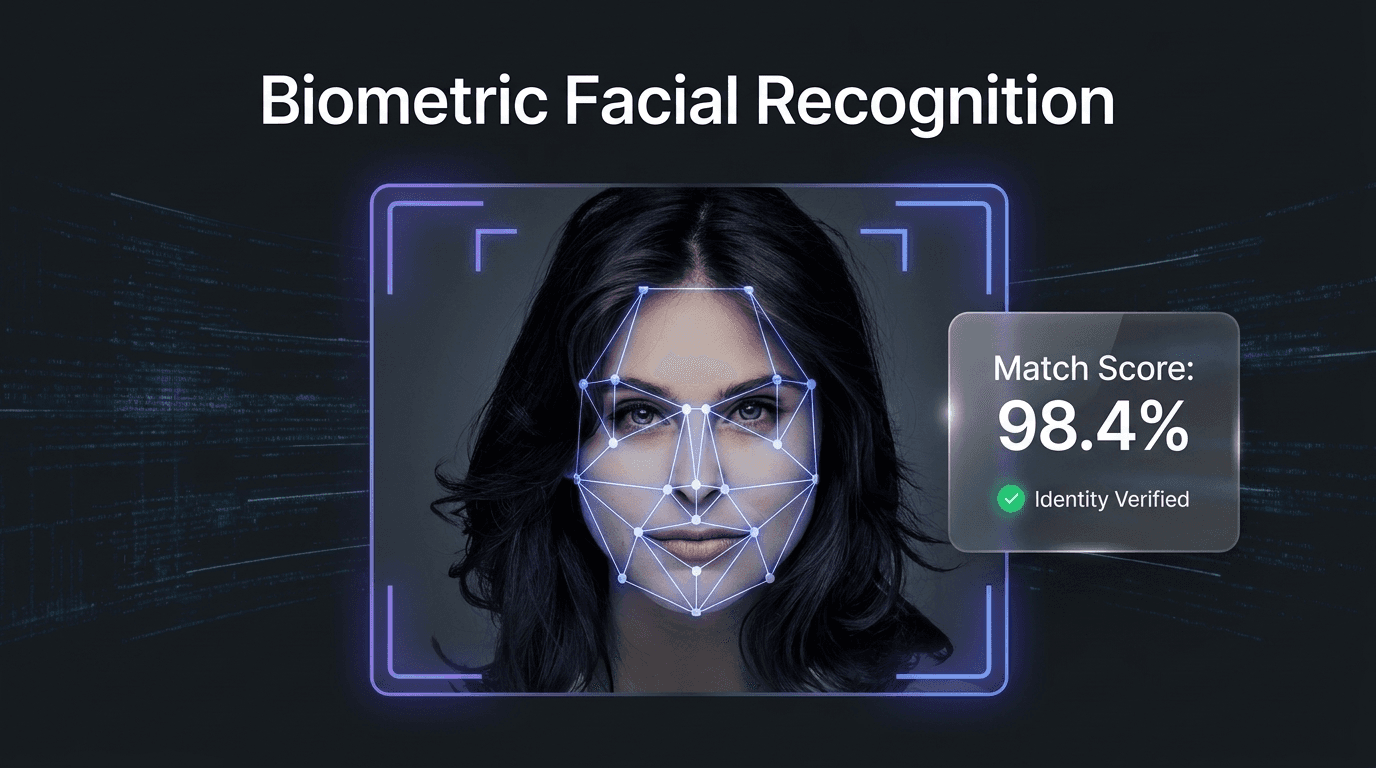
Facial Recognition: What It Is, How It Works, and How It's Used in Identity Verification
Facial recognition has become one of the most widely deployed biometric technologies in the world. Hundreds of millions of people use it daily to unlock their phones. Airports use it to board passengers. Offices use it to control building access. But for regulated businesses that onboard customers remotely, facial recognition serves a different and more specific purpose: it is the biometric matching layer that confirms the person presenting an identity document is the person that document was issued to.
This distinction matters because the public conversation around facial recognition is dominated by surveillance and privacy debates, while the operational reality for businesses performing identity verification is fundamentally different.
In identity verification, facial recognition operates as a 1:1 comparison between a live selfie and a document photograph, initiated by the user, scoped to a single verification session, and governed by explicit consent. It is not mass surveillance. It is the mechanism that prevents someone from using a stolen or borrowed identity document to open a bank account, activate a SIM card, or register on a regulated platform.
This guide covers what facial recognition is, how the underlying technology works, where it is used, how it functions within identity verification and KYC workflows, the factors that affect its accuracy, and the privacy and regulatory considerations that businesses need to manage.
What Is Facial Recognition?
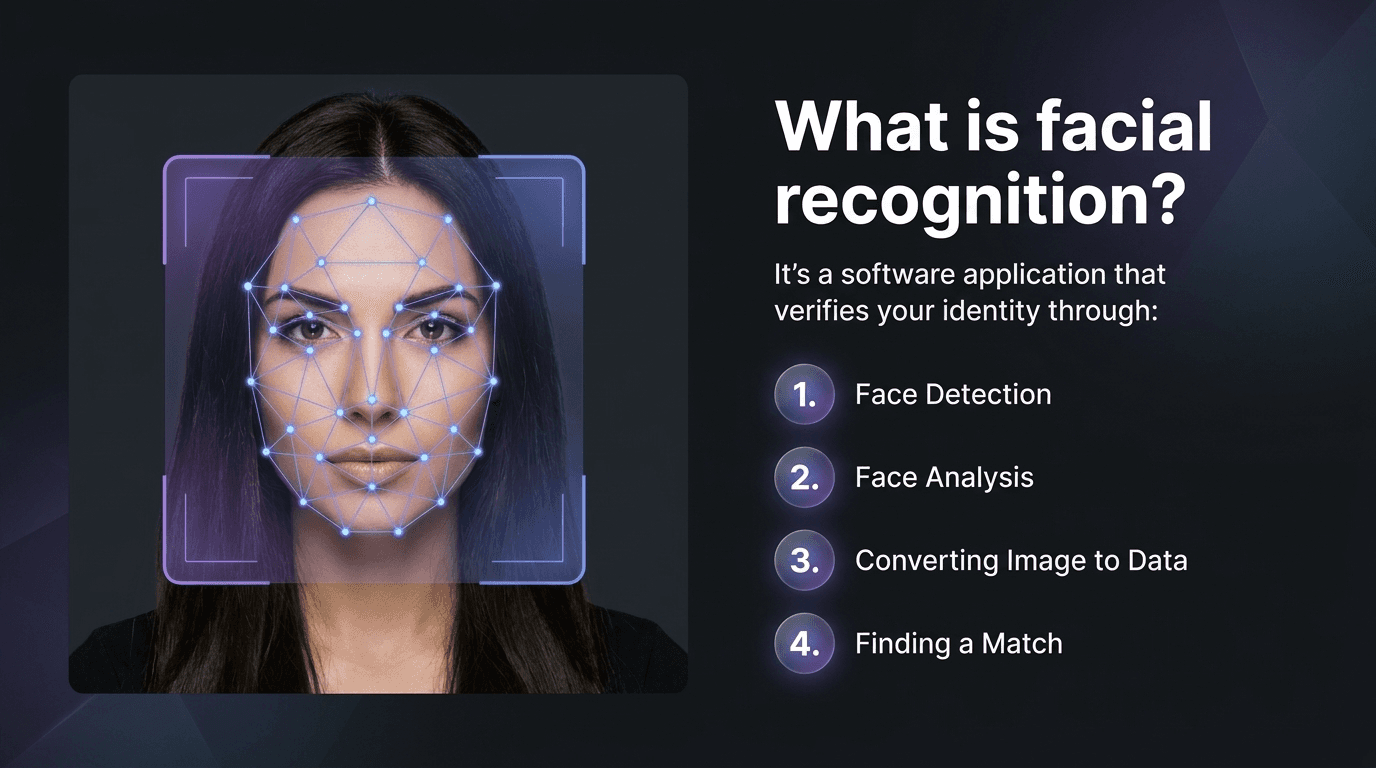
Facial recognition is a biometric technology that identifies or verifies a person by analyzing the unique geometric characteristics of their face.
The facial recognition definition encompasses any system that captures a facial image, extracts measurable features from it, and compares those features against stored data to establish or confirm identity.
The core concept is straightforward. Every human face has a distinctive geometry: the distance between the eyes, the width of the nose, the depth of the eye sockets, the shape of the cheekbones, the contour of the jawline. A facial recognition system measures these characteristics and converts them into a mathematical representation, commonly called a faceprint or facial template. This numerical encoding of facial geometry is what allows a computer to compare faces with precision and speed that human visual inspection cannot match.
Facial recognition is one of several biometric identification methods, alongside fingerprint scanning, iris recognition, voice analysis, and vein pattern matching. What distinguishes facial recognition from other biometrics is that it can operate without physical contact with a sensor, it works with standard camera hardware that is already present on virtually every smartphone and laptop, and it can process a biometric sample from a photograph or video frame rather than requiring a dedicated scanning device.
The technology has evolved through several generations. Early systems in the 1990s used linear algebra techniques to compare facial images, achieving limited accuracy under controlled conditions. The shift to deep learning in the 2010s transformed the field. Modern facial recognition systems use convolutional neural networks (CNNs) trained on millions of facial images to generate high-dimensional feature vectors that capture facial characteristics with far greater precision than geometric measurements alone. This deep learning foundation is what has made facial recognition accurate enough to serve as a reliable component of identity verification workflows.
How Facial Recognition Works
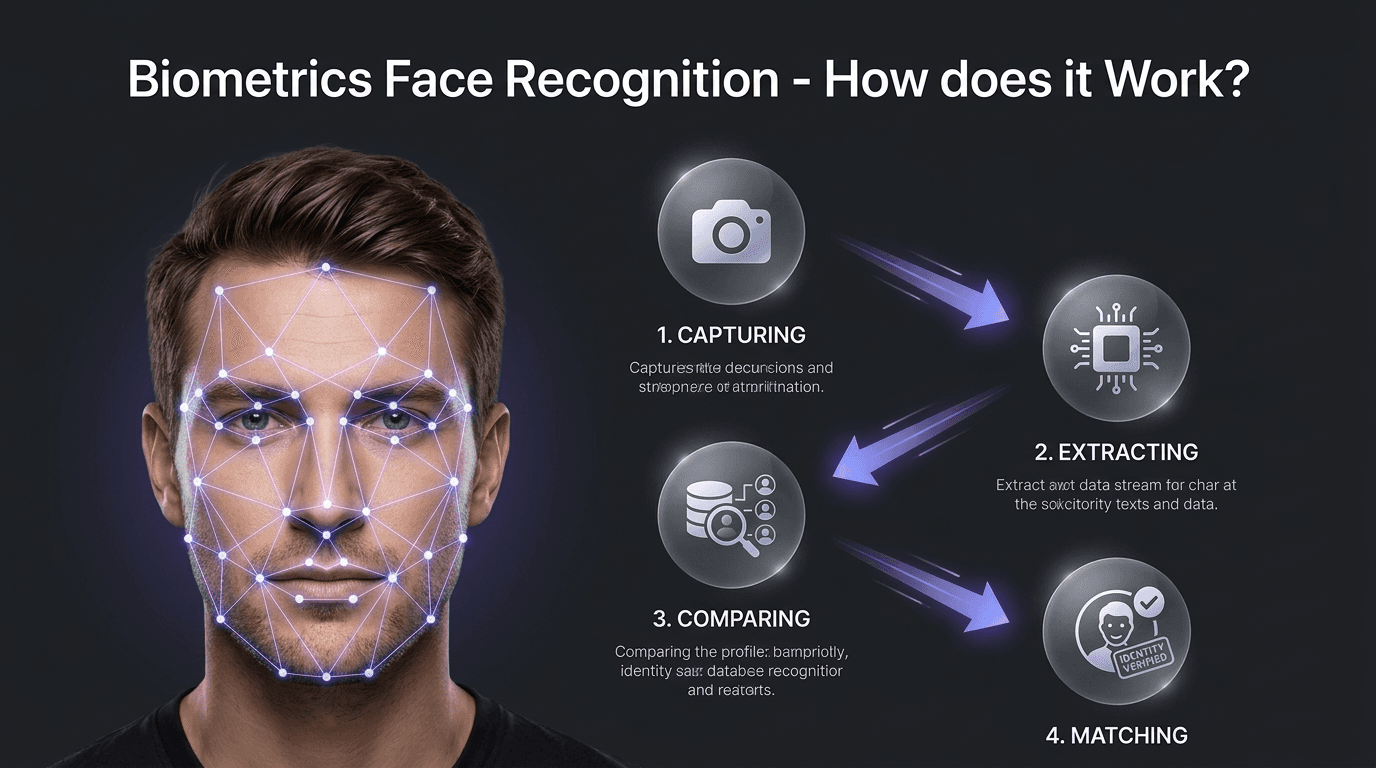
Facial recognition systems follow a structured process from image capture through to a match decision. Understanding each stage clarifies both the capabilities and the limitations of the technology.
Detection
Face detection is the first step: locating a face within an image or video frame. The system must distinguish a face from the background, other objects, and other people in the scene. Modern detection algorithms handle varying lighting conditions, partial occlusion (such as eyeglasses or face masks), and faces captured at different angles.
Classical approaches, such as the Viola-Jones algorithm introduced in 2001, used predefined patterns to detect frontal faces in real time. Current systems use deep neural networks that detect faces across a much wider range of poses, expressions, and conditions. Detection determines where faces are in the image; it does not determine whose faces they are.
Analysis and Feature Extraction
Once a face is detected, the system analyzes it by identifying key facial landmarks and extracting a set of measurements that characterize the face. Deep learning models process the detected face through multiple neural network layers, progressively extracting higher-level features until the face is represented as a high-dimensional numerical vector, typically consisting of 128 to 512 values.
This vector, the faceprint, is a compact mathematical representation of the face's distinguishing characteristics. Two images of the same person will produce similar faceprints; two images of different people will produce faceprints that differ measurably. The quality of the feature extraction model determines the accuracy of the entire system.
Matching and Comparison
The extracted faceprint is compared against one or more stored templates using similarity metrics such as cosine similarity or Euclidean distance. The comparison produces a similarity score: a numerical value indicating how closely the two faceprints correspond. A predefined threshold determines whether the score constitutes a match or a non-match.
The threshold setting involves a direct tradeoff. A lower threshold (more permissive) reduces false rejections but increases the risk of false matches. A higher threshold (more restrictive) reduces false matches but increases false rejections. The appropriate threshold depends on the use case: a phone unlock may accept a slightly lower threshold for convenience, while identity verification for financial services requires a higher threshold to minimize fraud risk.
1:1 Verification vs. 1:N Identification
A critical distinction in facial recognition is between verification and identification. These are fundamentally different operations, not variations of the same process.
1:1 verification answers the question: "Is this person who they claim to be?" The system compares a live facial image against a single reference image associated with a claimed identity. This is the mode used in identity verification: a customer provides a selfie, and the system compares it to the photograph on their submitted identity document. The comparison involves exactly two images.
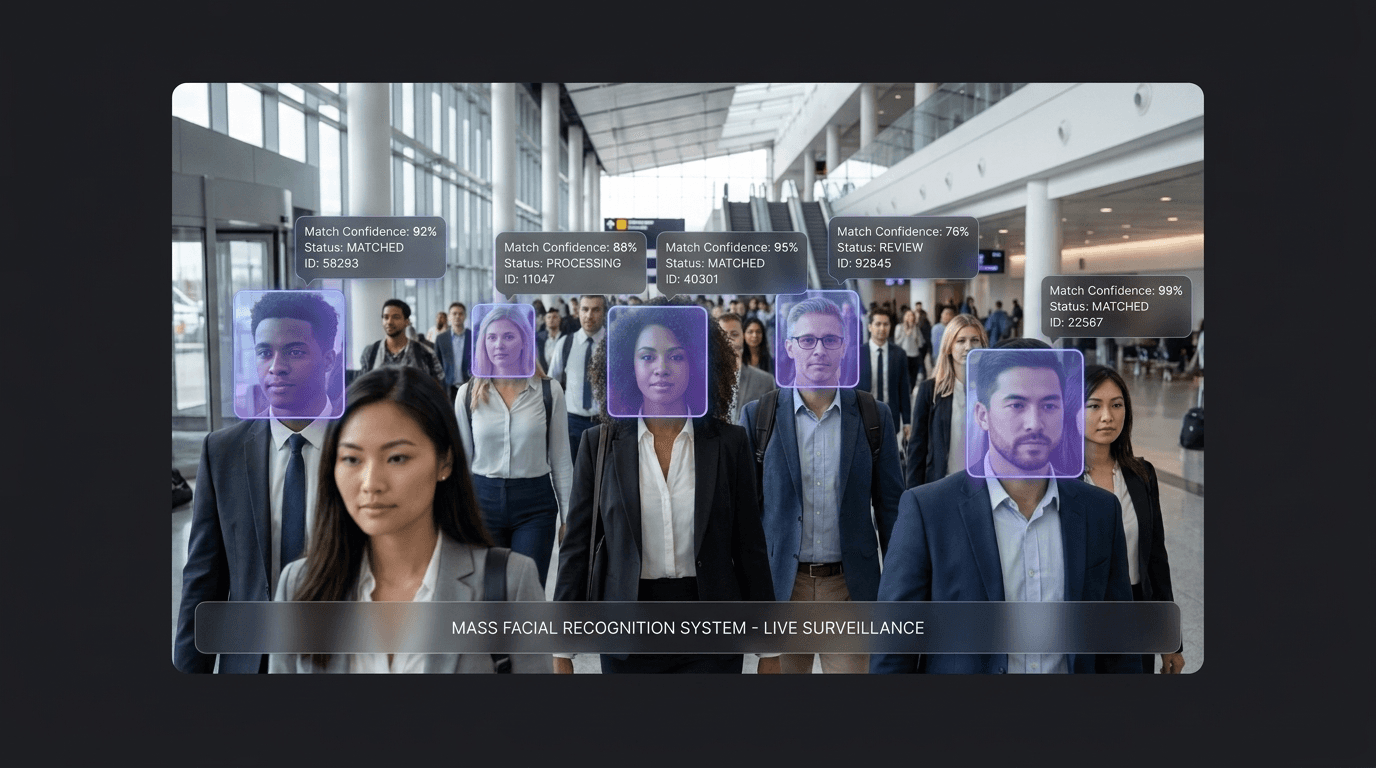
1:N identification answers a different question: "Who is this person?" The system compares a facial image against an entire database of stored templates to find potential matches. This is the mode used in law enforcement and surveillance: a camera captures an image, and the system searches a gallery of known individuals to determine whether any match exists.
This distinction matters for businesses because identity verification operates exclusively in 1:1 mode. The customer initiates the process, provides consent, and presents a claimed identity that the system then confirms or rejects. There is no database search and no mass screening. The privacy, accuracy, and regulatory implications of 1:1 verification are fundamentally different from those of 1:N identification.
Where Facial Recognition Is Used
Consumer Device Authentication
The most familiar application of facial recognition is device unlock. Apple's Face ID, introduced in 2017, uses a structured-light sensor to create a 3D map of the user's face and authenticate access to the device. Android devices offer similar functionality through their biometric frameworks. Device-level facial recognition operates entirely on-device, with the faceprint stored locally rather than transmitted to external servers.
Law Enforcement and Border Control
Law enforcement agencies use facial recognition in 1:N identification mode to match suspects against watchlists or databases of known individuals. Border control systems at airports and ports of entry use facial recognition to verify travelers against their passport photographs, an application that operates in 1:1 verification mode. The US Transportation Security Administration (TSA) has expanded facial recognition at airport security checkpoints, generating both efficiency gains and public debate about traveler privacy.
Access Control and Physical Security
Facial recognition is replacing badge and card systems in commercial buildings, manufacturing facilities, and event venues. Employees or authorized individuals are enrolled in a local database, and the system grants access when a face match is confirmed. This application combines the convenience of contactless authentication with security advantages over physical credentials that can be lost, shared, or stolen.
Identity Verification and KYC Onboarding
For regulated businesses, facial recognition is the biometric matching step within the identity verification workflow. During remote customer onboarding, the customer submits a government-issued identity document and provides a live selfie. The facial recognition system compares the selfie to the photograph extracted from the document, confirming that the person completing the onboarding process is the person the document was issued to.
This is the application where facial recognition delivers direct compliance value. KYC regulations require businesses to verify customer identity using reliable, independent methods. Document verification alone confirms the document is genuine, but it cannot confirm the person holding it is the rightful owner. Facial recognition closes that gap by establishing the biometric link between the document and the individual.
Facial Recognition in Identity Verification
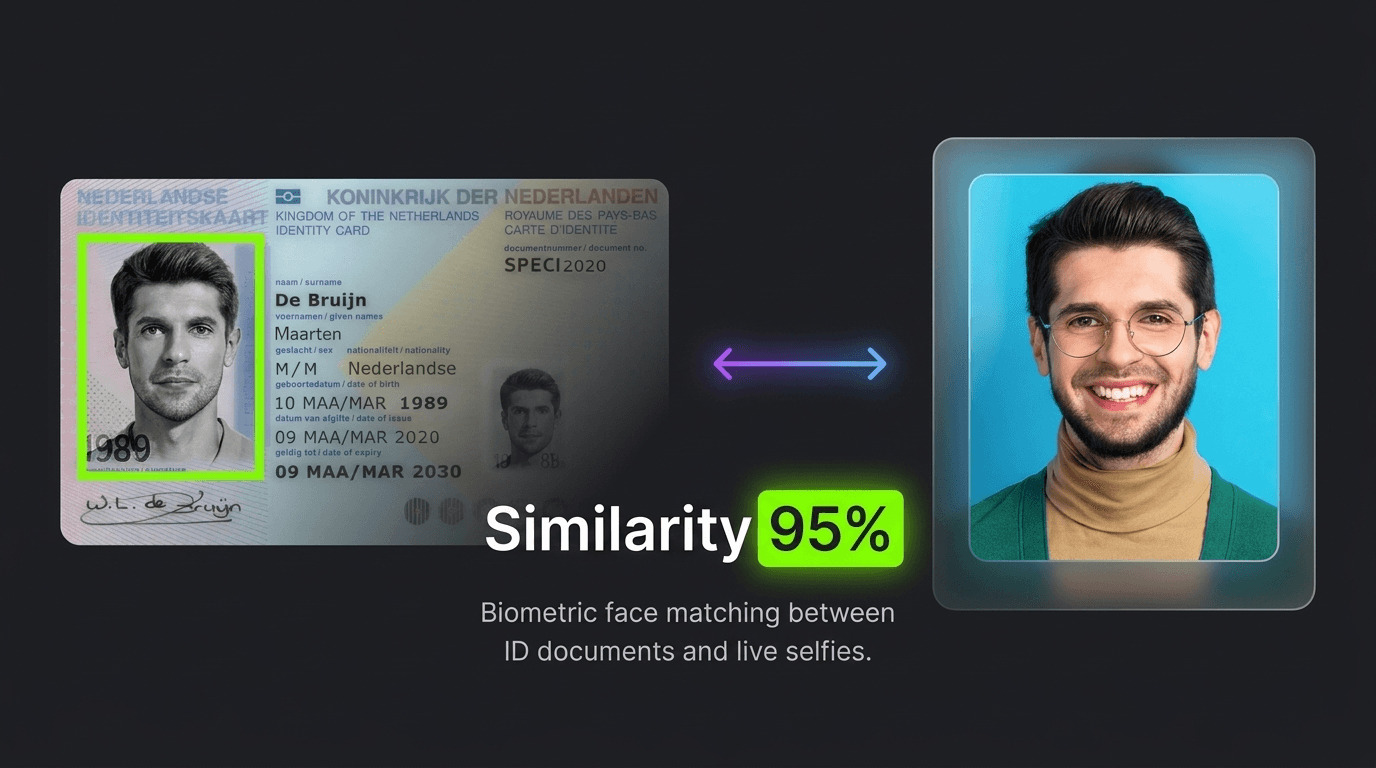
The role of facial recognition in identity verification extends beyond a simple photo comparison. It operates as one layer within a multi-layered verification process where each layer addresses a specific fraud vector.
Document verification establishes that the submitted identity document is genuine: the layout, security features, typography, and data formatting match the expected template for that document type and issuing country. But an authentic document in the wrong hands is still a fraud risk. A stolen passport is a genuine document being used by someone other than its rightful holder.
Facial recognition addresses this risk. The system extracts the photograph from the verified document and compares it to a live selfie provided by the customer. If the faceprints match within the configured threshold, the system confirms that the person completing the verification is the document holder. This biometric binding between person and document is what transforms document authentication into identity verification.
Liveness detection is the essential companion to facial recognition in this workflow. Without liveness detection, an attacker could present a photograph, a screen replay, or a deepfake video of the document holder's face and pass the biometric match. Passive liveness detection analyzes the captured image for physiological indicators of a live person, including skin texture, depth characteristics, light reflection patterns, and micro-movements, without requiring the user to perform any prompted action. Active liveness detection adds randomized prompts (head turns, blinks, specific expressions) that are difficult for static or pre-recorded attacks to reproduce.
NFC chip reading provides the highest-assurance reference for biometric matching. E-passports and chip-enabled national ID cards store the holder's facial image on an NFC chip, signed with a cryptographic certificate from the issuing government. When this chip image is used as the reference for the biometric comparison instead of the printed document photograph, the system gains two advantages: the reference image is guaranteed authentic (it cannot be physically altered or replaced without breaking the cryptographic signature), and it is typically a higher-resolution, higher-quality image that improves matching accuracy.
The combination of document verification, facial recognition with liveness detection, and NFC chip reading creates a verification process where each layer reinforces the others. Compromising one layer is insufficient to defeat the verification: a forged document will fail document authentication, a stolen document will fail biometric matching, a presentation attack will fail liveness detection, and a deepfake injection will fail if the reference image comes from a cryptographically validated NFC chip.
Facial Recognition Accuracy and Limitations
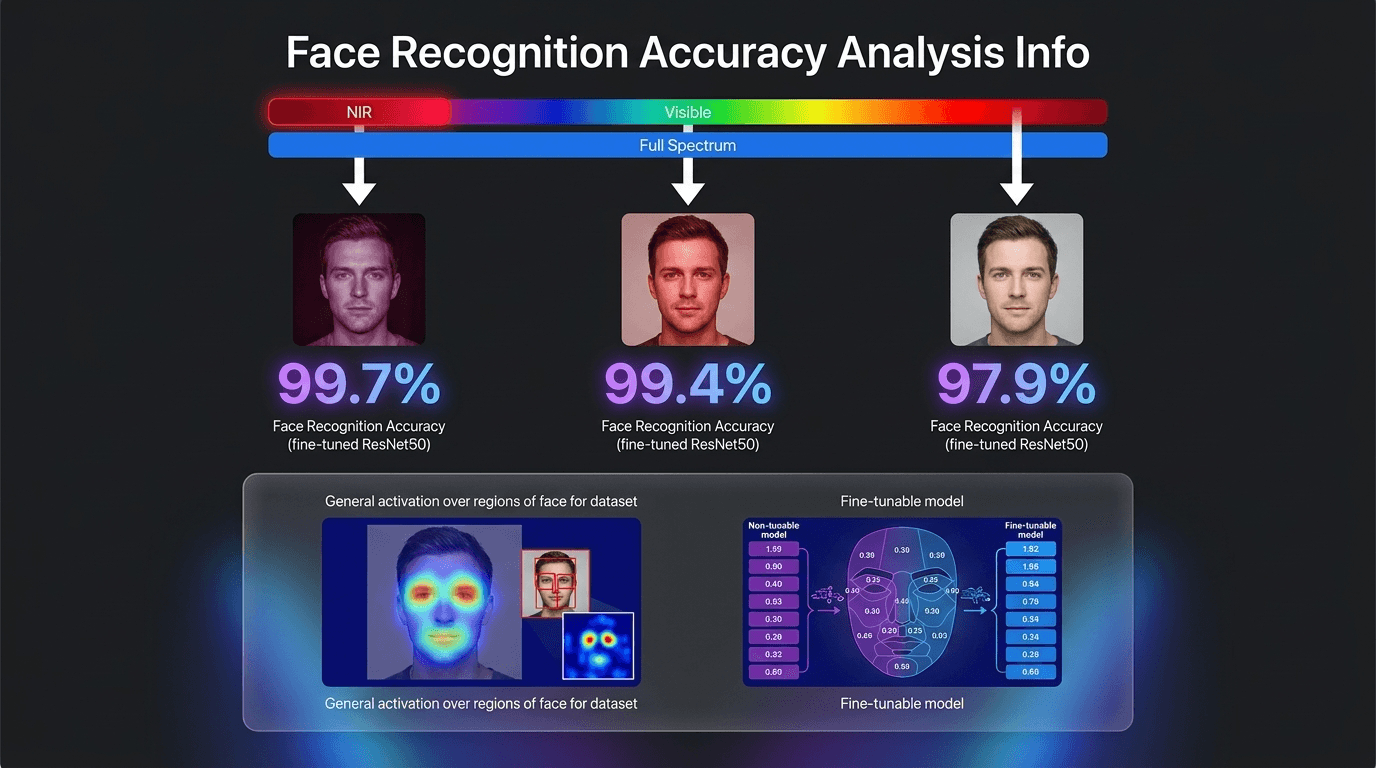
The accuracy of facial recognition technology has improved dramatically over the past decade. The National Institute of Standards and Technology (NIST) conducts the Face Recognition Vendor Test (FRVT), the most authoritative benchmark for facial recognition algorithm performance. NIST testing has documented that the best-performing algorithms achieve false non-match rates below 0.2% at a false match rate of one in one million, representing a significant improvement from error rates that were orders of magnitude higher a decade earlier.
Several factors affect accuracy in practice. Image quality is the most significant: well-lit, frontal photographs with sufficient resolution produce substantially better results than images captured in poor lighting, at oblique angles, or at low resolution. This is why identity verification systems that guide the user through a structured selfie capture process (ensuring adequate lighting, correct positioning, and sufficient image quality before accepting the sample) achieve higher accuracy than uncontrolled image capture.
Demographic performance variation has been a significant area of scrutiny. Earlier generations of facial recognition algorithms exhibited measurably different accuracy rates across demographic groups, with higher error rates for certain skin tones, ages, and genders. NIST studies have documented these disparities. The top-performing algorithms in recent FRVT evaluations have substantially narrowed these gaps, but the issue remains an active area of research and a legitimate concern that businesses should evaluate when selecting a facial recognition provider.
Environmental and temporal factors also affect performance. Aging can cause a faceprint to drift from the original enrollment image over time. Changes in appearance, such as significant weight change, facial hair, or cosmetic procedures, can affect matching scores. Verification systems mitigate these factors through periodic re-enrollment and through algorithms specifically trained to handle intra-person variation.
In the controlled environment of identity verification, where the user provides a guided selfie and the reference image comes from a high-quality document photograph or NFC chip, accuracy rates are significantly higher than in uncontrolled surveillance scenarios. The verification context eliminates many of the variables, such as extreme angles, poor lighting, long distances, and low-resolution capture, that degrade accuracy in other facial recognition applications.
Privacy and Ethical Considerations

Facial recognition operates on biometric data, which carries heightened privacy sensitivity because it is inherently personal, cannot be changed if compromised, and can be used to identify individuals without their knowledge or consent.
Regulatory frameworks reflect this sensitivity. Under GDPR, biometric data processed for the purpose of uniquely identifying a natural person is classified as special category data under Article 9, requiring explicit consent or another specific legal basis for processing. The Illinois Biometric Information Privacy Act (BIPA) requires informed written consent before collection, prohibits the sale of biometric data, mandates retention and destruction schedules, and provides a private right of action that has resulted in significant litigation and settlements. Texas CUBI, Washington state's biometric privacy law, and an expanding set of state-level statutes impose similar requirements with varying enforcement mechanisms.
The EU AI Act introduces a risk-based classification for facial recognition systems. Real-time remote biometric identification in public spaces for law enforcement is classified as prohibited (with narrow exceptions). Post-remote biometric identification for law enforcement is classified as high-risk. Identity verification systems that perform 1:1 biometric matching at the user's initiation are treated under a different risk framework, reflecting the fundamental operational difference between surveillance and verification.
This regulatory distinction maps directly to operational practice. Identity verification systems that use facial recognition in 1:1 mode, process biometric data only for the duration of the verification session, do not build or maintain facial recognition databases, and obtain explicit user consent before capture operate within a clearly defined regulatory boundary. Businesses that implement facial recognition for identity verification should ensure their systems follow data minimization principles: capture the biometric sample, perform the comparison, return the match result, and delete the biometric data. A system that confirms "this selfie matches this document photo" without retaining the faceprint beyond the verification session satisfies the verification requirement while minimizing the privacy footprint.
The ethical debate around facial recognition is substantive and legitimate. But much of it centers on 1:N identification and mass surveillance applications, not on 1:1 verification initiated by the user. For regulated businesses, understanding this distinction is essential to implementing facial recognition in a way that meets both compliance obligations and privacy expectations.
Facial Recognition - FAQ
What is facial recognition in simple terms?
How does facial recognition technology work?
What is the difference between facial recognition and facial verification?
Is facial recognition accurate?
Is facial recognition legal?
How is facial recognition used in identity verification?
Qoobiss ONTRACE uses facial recognition as the biometric matching layer within its identity verification workflow. During onboarding, the customer's live selfie is compared against the photograph extracted from their verified identity document using deep learning-based facial matching algorithms. Passive liveness detection, trained to identify presentation attacks and deepfake artifacts, confirms the selfie originates from a live person present at the time of verification. For chip-enabled documents, NFC chip reading provides a cryptographically signed facial image as the reference for biometric comparison, delivering the highest available matching assurance. The biometric data is processed for the verification session and not retained beyond it.
Request a demo at qoobiss.com to see how ONTRACE integrates facial recognition into your identity verification workflow.