Age Verification: What It Is, How It Works, and What Businesses Need to Know

Age Verification: Why it matters for your business
Age-restricted products and services have always required some form of age check. A bartender asks to see a driver's license. A pharmacy checks identification before dispensing certain medications. A casino verifies that patrons meet the minimum gambling age before they enter the floor. These interactions are straightforward when they happen in person, but the shift to digital channels has transformed age verification from a visual inspection at a counter into a technology and compliance challenge that affects every industry serving customers online.
The regulatory momentum behind age verification is accelerating. In the United States, more than a dozen states have passed age verification laws for online platforms. The EU's Digital Services Act imposes obligations on platforms accessible to minors. The UK's Online Safety Act mandates age assurance for certain categories of online content. Australia has launched age verification pilots for adult content platforms. For regulated businesses, age verification is not limited to restricting access to content. It is a compliance obligation embedded in KYC onboarding, gambling licensing, alcohol and tobacco e-commerce, and financial services.
This guide covers what age verification is, the methods businesses use to implement it, the regulatory landscape across major jurisdictions, how age verification applies across industries, and the privacy considerations that businesses need to balance against compliance requirements.
What Is Age Verification?
Age verification is the process of confirming that a person meets a minimum age requirement before they can access a product, service, or content category. The concept is simple. The implementation, in a digital context where the business cannot physically inspect a document, is considerably more complex.
A critical distinction exists between age verification and age estimation, which are sometimes grouped under the broader term "age assurance."
Age verification confirms age against an authoritative source, typically a government-issued identity document that contains the holder's date of birth. The result is a definitive answer: the person is or is not above the required age threshold, based on data from a trusted issuing authority.
Age estimation, by contrast, infers a person's approximate age from indirect signals. The most common approach uses AI-powered facial analysis to estimate an age range from a selfie or video frame. Other estimation methods include behavioral analysis, device-level signals, and third-party data matching. Age estimation does not require documentary evidence and is less intrusive from a data collection perspective, but it produces a probabilistic result rather than a confirmed age.
This distinction matters because regulatory requirements increasingly specify the level of assurance needed. Some mandates accept age estimation as a proportionate approach for lower-risk scenarios. Others, particularly in gambling, financial services, and increasingly for adult content access, require documentary age verification that establishes age from an authoritative source. Businesses need to understand which standard applies to their use case, because the method chosen determines both the compliance outcome and the user experience.
Age Verification Methods
Self-Declaration
The simplest and least reliable age verification method is self-declaration: asking the user to enter a date of birth or check a box confirming they are above the required age. This approach has been the default for most websites and online services for decades. It provides no actual verification because nothing prevents a user from entering a false date of birth.
Self-declaration is increasingly insufficient for regulatory compliance. Age verification laws in the United States, the UK, and the EU explicitly require methods that go beyond self-declaration for services that carry meaningful age-restriction obligations. For regulated businesses, self-declaration does not constitute age verification in any compliance-relevant sense.
Credit Card Verification
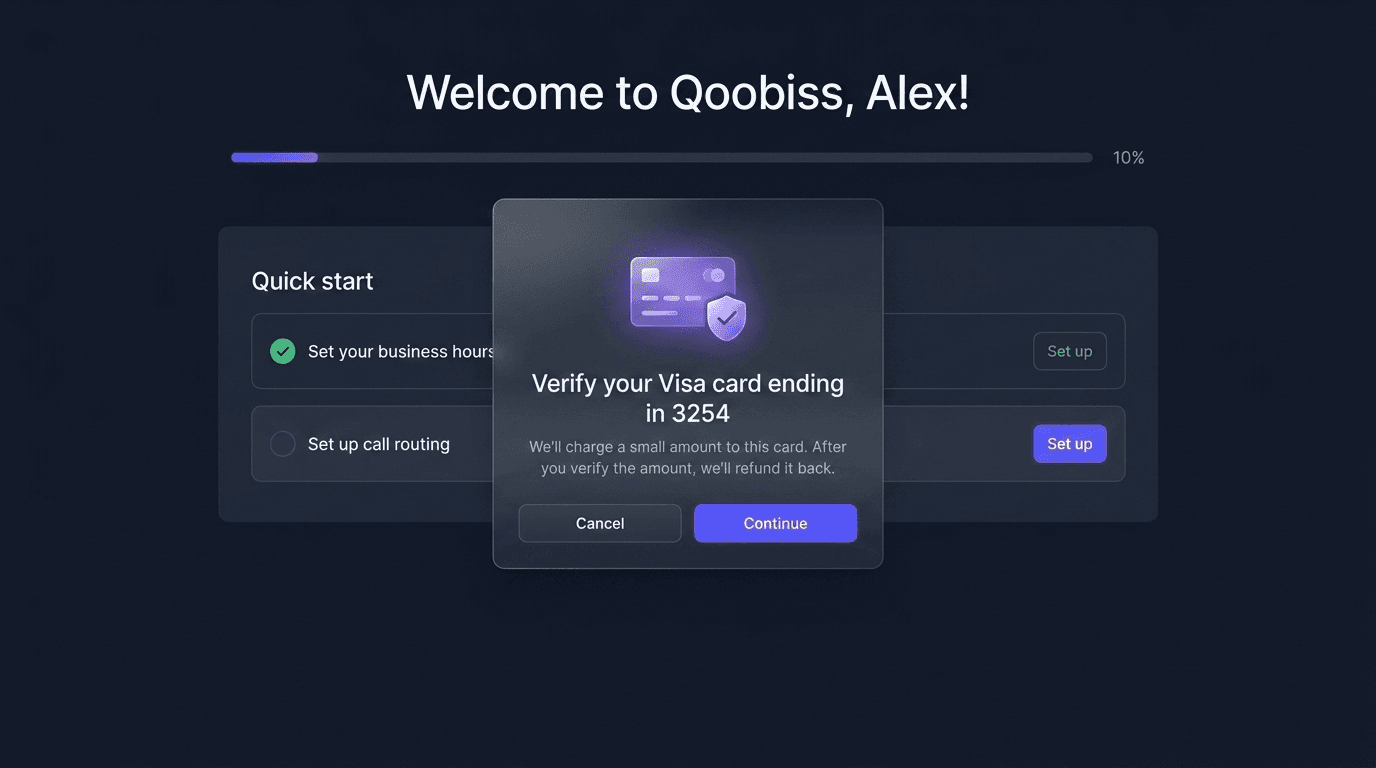
Using a credit card as a proxy for age verification relies on the assumption that credit cards are issued only to individuals aged 18 or older (or 16 in some jurisdictions). A payment transaction or card authorization check serves as indirect evidence of age.
Credit card verification offers moderate assurance. It confirms that the user has access to an adult financial instrument, but it does not confirm the exact age of the person using it. A minor using a parent's card would pass the check. Additionally, some jurisdictions, including France and Italy, do not accept credit card verification as a valid age verification method under their regulatory frameworks.
Document-Based Verification
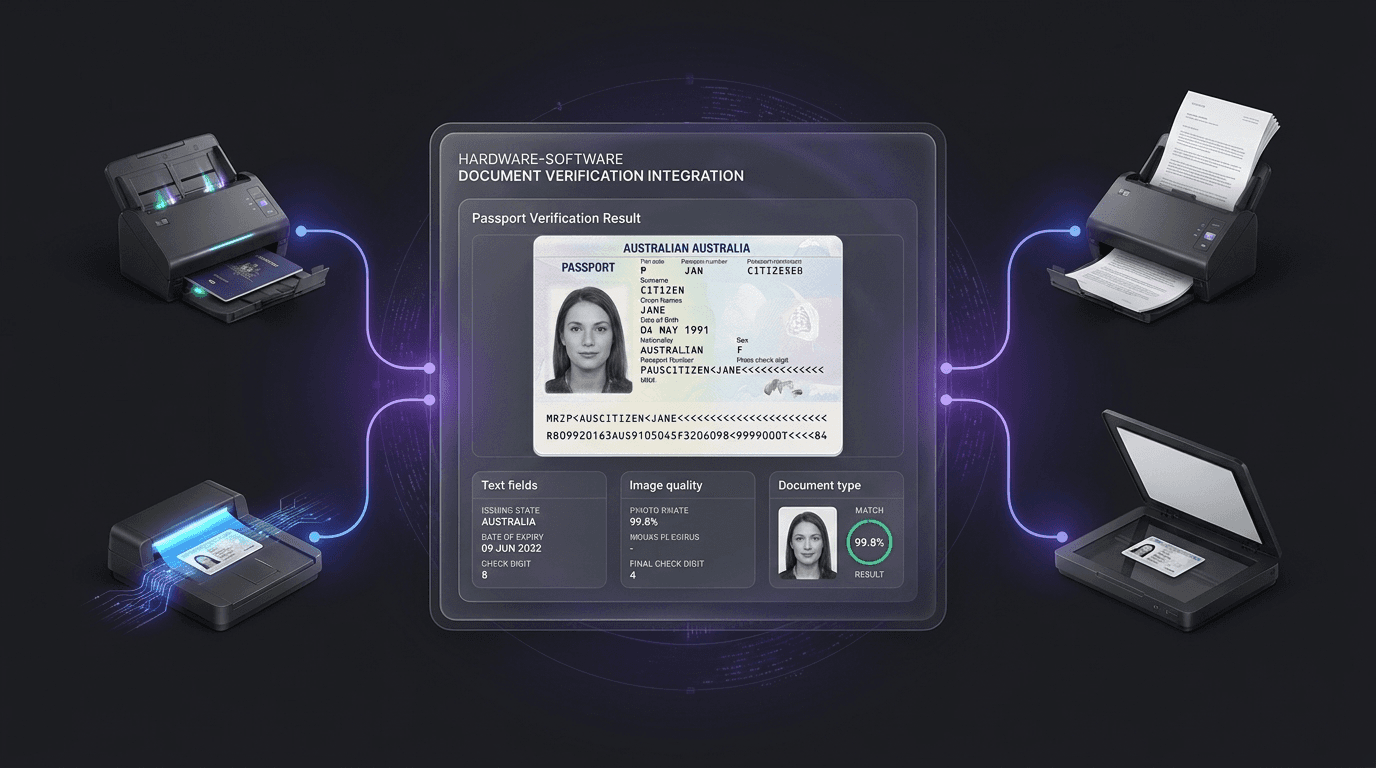
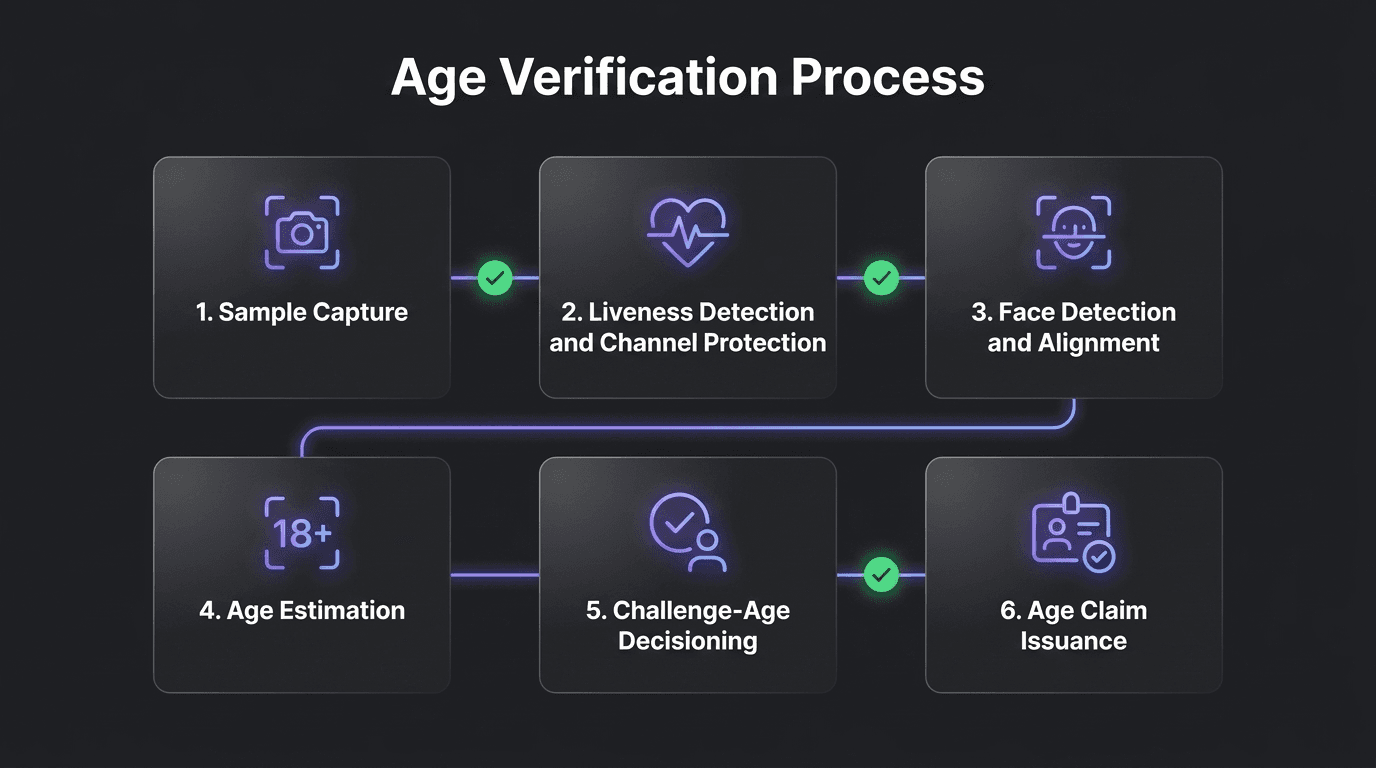
Document-based age verification requires the user to submit a government-issued identity document, such as a passport, driver's license, or national ID card. The verification system captures the document image, extracts the date of birth through OCR, and confirms the document's authenticity through template matching and security feature analysis.
This method provides the highest assurance level for age confirmation because the date of birth is sourced from an authoritative government-issued document. When combined with biometric matching (comparing a selfie to the document photo), it also confirms that the person submitting the document is the person it was issued to, preventing borrowed documents from being used.
For chip-enabled documents such as e-passports and national ID cards, NFC chip reading adds a further layer. The date of birth stored on the chip is cryptographically signed by the issuing government, providing definitive proof of age that cannot be altered or forged.
Facial Age Estimation
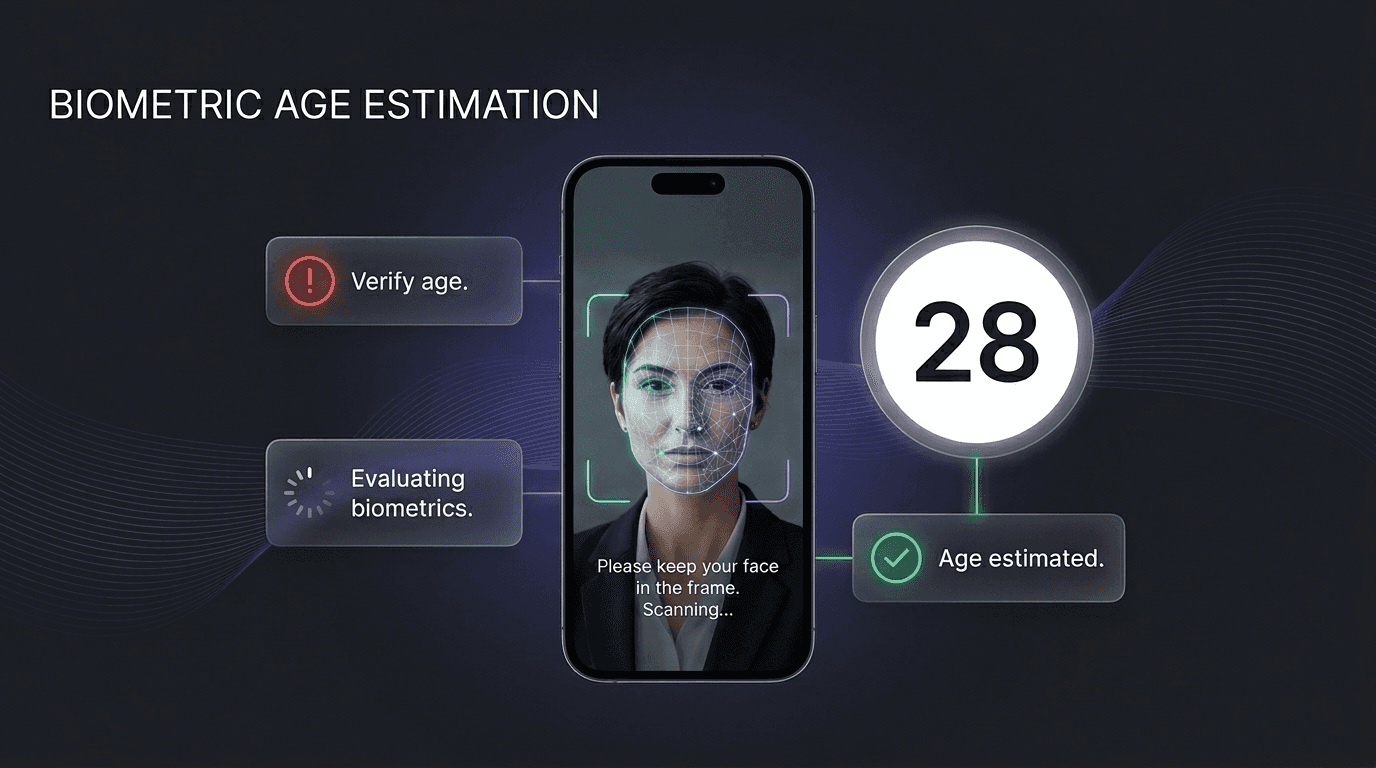
AI-powered facial age estimation analyzes a user's facial features from a selfie or video frame to predict their approximate age. The technology uses deep learning models trained on large datasets to estimate age based on facial geometry, skin texture, and other visual indicators.
Facial age estimation is privacy-preserving in the sense that it does not require the user to submit an identity document or disclose personal information beyond a facial image (which can be processed and immediately discarded). However, the result is an estimate with a margin of error, not a confirmed age. This makes it suitable for scenarios where approximate age determination is acceptable, but insufficient where regulatory requirements demand definitive age confirmation.
Digital Identity and Reusable Credentials
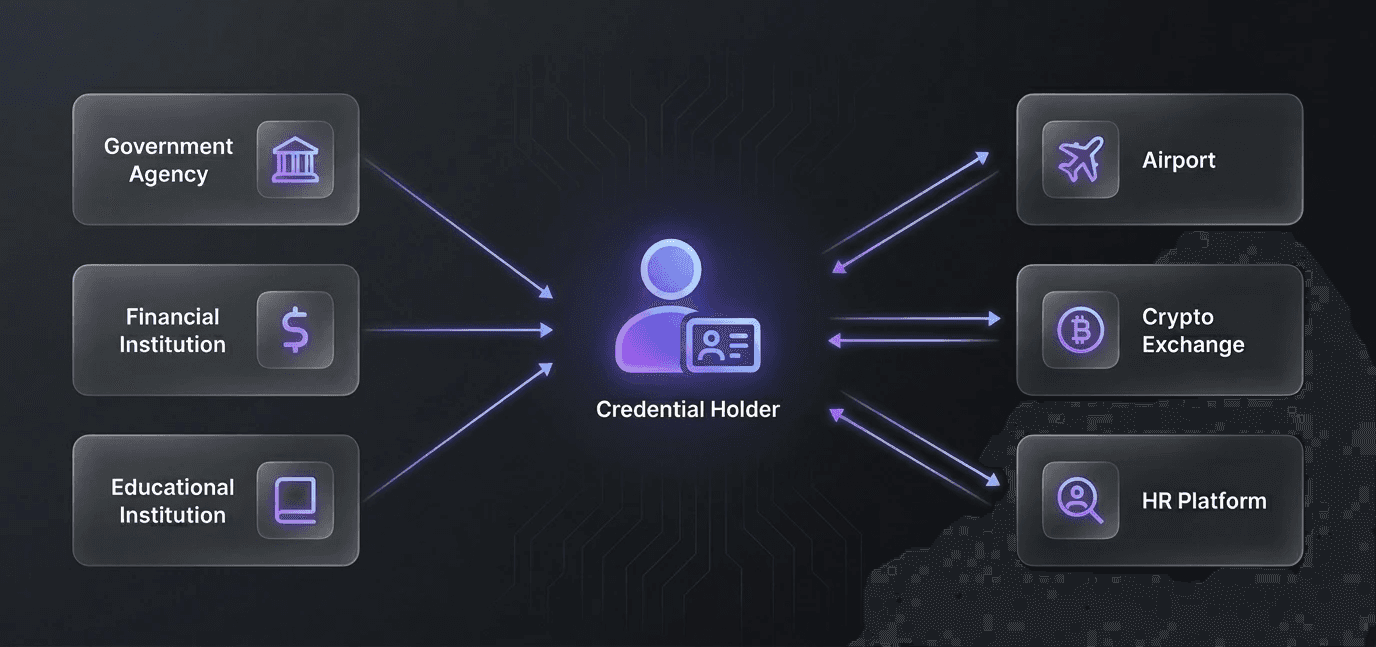
An emerging approach to age verification uses pre-verified digital identity credentials. Under this model, a user verifies their age once through a robust method (document verification, for example) and receives a digital credential or age token that can be reused across multiple services. The credential confirms "over 18" (or another age threshold) without requiring the user to re-submit identity documents or personal data for each service.
The European Digital Identity Wallet under eIDAS 2.0 and the UK's Digital Identity and Attributes Trust Framework both support this approach. As these frameworks mature, reusable age credentials are expected to become a primary age verification channel, reducing friction for users and data collection burden for businesses.
Age Verification Laws and Regulations
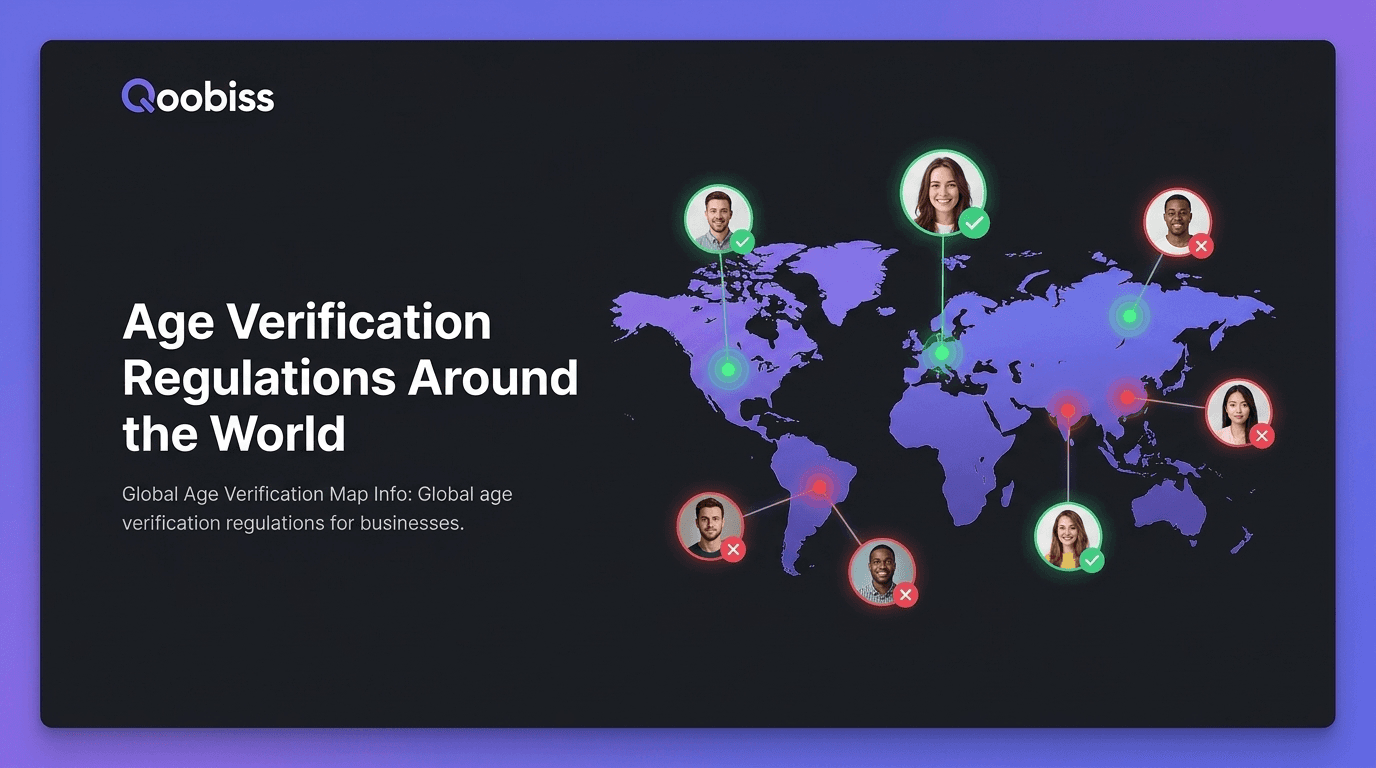
United States 🇺🇸
The US does not have a single federal age verification law. Instead, a rapidly expanding patchwork of state-level legislation governs age verification requirements, primarily for online platforms providing adult content but increasingly extending to social media and other services.
Louisiana's Act 440, effective in 2023, was among the first state laws to mandate age verification for adult content websites. Texas followed with HB 1181, requiring commercial entities distributing material harmful to minors to verify user ages through government-issued identification or commercially reasonable verification methods. Virginia, Mississippi, Utah, Montana, Arkansas, and several other states have enacted similar legislation, each with variations in scope, method requirements, and penalties.
California has taken a different approach. AB 1043 requires age verification at the operating system level, placing the obligation on device manufacturers and OS providers rather than individual websites. This model would shift age verification upstream, making it a platform-level feature rather than a site-by-site implementation.
At the federal level, COPPA (Children's Online Privacy Protection Act) requires parental consent for the collection of personal information from children under 13, which includes an age determination step. Proposed federal legislation, including the Kids Online Safety Act (KOSA), would impose additional obligations, but no comprehensive federal age verification mandate has been enacted as of 2026.
European Union 🇪🇺
The EU addresses age verification through multiple regulatory instruments. The Digital Services Act (DSA) requires very large online platforms to assess and mitigate risks to minors, which includes implementing age-appropriate access measures. The Audiovisual Media Services Directive (AVMSD) mandates that on-demand video platforms implement age verification for content that could impair minors' development.
The forthcoming European Digital Identity Wallet under eIDAS 2.0 is expected to become a primary mechanism for age verification across EU services. The wallet will allow users to share a verified age attribute (confirming they are above a specific threshold) without disclosing their full date of birth or other personal data, directly addressing the privacy concerns associated with document-based age verification.
United Kingdom 🇬🇧
The UK's Online Safety Act, which received Royal Assent in 2023, imposes duties on providers of regulated user-to-user services and search services to protect children from harmful content. For services that publish or allow user-generated pornographic content, the Act requires robust age verification.
The UK government has also established the Digital Identity and Attributes Trust Framework, which certifies digital identity providers that meet defined standards for identity verification, including age verification. The ICO's Age Appropriate Design Code (Children's Code) imposes additional obligations on online services likely to be accessed by children, requiring them to implement age-appropriate design and, in some cases, age assurance measures.
Other Jurisdictions 🌎
Australia launched an age verification pilot in 2024 to test age assurance technologies for restricting minors' access to adult content online, with legislation requiring platforms to implement age verification measures. Germany's Jugendmedienschutz-Staatsvertrag (Youth Media Protection Treaty) has mandated age verification for adult content since its introduction, requiring systems that provide assurance equivalent to face-to-face identity verification.
The compliance challenge for businesses operating across multiple jurisdictions is that different countries mandate different methods and assurance levels. A method accepted in one jurisdiction may not satisfy requirements in another, which means businesses need verification infrastructure flexible enough to meet the strictest applicable standard.
Age Verification Across Industries
Online gambling and gaming. Age verification is a licensing requirement for gambling operators in virtually every regulated jurisdiction. Gambling commissions typically require documentary age verification at account registration, before any real-money activity can occur. The UK Gambling Commission, Malta Gaming Authority, and state gaming commissions in the US all mandate identity and age verification as conditions of operator licensing.
Alcohol and tobacco e-commerce. Online retailers selling age-restricted products must verify the buyer's age both at the point of purchase and, in many jurisdictions, at the point of delivery. This creates a two-step verification requirement that extends the age check beyond the digital transaction into the physical fulfillment process.
Financial services. Age verification is inherently part of KYC onboarding in banking and financial services. Minimum age requirements for opening accounts, applying for credit, and entering into financial contracts mean that every identity verification process includes an age determination step. For financial institutions, age verification is not a separate compliance obligation; it is embedded in the broader identity verification workflow.
Social media and online platforms. The DSA, the UK Online Safety Act, and US state laws are collectively driving age verification requirements onto social media platforms. These obligations range from age-gating specific content categories to verifying all users' ages at account creation. The scale of these platforms (billions of users) makes the choice of verification method particularly consequential for both user experience and operational cost.
Adult content. This is the highest-profile use case driving current legislative activity. State-level laws in the US, the UK Online Safety Act, and Australian legislation all target adult content platforms with specific age verification mandates. The requirements have shifted the industry from self-declaration (clicking "I am 18") toward document-based or facial estimation methods that provide meaningful assurance.
Telecommunications. SIM registration regulations in multiple jurisdictions include age verification requirements, particularly where prepaid SIM cards are sold without traditional account-opening processes. Identity verification at the point of SIM activation inherently includes age determination from the submitted identity document.
How Identity Verification Delivers Age Verification
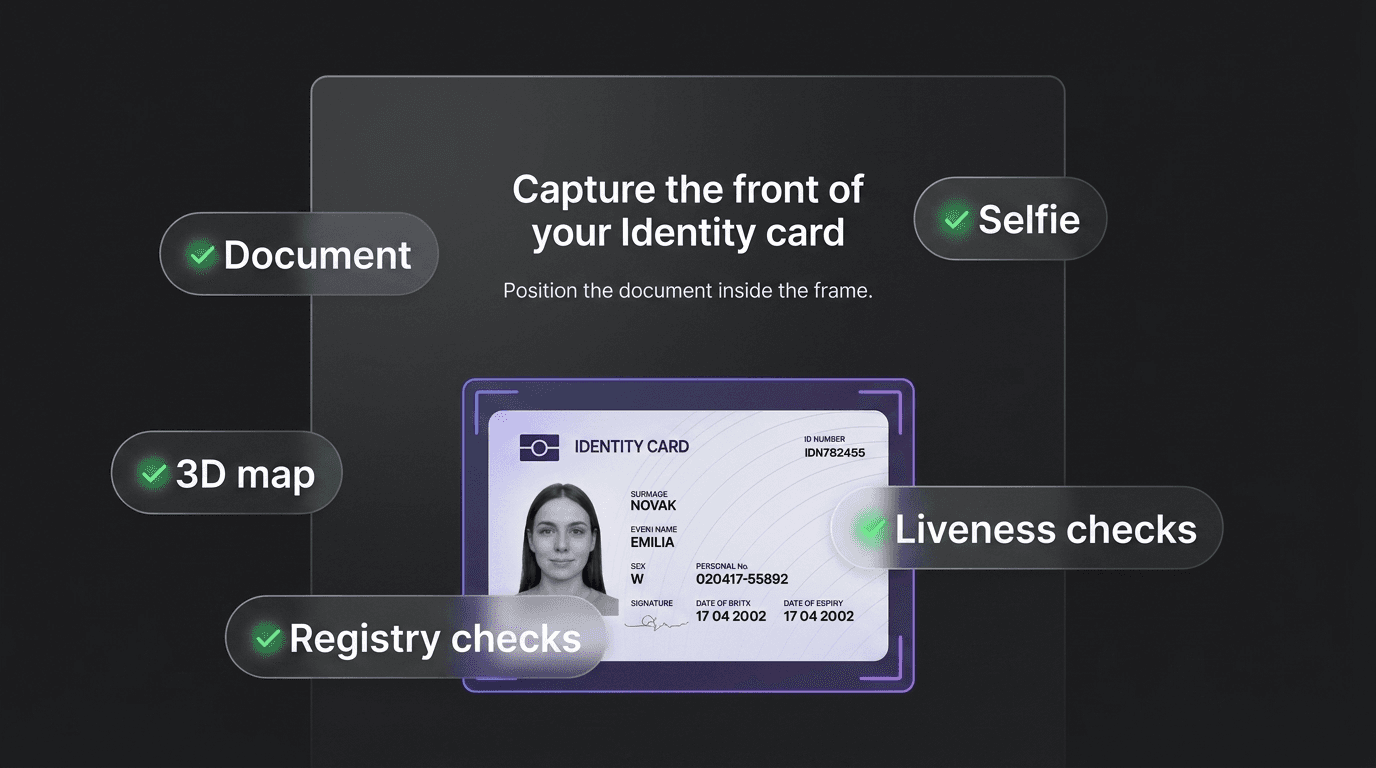
For businesses already performing identity verification for KYC or regulatory compliance, age verification is not a separate problem requiring a separate solution. When a customer's identity is verified through document verification, the date of birth is extracted and confirmed as part of the standard process. The same workflow that authenticates the document, matches the biometric, and screens the customer against sanctions databases also determines the customer's age with the highest available level of assurance.
This means that businesses performing KYC onboarding already have age verification built into their identity verification workflow. A financial institution verifying a customer's passport during account opening does not need a separate age verification step; the customer's date of birth has already been extracted from a government-issued document and confirmed through document authentication.
For businesses that need age verification without requiring full identity verification, such as content platforms or social media services, the same document-based technology can be configured to extract only the date of birth without storing or retaining the customer's full identity data. This approach satisfies regulatory requirements for documentary age verification while addressing data minimization principles under GDPR and similar privacy frameworks.
NFC chip reading adds the highest tier of assurance. When a user's date of birth is read from the cryptographically signed chip of an e-passport or national ID card, the age confirmation is backed by a digital signature from the issuing government. No other age verification method can match this level of certainty.
Privacy Considerations in Age Verification
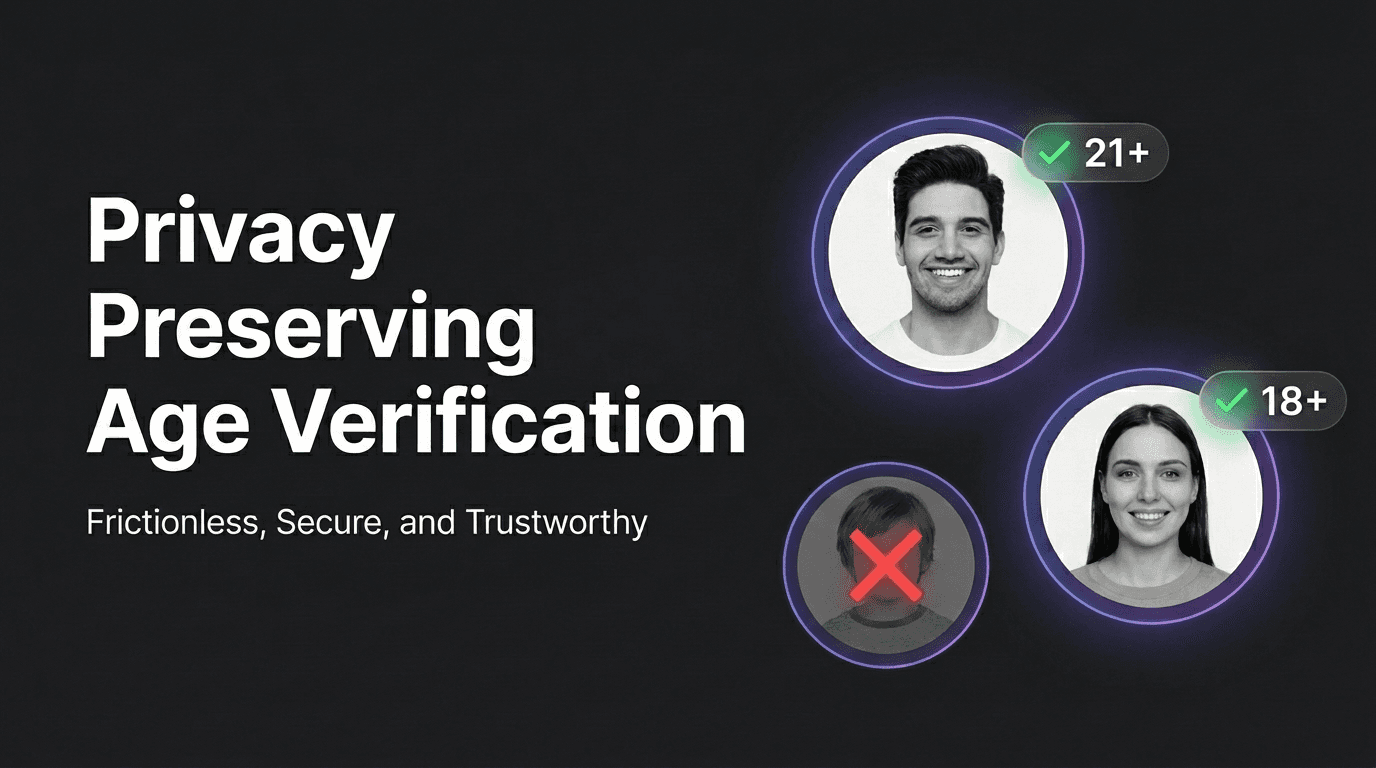
Age verification operates in an inherent tension between effective compliance and user privacy. Confirming a person's age with high assurance typically requires collecting personal data, whether that is a document image, a selfie, or a transaction record. Privacy advocates have raised legitimate concerns about the data collection, storage, and surveillance implications of mandatory age verification, particularly at the scale required for platforms with millions or billions of users.
Data minimization is the primary principle for managing this tension. Where full identity verification is not required, age verification systems should collect only the information necessary to confirm the age threshold and discard or avoid storing identity data that is not needed for the compliance purpose. A system that confirms "this user is over 18" without retaining the user's name, document number, or facial image satisfies the age verification requirement while minimizing privacy impact.
Privacy-preserving approaches are advancing. Zero-knowledge proofs and verifiable credentials can cryptographically confirm that a user meets an age threshold without disclosing the underlying date of birth or identity data to the relying party. The European Digital Identity Wallet is designed to support exactly this type of selective disclosure: sharing a verified age attribute without revealing additional personal information.
For businesses collecting biometric data during facial age estimation, GDPR (which classifies biometric data as special category data), US state biometric privacy laws such as Illinois BIPA, and similar regulations impose consent, notice, and data handling obligations. The choice of age verification method directly affects the regulatory burden the business assumes, which makes it a decision with both compliance and privacy implications.
Age Verification - FAQ
What is age verification in simple terms?
What is the difference between age verification and age estimation?
What age verification methods are most reliable?
Which US states have age verification laws?
Can age verification be done without collecting personal data?
How does age verification work for online gambling?
Qoobiss ONTRACE includes age verification as an integrated component of its identity verification workflow. During document verification, the customer's date of birth is extracted from the submitted government-issued document and confirmed through document authentication, biometric matching, and where available, NFC chip reading. For businesses that require age verification without full identity verification, ONTRACE can be configured to confirm age thresholds while minimizing the personal data collected and retained. Whether the requirement is KYC onboarding in financial services, age-gating for online gambling, or regulatory compliance for content platforms, ONTRACE provides the documentary age verification that current legislation demands.
Request a demo at qoobiss.com to see how age verification fits into your compliance workflow.