Biometric Verification: How It Works and Why It's Key to Identity Security


Passwords can be stolen. Documents can be forged. Knowledge-based authentication questions can be guessed or socially engineered. Biometric verification exists because traditional identity verification methods all share the same fundamental limitation: they verify something a person has or knows, not who the person actually is.
For regulated businesses performing customer onboarding, the shift toward biometric verification is driven by two converging pressures. First, remote and digital onboarding has become the default channel for financial services, fintech, crypto platforms, and telecommunications providers, which means identity must be verified without a physical interaction. Second, the sophistication of identity fraud, including AI-generated fake documents and synthetic identities, has outpaced what document checks alone can reliably detect. Biometric verification closes that gap by confirming that the person presenting an identity document is the same person depicted on it.
This guide covers what biometric verification is, how it differs from biometric authentication, the types of biometrics used in identity verification, how biometric verification systems work technically, the role of liveness detection, where biometrics are used across regulated industries, and the compliance considerations businesses need to manage.
What Is Biometric Verification?
Biometric verification is the process of confirming a person's claimed identity by comparing a captured biometric sample against a stored reference template. The biometric verification meaning, in both technical and compliance contexts, is a one-to-one comparison: the system asks “is this person who they say they are?” and answers by measuring how closely a live biometric sample matches a reference linked to that specific identity.
This is distinct from biometric identification, which performs a one-to-many search across a database of biometric templates to answer a different question: “who is this person?” Identification does not require the person to claim an identity first. It searches for a match across all stored records. Verification starts with a claimed identity and checks whether the biometric sample confirms it.
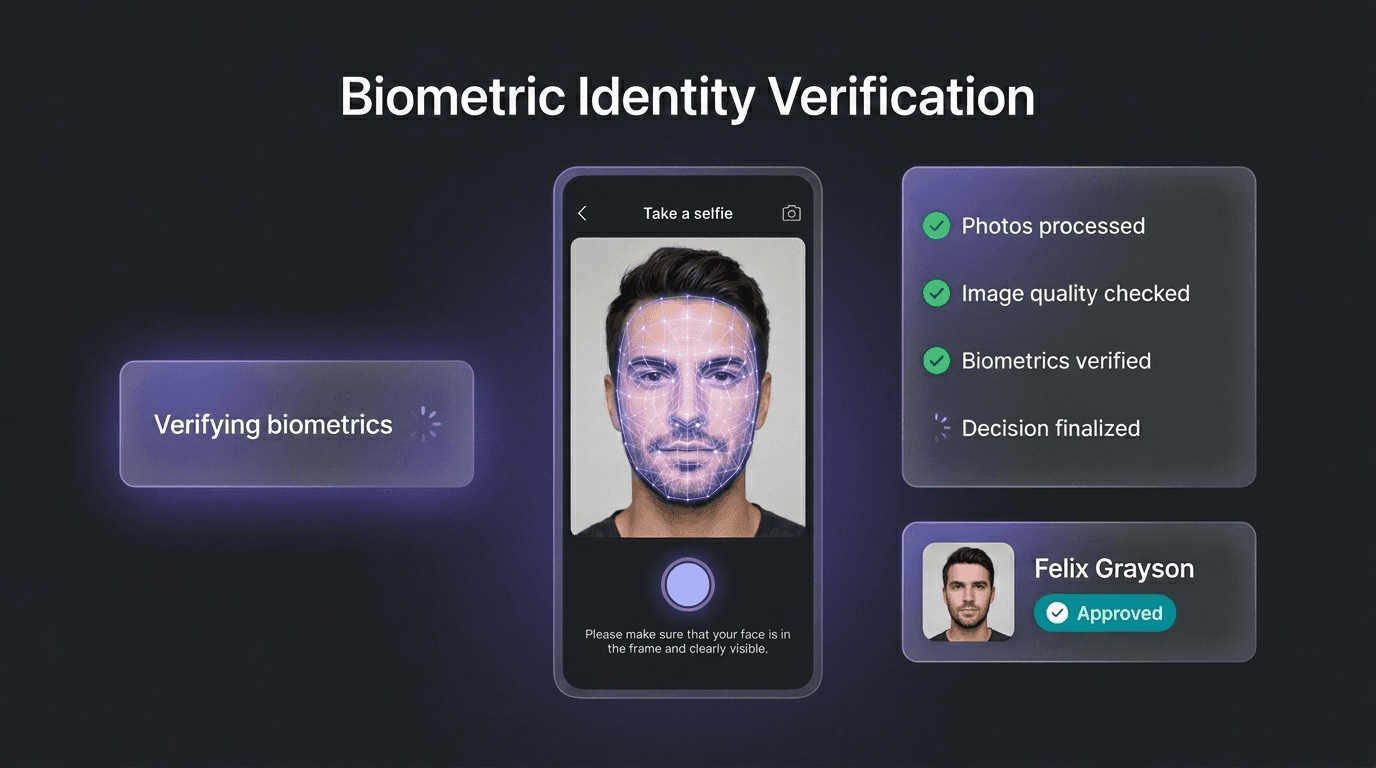
In identity verification workflows, biometric verification typically operates as one layer within a broader process. A customer submits an identity document (passport, driver’s license, national ID card), and the system extracts the photograph from the document. The customer then provides a live biometric sample, most commonly a selfie captured through a smartphone camera. The verification system compares the two, determining whether the face in the selfie matches the face on the document with sufficient confidence to confirm that the person holding the document is the person depicted on it.
This document-to-selfie matching is the most common deployment of biometric verification in regulated industries, because it directly addresses the core onboarding question: is the person presenting this identity document actually the person it was issued to?
Biometric Authentication vs Biometric Verification
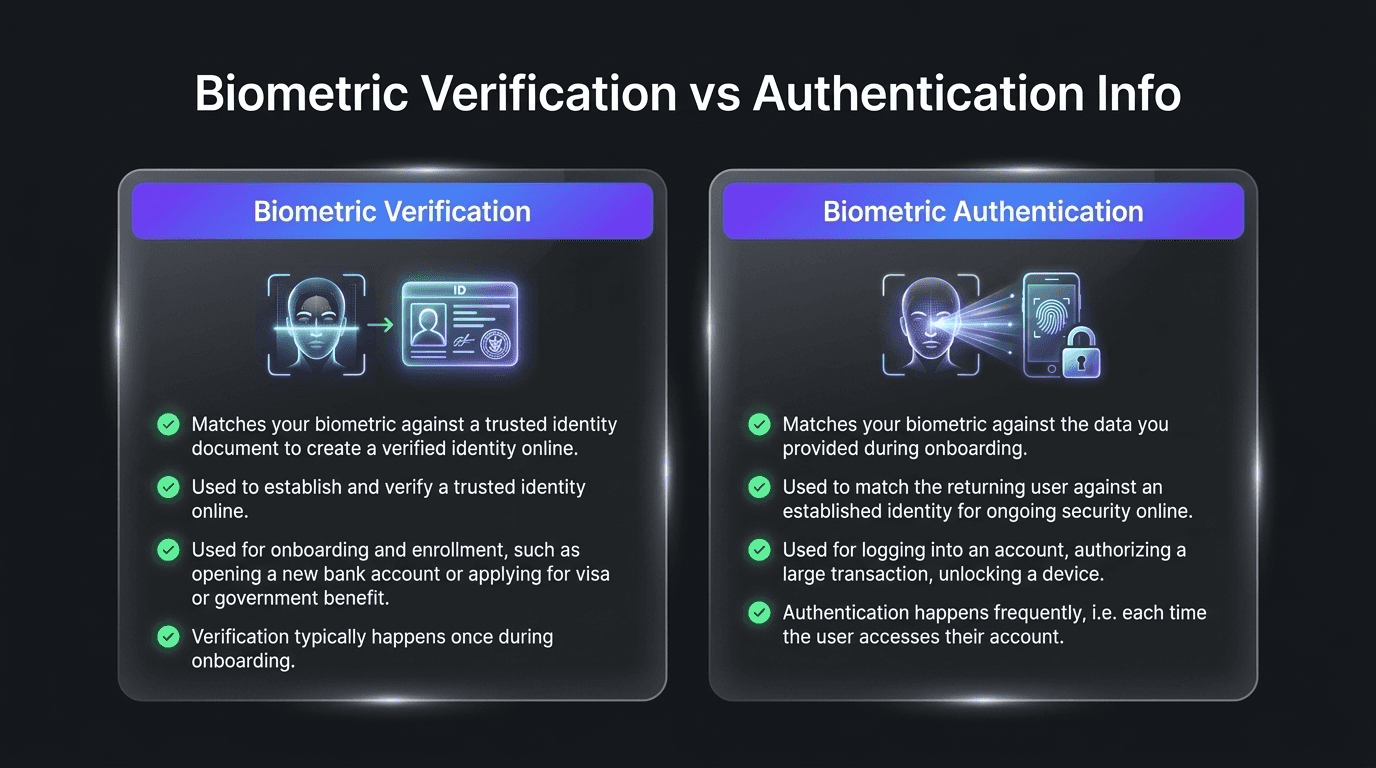
The terms biometric authentication and biometric verification are frequently used interchangeably, but they serve different purposes in identity workflows, and the distinction matters for compliance.
Biometric verification is an identity proofing process. It confirms that a person is who they claim to be, typically during onboarding or initial registration. The comparison is between a live biometric sample and a reference from a trusted source, such as a government-issued identity document. Verification establishes identity at the point of first contact.
Biometric authentication is a re-access process. It confirms that a returning user is the same person who previously enrolled. The comparison is between a live biometric sample and a template stored during a prior verification or enrollment event. Authentication assumes identity has already been established and simply checks continuity: “is this the same person who passed verification last time?”
For regulated businesses, the practical difference is significant. KYC and AML obligations require identity verification at onboarding, which means comparing the customer’s biometric data against an independent, authoritative source (typically a government-issued document).
Biometric authentication alone, without an initial identity proofing step, does not satisfy regulatory requirements because it only confirms consistency, not identity. A fraudster who enrolls with a stolen document and a matching selfie would pass every subsequent authentication check. The verification step, performed correctly at onboarding, is what prevents that scenario.
Types of Biometric Verification
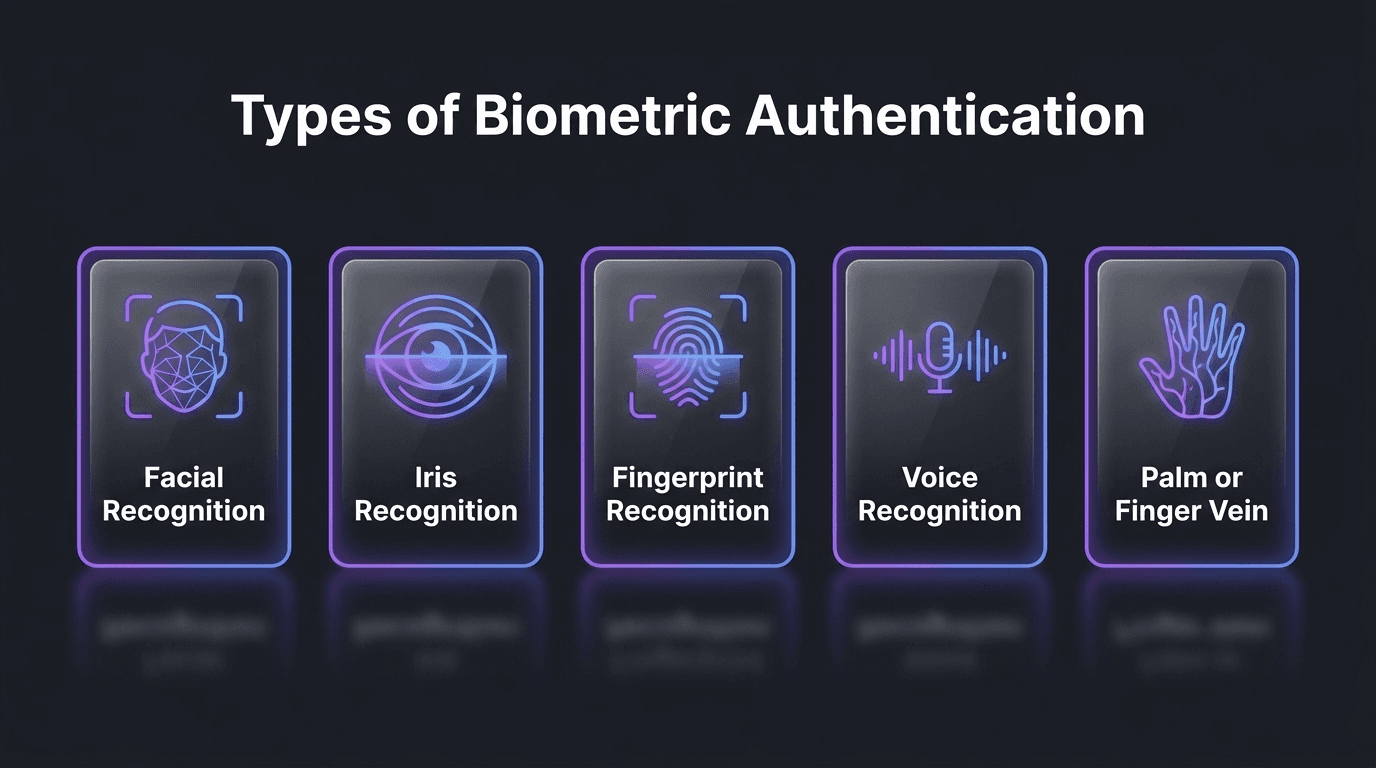
Facial Recognition
Facial biometric verification is the dominant modality in digital identity verification. It works by capturing an image of the person’s face, extracting a set of geometric measurements and facial features (the distance between eyes, the shape of the jawline, the proportions of the nose and cheekbones), and converting those features into a mathematical template. This template is then compared against the reference photograph extracted from the identity document.
Facial recognition has become the standard for remote verification because it requires only a standard camera, which every smartphone provides. No specialized hardware is needed. This makes it the most scalable and accessible biometric modality for customer onboarding across financial services, fintech, crypto exchanges, and other regulated industries. Modern facial recognition algorithms achieve accuracy rates above 99% under controlled conditions, though performance can be affected by lighting, image quality, and changes in appearance such as aging, glasses, or facial hair.
Fingerprint Verification
Fingerprint verification captures the unique ridge patterns on a person’s fingertip and compares them against a stored template. The technology is mature and widely deployed in physical access control, law enforcement, mobile device security, and national identity programs.
In the context of identity verification for regulated businesses, fingerprint biometrics are most commonly used where physical hardware is available: in-branch banking, border control, and government services. For remote digital onboarding, fingerprint verification is less practical because it requires a dedicated sensor rather than a standard camera, limiting its applicability in smartphone-first verification flows.
Iris and Retina Scanning
Iris recognition captures the complex patterns in the colored ring of the eye, which are unique to each individual and remain stable throughout life. The technology offers extremely high accuracy, with false match rates significantly lower than both facial recognition and fingerprint systems. Retina scanning, which maps the blood vessel pattern at the back of the eye, is even more precise but requires closer proximity to the scanning device.
Both modalities are used primarily in high-security environments: airport border control (notably the UAE and India), national identity programs, and government facilities. Their deployment in commercial identity verification remains limited due to the need for specialized hardware.
Voice Recognition
Voice biometric verification analyzes the characteristics of a person’s speech, including pitch, cadence, tone, and vocal tract shape, to create a voiceprint that can be compared against a stored reference. Voice verification is used in call center authentication for banking and financial services, where the customer’s voice serves as a passive authentication factor during phone interactions.
Voice biometrics are more susceptible to environmental interference (background noise, phone line quality) and can be affected by illness, aging, or emotional state, which makes them less reliable as a sole verification method. They are typically deployed as a supplementary layer rather than a primary identity verification modality.
Other Biometric Modalities
Additional biometric modalities include vein pattern recognition, which maps the vein structure beneath the skin of the palm or finger using infrared imaging; palm geometry, which measures the physical dimensions of the hand; and behavioral biometrics, which analyze patterns in how a person types, moves a mouse, holds a phone, or walks (gait analysis). Behavioral biometrics are particularly relevant for continuous authentication, detecting when a verified user’s behavior deviates from their established pattern, which may indicate account compromise.
How Biometric Verification Systems Work
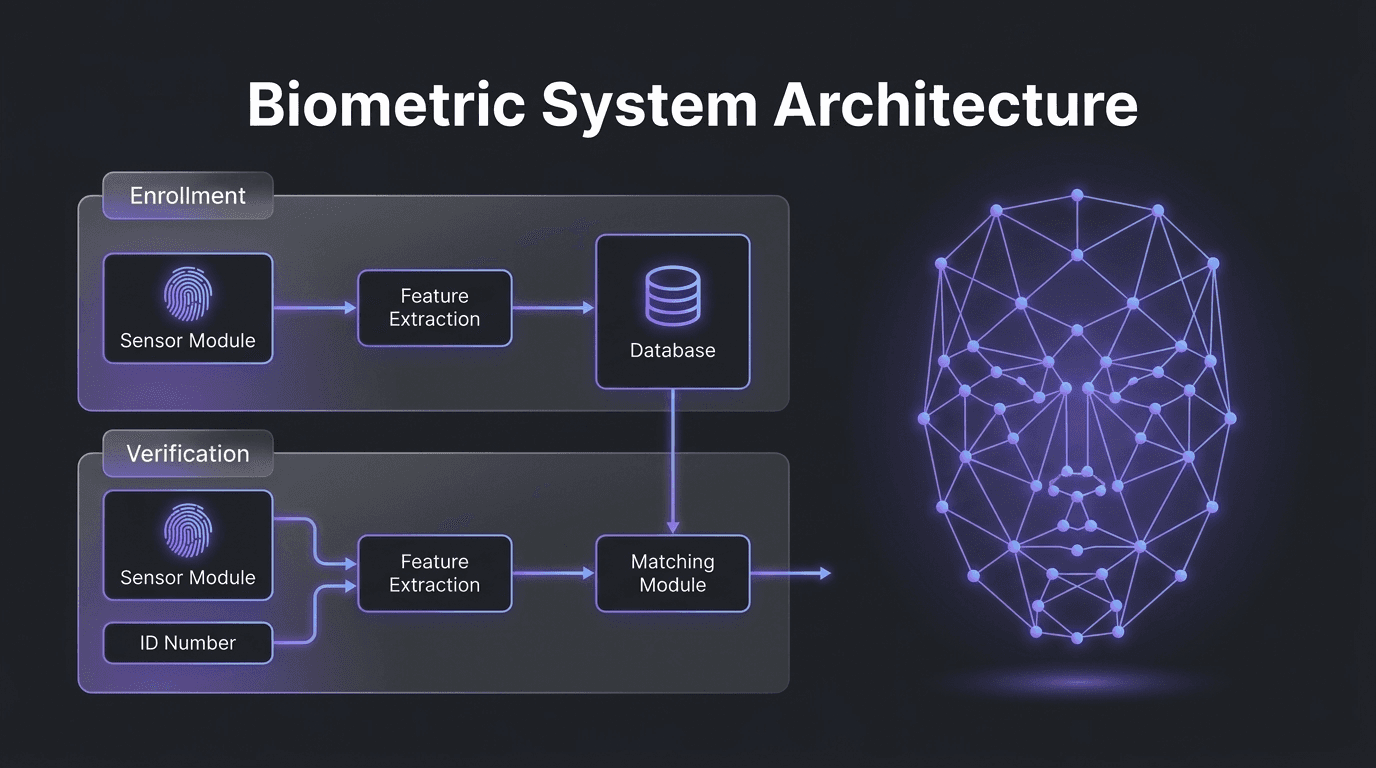
A biometric verification system follows a structured workflow regardless of the specific modality being used.
Enrollment. The reference template is established. In identity verification, this typically means extracting the photograph from a government-issued document and converting it into a biometric template. For biometric authentication scenarios, the enrollment step may involve capturing a biometric sample directly from the user during initial registration.
Capture. A live biometric sample is acquired from the person being verified. For facial verification, this is a selfie or short video captured through the device camera. The capture process must produce a sample of sufficient quality for accurate comparison, which means adequate lighting, resolution, and positioning.
Feature extraction. The captured sample is processed by algorithms that identify and extract the distinguishing biometric features, converting them into a mathematical representation (the template). This template is a numerical encoding of the biometric data, not the raw image itself.
Matching. The live template is compared against the reference template using matching algorithms that calculate a similarity score. The score represents how closely the two templates correspond.
Decision. The similarity score is evaluated against a configurable threshold. If the score exceeds the threshold, the verification passes. If it falls below, the verification fails. The threshold setting involves a trade-off between two error metrics: the false acceptance rate (FAR), which measures how often the system incorrectly accepts a non-matching sample, and the false rejection rate (FRR), which measures how often the system incorrectly rejects a legitimate match. A stricter threshold reduces FAR but increases FRR, and vice versa. The appropriate balance depends on the risk profile of the use case.
Processing can occur on-device, where the biometric computation happens locally on the user’s smartphone, or server-side, where the sample is transmitted to a remote server for comparison. Server-side processing allows for more computationally intensive algorithms and centralized template management, while on-device processing offers faster response times and keeps biometric data on the user’s hardware.
Liveness Detection: Defending Against Spoofing
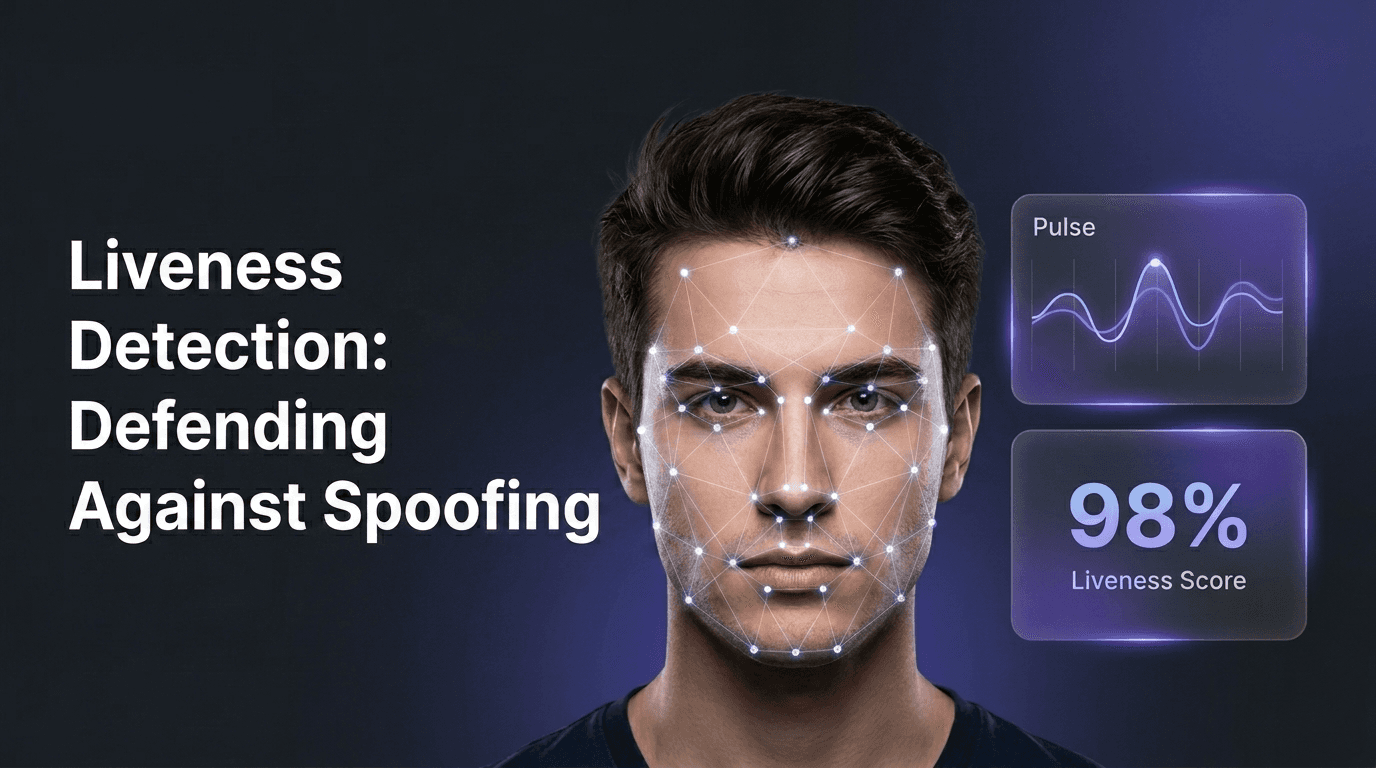
Biometric verification is only as reliable as its ability to confirm that the biometric sample comes from a live person rather than a reproduction. Without liveness detection, a verification system can be defeated by presenting a printed photograph, a screen displaying a photo, a 3D mask, or a deepfake video of the target individual. These are collectively known as presentation attacks.
Liveness detection technology analyzes the captured biometric sample for indicators that distinguish a live person from a reproduction.
Active liveness prompts the user to perform specific actions during capture, such as blinking, turning their head, or smiling. The system verifies that the captured sequence shows the requested movements, which are difficult to replicate with a static image or pre-recorded video. Active liveness is effective but introduces friction into the user experience and extends the verification time.
Passive liveness analyzes the biometric sample without requiring the user to perform any specific action. The system examines texture, depth, reflection patterns, micro-movements, and other visual properties to determine whether the image is captured from a live face or a reproduction. Passive biometric verification is preferred in most commercial deployments because it operates transparently and does not disrupt the user flow.
Advanced liveness detection systems use deep learning models trained on large datasets of genuine and spoofed samples. These models can detect deepfake videos, 3D-printed masks, and screen replay attacks by identifying artifacts that are invisible to human observation: inconsistent skin texture, unnatural lighting reflections, compression patterns characteristic of digital manipulation, and the absence of involuntary micro-expressions.
For regulated businesses, liveness detection is not optional. A biometric verification system without robust liveness detection is vulnerable to the exact types of fraud it is supposed to prevent.
Where Biometric Verification Is Used
Biometric identity verification has expanded across industries as regulatory requirements and fraud threats have driven adoption.
Financial services. Banks and financial institutions use biometric verification for KYC onboarding, re-verification of existing customers, and transaction authentication. Regulatory requirements under AML directives mandate reliable identity verification, and biometric face matching against government-issued documents has become a standard component of digital onboarding workflows.
Fintech and cryptocurrency. Remote-first business models in fintech and crypto depend entirely on digital identity verification. Biometric verification provides the identity proofing layer that enables these platforms to onboard customers without physical interaction while meeting regulatory requirements for customer identification.
Government and border control. National identity programs, passport issuance, voter registration, and benefits distribution use biometric verification (primarily fingerprint and facial recognition) to establish and confirm citizen identity. Border control systems at airports use facial recognition to match travelers against their passport photos, and increasingly against visa and immigration databases.
Telecommunications. SIM registration regulations in many jurisdictions require operators to verify the identity of customers purchasing mobile services. Biometric verification enables this at scale, particularly in markets where in-person verification at retail locations is the primary channel.
Gaming and gambling. Online gambling operators are required to verify both the identity and age of their customers. Biometric verification provides the identity proofing component, while document verification confirms the age and jurisdiction eligibility.
Healthcare. Patient identity verification prevents medical identity fraud and ensures that medical records, prescriptions, and insurance claims are associated with the correct individual. Fingerprint and facial recognition are deployed at the point of care in hospital and clinic environments.
Biometric Verification and Regulatory Compliance
Biometric verification supports compliance objectives, but it also creates data protection obligations that regulated businesses must manage carefully.
On the compliance utility side, the FATF Recommendations require that regulated entities verify customer identity using reliable and independent sources. Biometric verification against a government-issued document satisfies this requirement when the verification process includes document authenticity checks, biometric face matching, and liveness detection. The EU eIDAS regulation and the forthcoming European Digital Identity Wallet framework further formalize the role of biometric verification in digital identity proofing.
On the data protection side, biometric data is classified as a special category under the EU GDPR, which means processing requires explicit consent or another specified legal basis, and is subject to enhanced security and retention requirements. In the United States, Illinois’s Biometric Information Privacy Act (BIPA) and similar laws in Texas, Washington, and other states impose consent, notice, and data retention obligations on organizations that collect biometric identifiers. Violations carry significant liability, as demonstrated by multiple class-action settlements under BIPA exceeding $100 million.
For regulated businesses, the operational challenge is implementing biometric verification in a way that satisfies both identity verification requirements and data protection obligations. This typically involves processing biometric data only for the specific purpose of identity verification, minimizing retention periods, applying strong encryption, and providing clear disclosure and consent mechanisms to the end user.
FAQ
What is biometric verification in simple terms?
What is the difference between biometric verification and biometric identification?
Is biometric verification safe?
Can biometric verification be fooled?
What is passive biometric verification?
How is biometric verification used in banking?
Qoobiss ONTRACE integrates facial biometric verification, liveness detection, and document-to-selfie matching into a unified identity verification workflow. The platform captures a live selfie, performs passive liveness analysis to confirm the sample comes from a real person, and matches the face against the photograph extracted from the customer’s identity document. Combined with NFC chip reading, automated document analysis, and security feature verification, ONTRACE delivers the multi-layered identity proofing that regulated businesses need to meet KYC obligations and defend against document fraud, synthetic identities, and presentation attacks. Request a demo to see how biometric verification fits into your onboarding workflow.