What Is Account Takeover (ATO) Fraud? How Attacks Work and How to Stop Them


Account takeover, or ATO, is one of the most damaging forms of online fraud, and one of the fastest to scale. Instead of stealing an identity to open new accounts, an attacker seizes control of an account a person already owns, whether a bank login, an email inbox, or a retail profile, and drains its value from the inside. The numbers are stark.
Account takeover was the costliest type of identity fraud in 2025, with losses above $15 billion in the US alone and 6 million consumers affected, an 18 percent rise on the year before.
Criminals now run an estimated 26 billion credential stuffing attempts every month, and MFA fatigue attacks climbed 217 percent year over year, which means the defenses many businesses rely on are no longer enough on their own.
This guide explains what account takeover fraud is, how it differs from identity theft, the full attack lifecycle, the methods attackers use, the warning signs to watch for, the US and EU rules that apply, and how strong identity verification stops takeovers before they cause damage.
What Is Account Takeover Fraud?
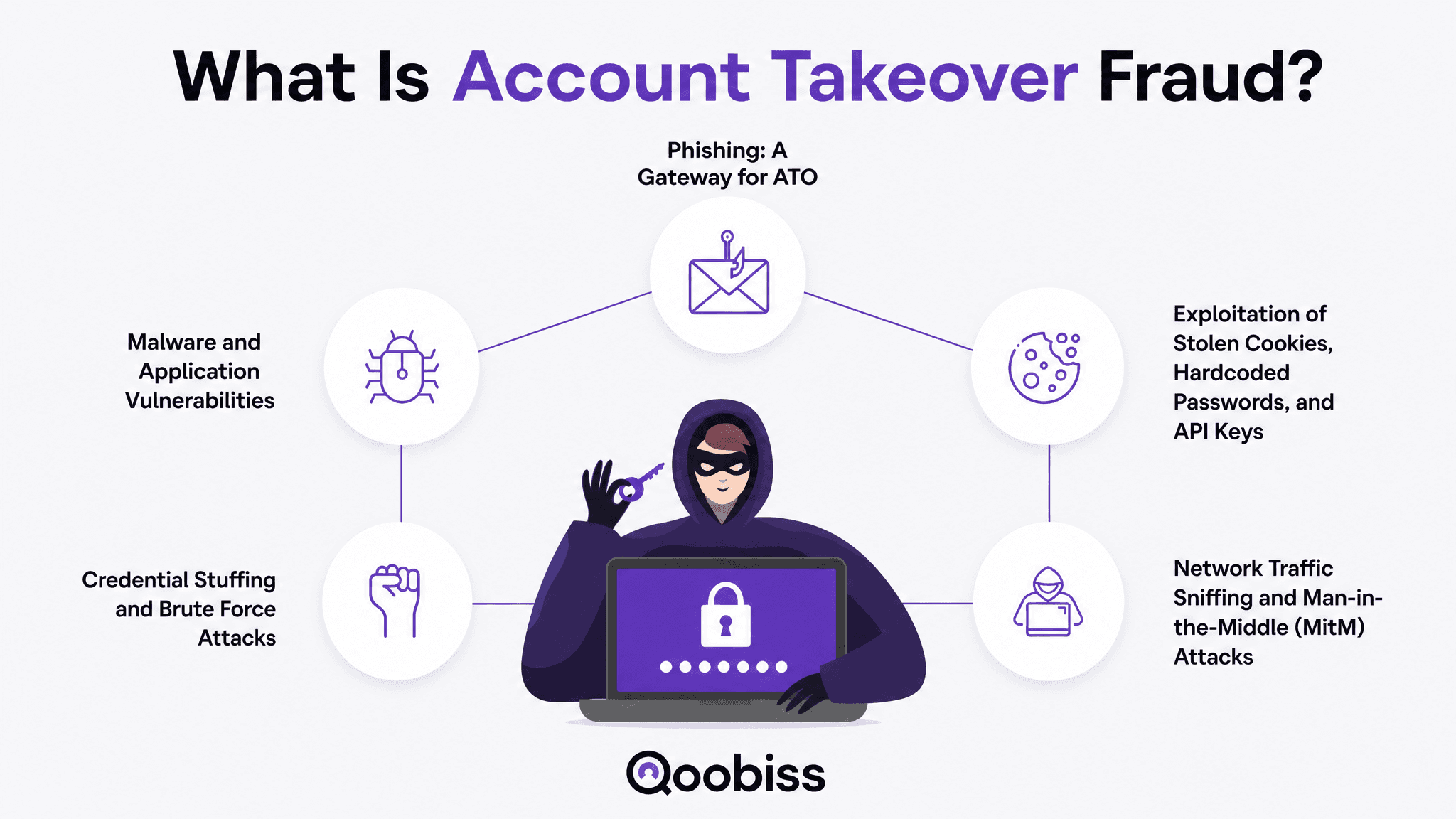
Account takeover fraud happens when a criminal gains unauthorized access to a legitimate user's online account and uses it for their own gain.
Because the account already exists and already has a trusted history, an ATO attacker can move money, make purchases, or reach deeper into an organization while looking, at first glance, like the real owner.
That stealth is the whole point: the longer the intruder stays unnoticed, the more damage they do.
Attackers pursue account takeover for several reasons, and almost any account has value to someone:
Financial gain: draining bank balances, making fraudulent purchases, or moving funds to a newly added payee.
Stored value: loyalty points, airline miles, gift card balances, and crypto wallets that convert easily to cash.
Data and access: harvesting personal data, or using a compromised inbox to launch business email compromise and reach other systems.
Resale: selling verified, working credentials in bulk on criminal marketplaces.
Account Takeover vs. Identity Theft
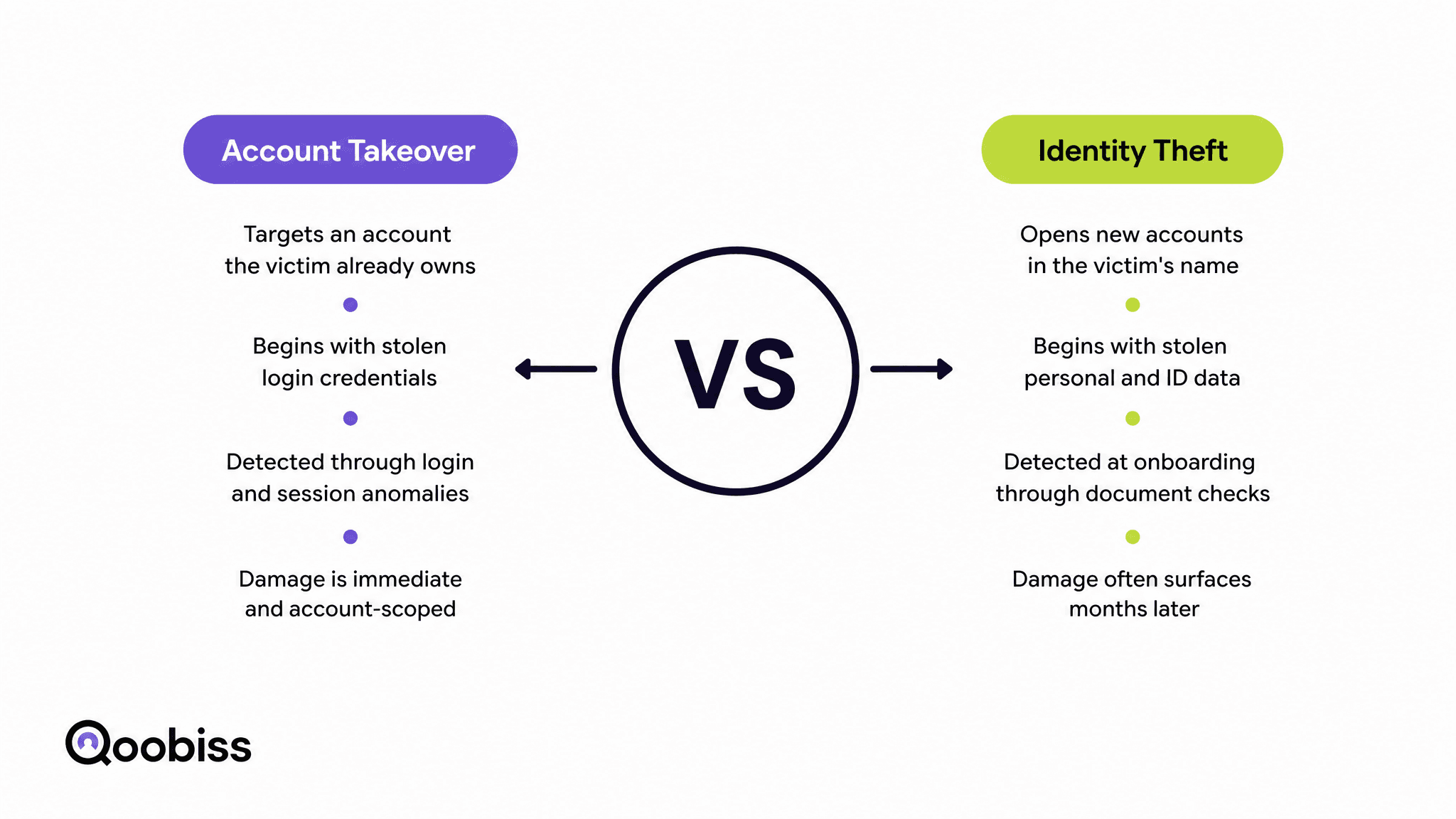
These two terms are often used interchangeably, but they describe different crimes, and the distinction matters for how you detect and respond to each. Identity theft is about creating something new from stolen data. Account takeover is about seizing something that already exists.
Aspect | Identity theft | Account takeover |
|---|---|---|
What is stolen | Personal data such as ID number, date of birth, or documents | Login credentials to an account the victim already holds |
What the attacker does | Opens new accounts or lines of credit in the victim's name | Hijacks and drains the victim's existing accounts |
How it is detected | Unknown new accounts appear on a credit report | Unusual logins, changed details, or activity on a known account |
Typical first sign | A bill or account the victim never opened | A login alert or password reset the victim did not request |
The two often connect. More than half of adults who have suffered identity fraud say it began with an account takeover.
How an Account Takeover Attack Works: The Lifecycle
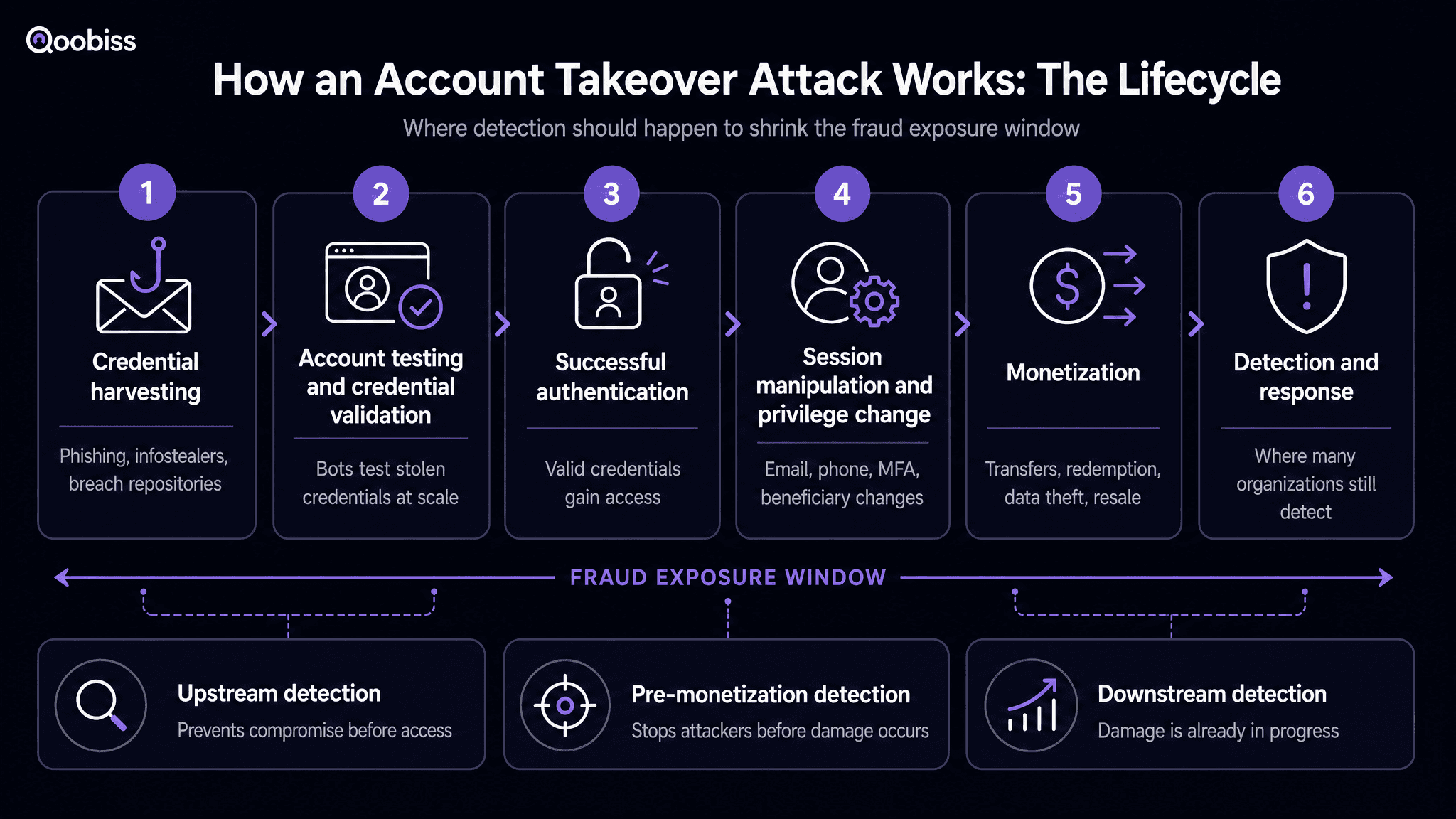
An account takeover is rarely a single event. It usually unfolds in stages, and each stage leaves its own trace, which is exactly why layered detection works. Mapping the lifecycle shows a business where it can intervene before money moves.
Stage | What happens | Signal to watch | Control that stops it |
|---|---|---|---|
Acquisition | Attacker obtains credentials via a breach, phishing, or infostealer malware. | Credentials appearing in breach data | Breach monitoring, passwordless login |
Validation | Bots test the stolen credentials across many sites at scale. | Spikes in failed logins from many IPs | Bot detection, rate limiting |
Infiltration | A working login succeeds, often from a new device or location. | Impossible travel, new device | Step-up identity verification |
Quiet recon | Attacker changes contact details and adds a payee while staying hidden. | Email, phone, or password changed | Re-verify identity on profile changes |
Monetization | Funds, goods, or data are extracted from the account. | Anomalous transaction pattern | Real-time transaction monitoring |
How Attackers Take Over Accounts: The Main Methods
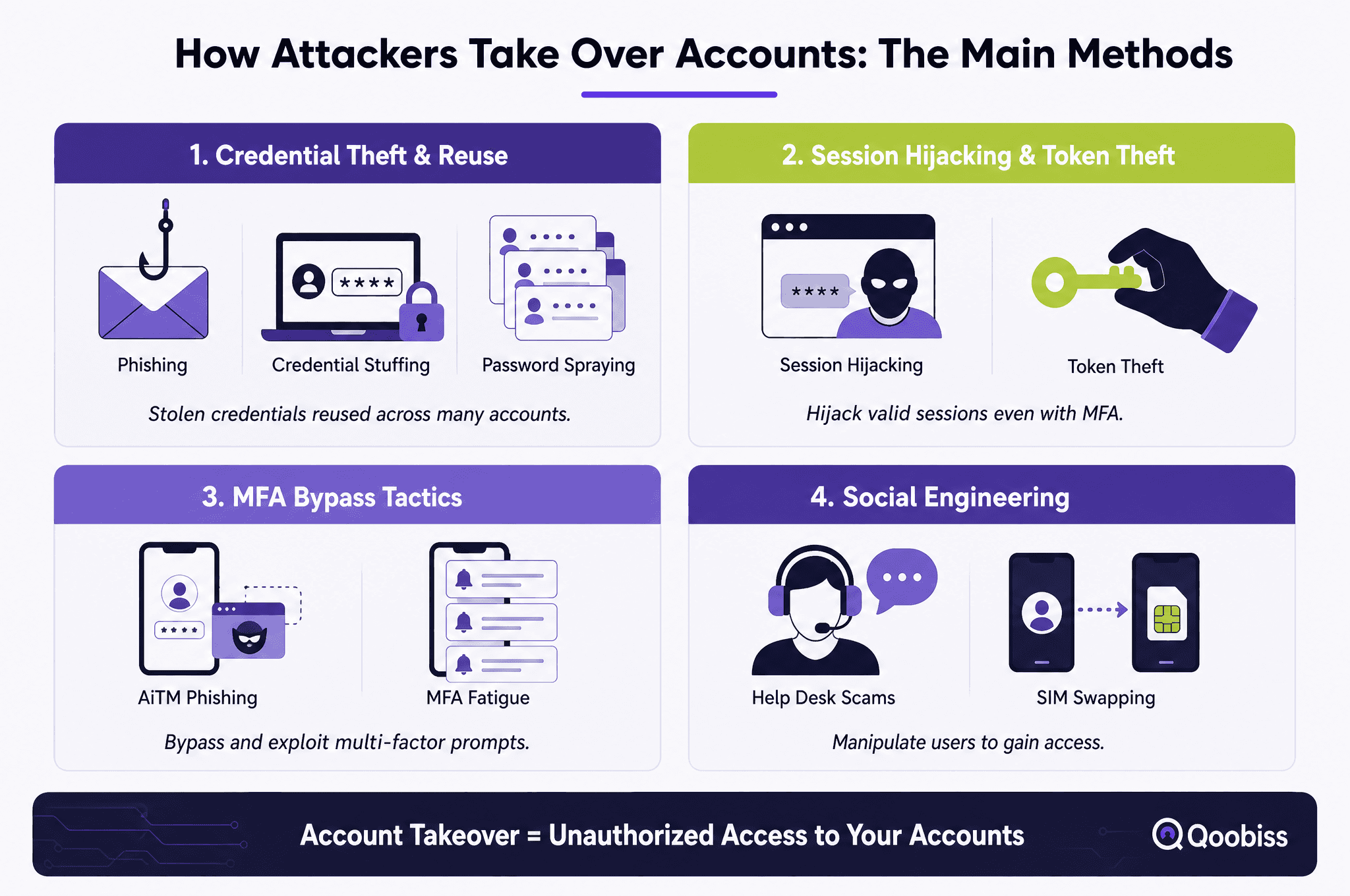
Attackers have many routes into an account, and the most effective ones increasingly defeat basic multi-factor authentication. Understanding
each method helps you match the right defense to the right threat.
Method | How it works | Why it is dangerous |
|---|---|---|
Credential stuffing | Bots replay username and password pairs leaked from other breaches. | Works because people reuse passwords, and runs at massive scale. |
Phishing and AiTM | Fake login pages and adversary-in-the-middle kits capture live session cookies. | Modern kits bypass MFA by replaying the authenticated session. |
SIM swapping | The attacker ports the victim's phone number to a new SIM. | Intercepts the SMS one-time passwords used for MFA. |
MFA fatigue | Repeated push prompts until the victim approves one by mistake. | Exploits human error rather than a technical flaw. |
Session hijacking | Stolen cookies or tokens reuse an already authenticated session. | Skips the login entirely, so no password is needed. |
Malware and infostealers | Keyloggers and info-stealing malware harvest credentials and cookies. | Captures everything, including tokens, silently. |
The Red Flags: How to Detect Account Takeover
Because ATO attackers try to blend in, detection depends on spotting
small anomalies that a legitimate user would rarely trigger. The following signals, especially when several appear together, are strong indicators that an account has been compromised:
A login from an unfamiliar device, browser, or location, or two logins from impossible-travel distances apart.
A sudden wave of failed login attempts, often from many IP addresses at once.
Password, email, or phone number changes the user did not request.
New or hidden email forwarding rules quietly redirecting messages.
A newly added payee or a change of shipping address just before a transaction.
Unusual transaction patterns, large downloads, or activity at odd hours.
Why MFA Alone Is No Longer Enough
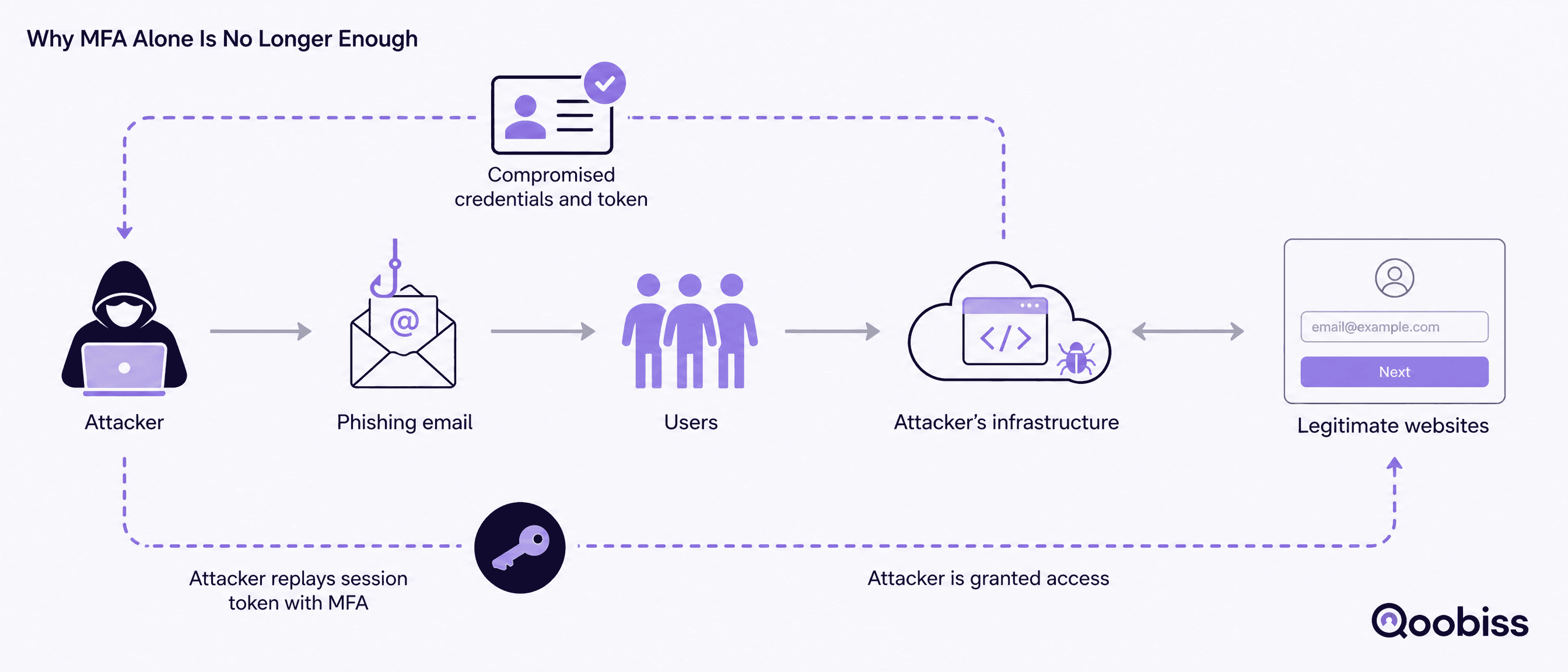
Multi-factor authentication remains essential, but it is no longer sufficient on its own. Adversary-in-the-middle phishing kits steal live session tokens, SIM swaps intercept SMS codes, and MFA fatigue attacks, up 217 percent year over year, simply wear users down until they approve a fraudulent prompt.
Attackers are even using deepfake audio to defeat the voice biometrics some institutions rely on. The lesson is that verifying a device or a one-time code is not the same as verifying the person. When a high-risk action occurs, the strongest defense is to re-confirm the human identity behind the account.
Your Regulatory Obligations: US and EU
Account takeover is not only a security problem, it is a compliance one. Regulators on both sides of the Atlantic increasingly expect businesses to authenticate users strongly and to shoulder liability when they fail. Payment and financial firms should understand all of the following frameworks:
Framework | Region | What it requires |
|---|---|---|
Reg E (EFTA) | US | Limits consumer liability for unauthorized electronic transfers, placing much of the ATO loss on the institution. |
FFIEC guidance | US | Expects layered security and strong authentication for access to financial accounts. |
PSD2 (SCA) | EU | Mandates Strong Customer Authentication and dynamic linking for electronic payments. |
PSD3 / PSR (incoming) | EU | Expands authentication rules and shifts fraud liability onto providers that fail to authenticate. |
GDPR | EU | Requires breach notification, generally within 72 hours, when personal data is exposed. |
eIDAS 2.0 | EU | Introduces the EU Digital Identity Wallet and high-assurance identity proofing. |
The direction of travel in the EU is clear: under the incoming PSD3 and Payment Services Regulation, a provider that fails to apply Strong Customer Authentication when required can be made to bear the fraud loss itself. Authentication is becoming the line between who pays and who does not.
How to Prevent Account Takeover
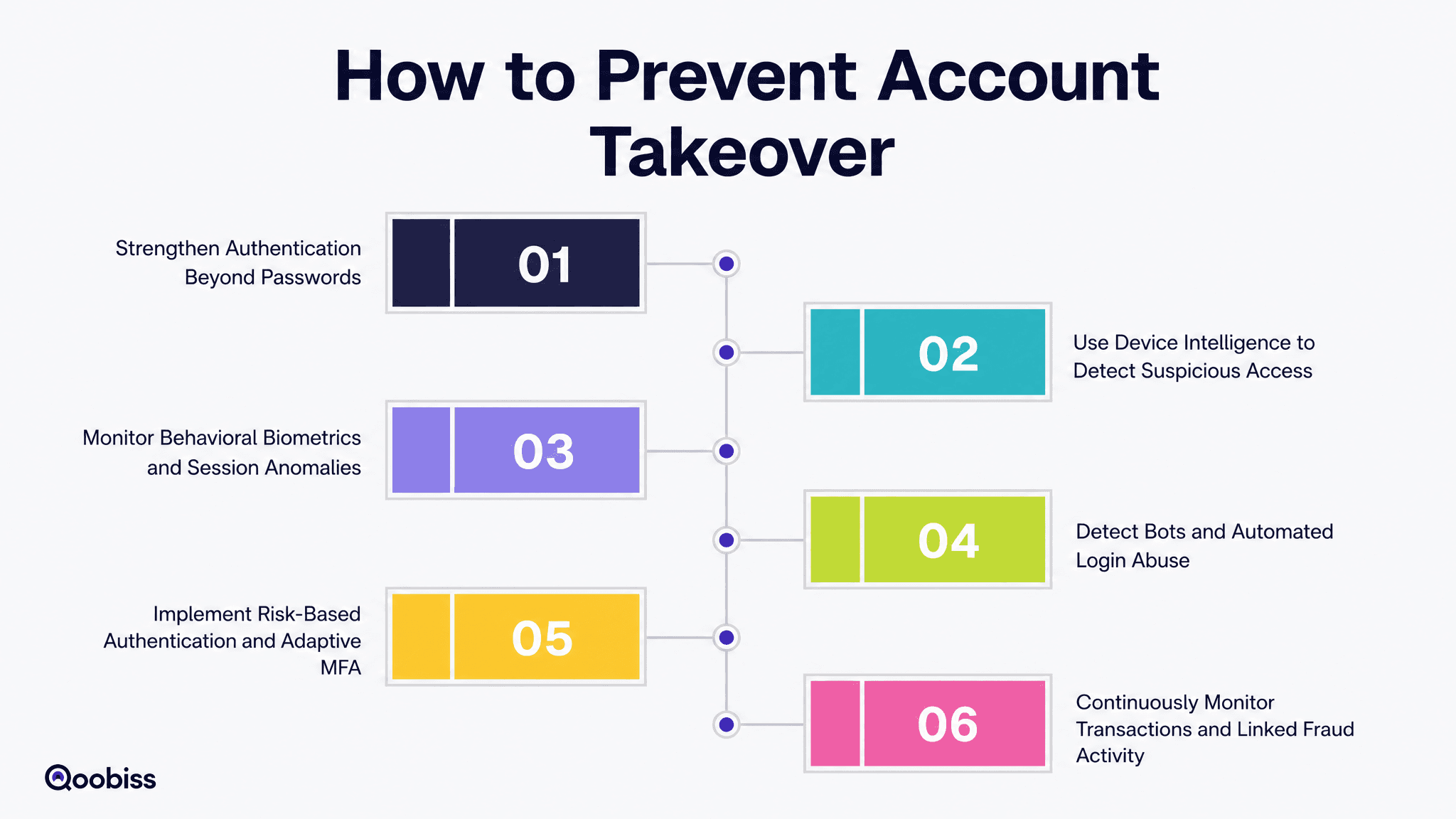
Because most takeovers exploit weak or stolen credentials, the most effective defenses verify the person, not just the password, and do so
continuously rather than only at login. The strongest programs layer several controls:
Re-verify identity on high-risk actions. Step-up identity verification that re-runs KYC-grade proofing, a document and selfie check, when a password reset, new payee, or large transfer occurs stops an intruder even after they have the password.
Add biometrics with liveness. Biometric verification backed by liveness detection confirms a real, present human, not a photo, a replay, or a stolen credential.
Defend against deepfakes. Modern deepfake and facial recognition defenses detect synthetic faces and injection attacks that try to fool biometric checks.
Monitor devices and behavior. Device fingerprinting and behavioral signals flag new hardware, impossible travel, and bot-like activity before access is granted.
Watch every transaction in real time. Continuous transaction monitoring catches the anomalous payment or new payee that marks the monetization stage.
Go passwordless where you can. FIDO2 security keys and passkeys remove the reusable password that credential stuffing depends on.
Together, these controls close the gap that MFA alone leaves open: they verify the human, not just the handset.
What to Do if an Account Is Taken Over
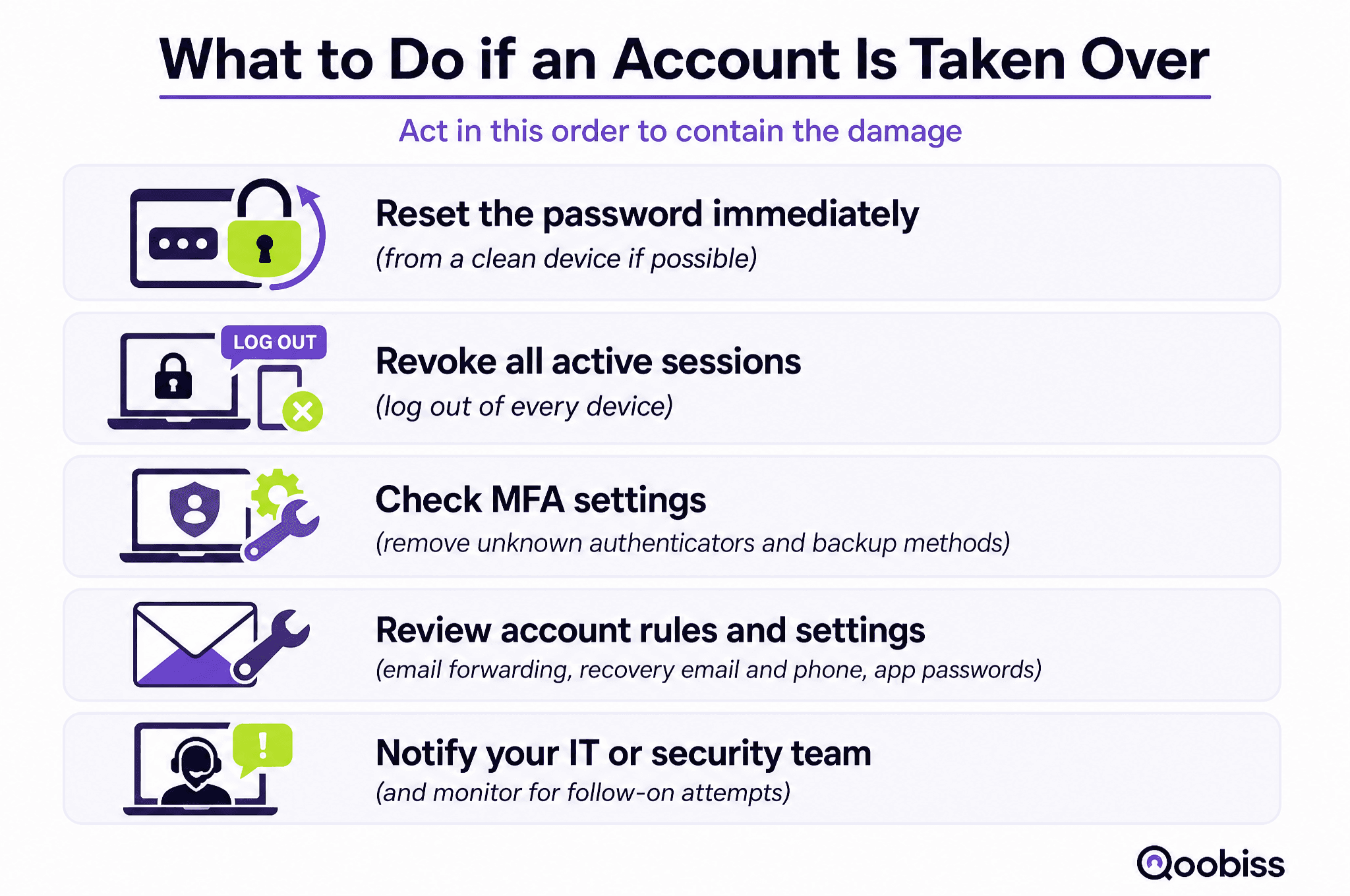
Even strong defenses can be tested, so a fast, clear response plan limits the damage when an account is compromised. Whether the victim is your customer or your own business, the priorities are the same:
Contact the financial institution immediately and request a recall or reversal of any fraudulent transfer.
Reset or revoke all exposed credentials, and terminate active sessions and tokens.
Remove any unauthorized forwarding rules, payees, or linked devices.
Report the incident to the relevant authority, such as the FBI's IC3 in the US.
Monitor the account and any linked accounts for follow-on activity.
Stop Account Takeover at the Identity Layer with Qoobiss
Qoobiss helps banks, fintechs, and digital platforms stop account takeover before it causes damage. Omnicheck pairs AML screening with real-time transaction monitoring, while Qoobiss's fraud prevention and identity verification tools re-confirm the real person behind every high-risk action using biometrics and liveness. See how Qoobiss protects banking and lending and fintech and payments teams, or get in touch to see it in action.
Frequently Asked Questions
What is an account takeover?
What are the red flags of account takeover?
What is the difference between identity theft and account takeover?
What is the first step in account takeover?
How do you prevent account takeover fraud?