Digital Signatures: The Invisible Tech That Proves You Are You

Digital Signatures: What They Are, How They Work, and Why They Matter for Identity Verification
Digital signatures are the cryptographic mechanism that makes it possible to trust data you cannot physically inspect. Every time a browser confirms a website's identity, every time an e-passport's chip data is validated during identity verification, every time a signed contract is confirmed as unaltered, a digital signature is performing the underlying cryptographic work.
For most people, digital signatures are associated with signing PDFs or contracts electronically. But for businesses operating in regulated environments, digital signatures serve a more fundamental purpose.
They are the technology that authenticates identity documents at the cryptographic level, secures data transmission between verification systems, and provides mathematical proof that the information a business relies upon for compliance decisions has not been tampered with. In identity verification, digital signatures are the reason NFC chip reading on e-passports delivers a level of document assurance that no visual inspection or image analysis can match.
This guide covers what digital signatures are, how the underlying cryptography works, the difference between digital signatures and electronic signatures, where digital signatures are used, how they function within identity document authentication and verification, and the legal frameworks that govern their use.
What Are Digital Signatures?
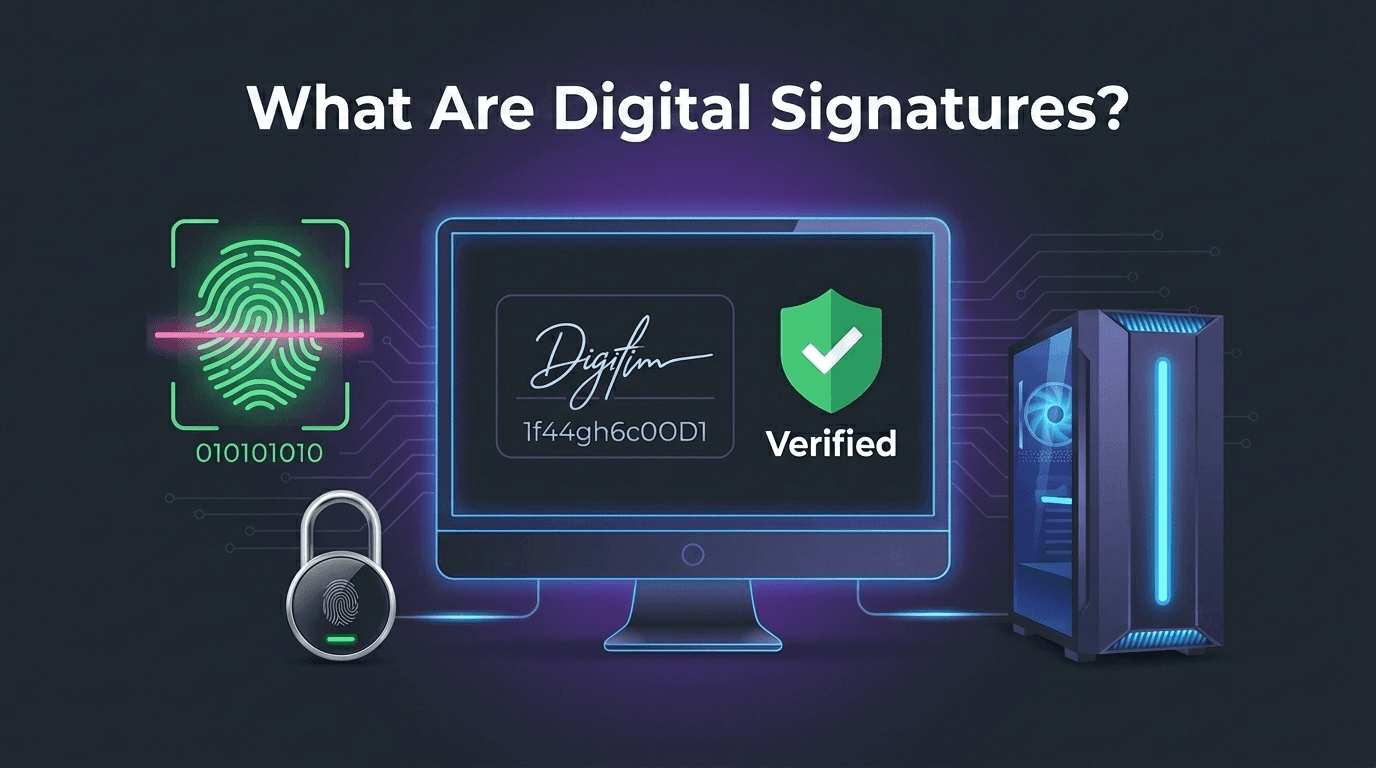
A digital signature is a cryptographic technique that provides three security properties for digital data: authentication, integrity, and non-repudiation. Authentication confirms who created or signed the data. Integrity confirms the data has not been altered since it was signed. Non-repudiation means the signer cannot credibly deny having signed, because only the holder of the private key could have produced the signature.
These three properties distinguish digital signatures from other forms of electronic signing. A typed name at the bottom of an email provides no cryptographic assurance. A scanned image of a handwritten signature can be copied onto any document. A digital signature, by contrast, is mathematically bound to both the signer's identity and the specific content of the data. Changing even a single character in the signed data invalidates the signature, and producing a valid signature requires access to the signer's private key.
Digital signatures are built on asymmetric cryptography, also called public key cryptography. This system uses a pair of mathematically linked keys: a private key, which the signer keeps secret, and a public key, which is distributed to anyone who needs to verify the signature. The mathematical relationship between the two keys is such that data signed with the private key can only be verified with the corresponding public key, and the private key cannot be derived from the public key. This asymmetry is what makes the system secure.
The term "digital signature" is often used loosely to mean any form of electronic signing, but in its precise technical sense, it refers specifically to signatures created using cryptographic algorithms and governed by a public key infrastructure. This distinction matters because the security properties, legal standing, and verification capabilities of a true digital signature are fundamentally different from those of a simple electronic signature.
How Digital Signatures Work
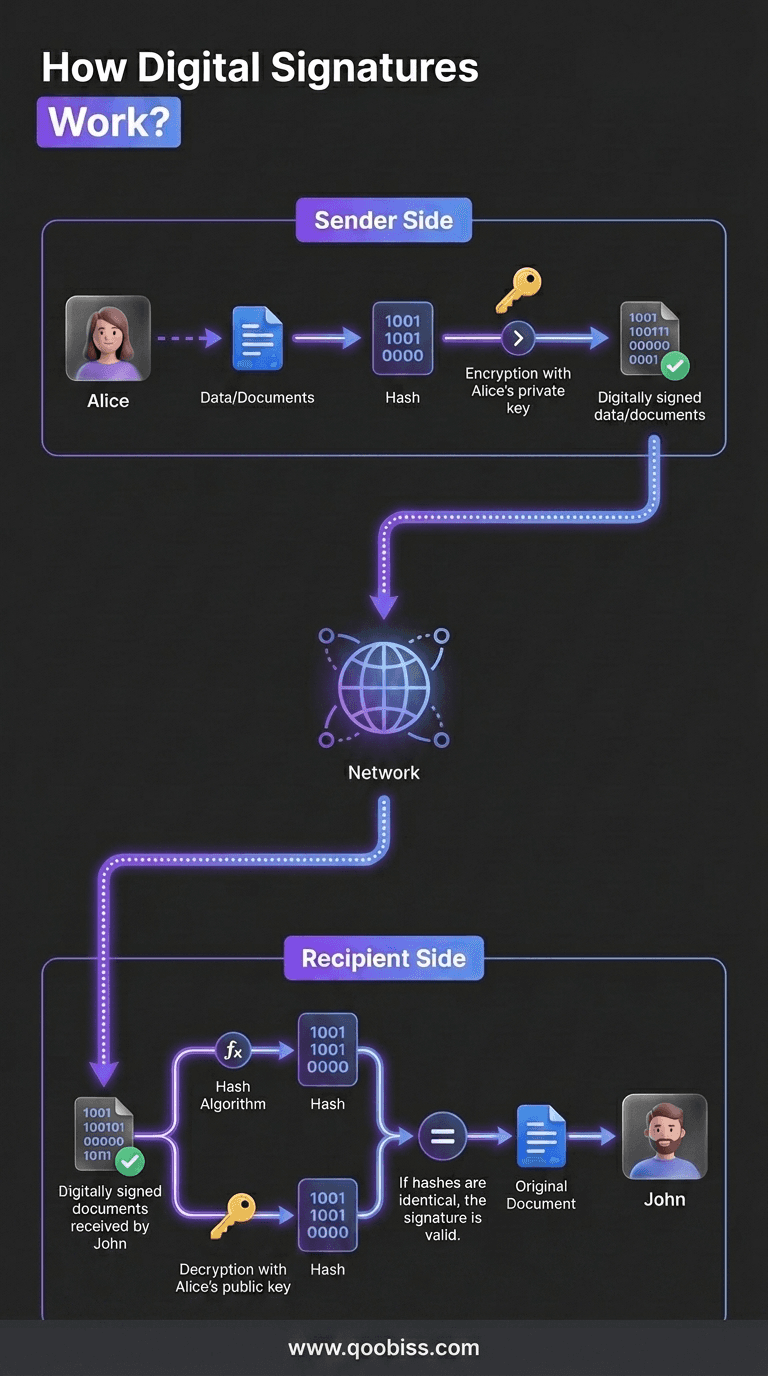
The process of creating and verifying a digital signature follows a structured sequence. Each step builds on established cryptographic principles.
Key Generation
The signer generates a key pair using an asymmetric cryptographic algorithm. The most widely used algorithms include RSA (Rivest-Shamir-Adleman), DSA (Digital Signature Algorithm), ECDSA (Elliptic Curve Digital Signature Algorithm), and EdDSA (Edwards-curve Digital Signature Algorithm). ECDSA and EdDSA have gained adoption because they achieve equivalent security with smaller key sizes, which is relevant for constrained environments such as smart cards and NFC chips on identity documents.
The private key is stored securely and never shared. The public key is made available to anyone who needs to verify signatures produced by the corresponding private key.
Signing
To sign a piece of data, the signer first applies a cryptographic hash function to the data. Hash functions such as SHA-256 or SHA-3 take input of any length and produce a fixed-length output called a digest or hash value. This digest is a unique fingerprint of the data: any change to the input, no matter how small, produces a completely different digest.
The signer then encrypts the hash digest using their private key. The encrypted digest is the digital signature. It is attached to or transmitted alongside the original data. The signature is compact (typically a few hundred bytes) regardless of the size of the signed data, because it operates on the fixed-length hash rather than the full content.
Verification
The recipient performs two operations. First, they use the signer's public key to decrypt the digital signature, recovering the original hash digest that the signer computed. Second, they independently compute the hash of the received data using the same algorithm.
If the two hash values match, the signature is valid. This confirms two things simultaneously: the data was signed by the holder of the corresponding private key (authentication), and the data has not been modified since signing (integrity). If even one bit of the data has changed, the independently computed hash will differ from the decrypted original, and verification will fail.
Certificates and Public Key Infrastructure
A public key alone is just a number. For it to be useful in verification, there must be a trustworthy way to confirm that a specific public key belongs to a specific entity. Digital certificates solve this problem.
A digital certificate is issued by a Certificate Authority (CA), a trusted third party that verifies the identity of the certificate holder and binds their public key to their identity in a signed document. The certificate itself is signed by the CA's private key, creating a chain of trust: the recipient trusts the CA, the CA vouches for the certificate holder, and the certificate contains the public key needed for signature verification.
Public Key Infrastructure (PKI) is the system of CAs, registration authorities, certificate policies, and revocation mechanisms that manages this trust hierarchy. PKI is what allows digital signatures to work at scale, across organizations, borders, and systems that have no prior relationship with each other.
Digital Signatures vs. Electronic Signatures
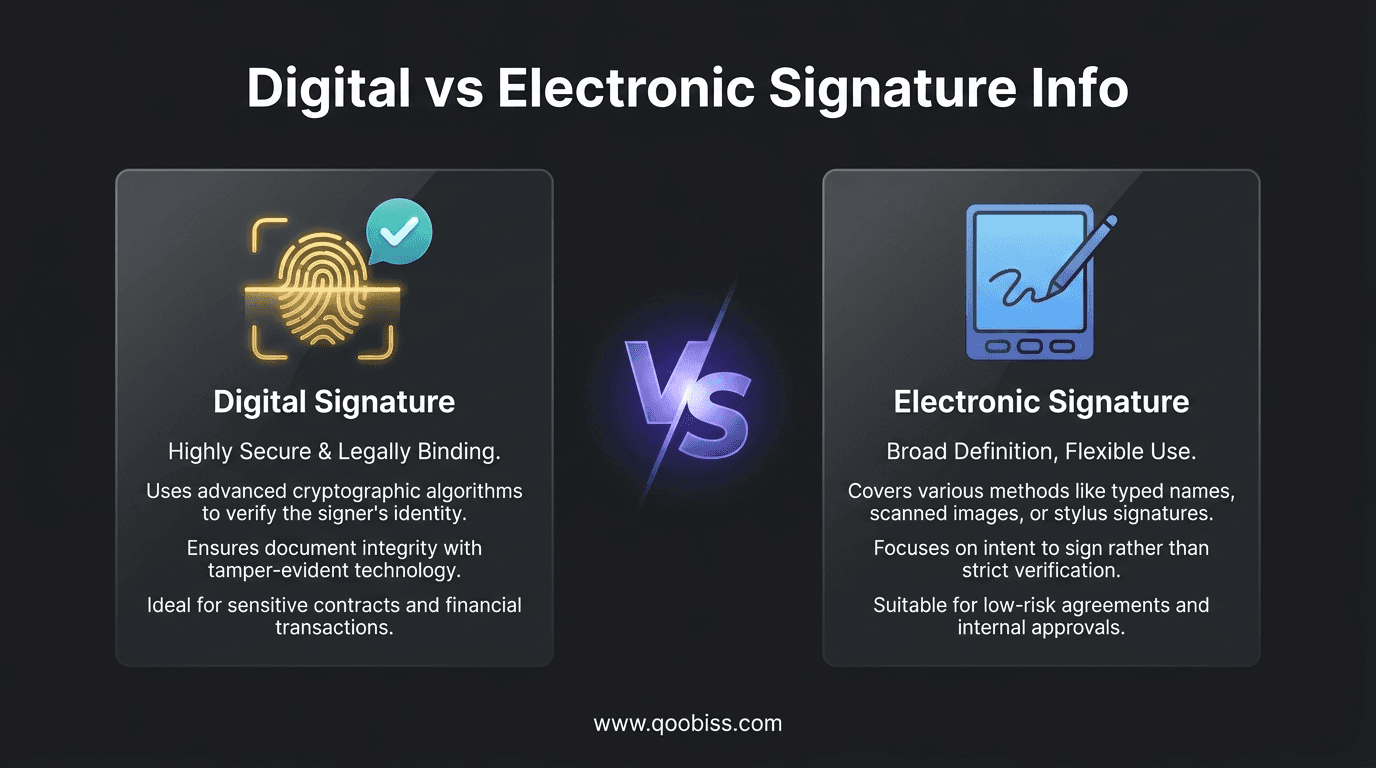
This distinction is the source of significant confusion, and it matters both legally and technically.
An electronic signature is a broad legal category encompassing any electronic indication of a person's intent to agree to or approve the contents of a document. This includes typing a name into a form field, clicking an "I agree" button, drawing a signature on a touchscreen, or checking a box. Electronic signatures are defined by their legal intent, not by any specific technology.
A digital signature is a specific type of electronic signature that uses cryptographic algorithms, key pairs, and digital certificates to provide authentication, integrity, and non-repudiation. All digital signatures are electronic signatures, but most electronic signatures are not digital signatures.
The practical difference is the level of assurance. A simple electronic signature confirms that someone interacted with a document. A digital signature provides cryptographic proof of who signed, that the content has not changed, and that the signer cannot deny having signed.
For routine agreements where the risk of dispute is low, a simple electronic signature may be sufficient. For high-value transactions, regulated documents, and identity verification, the cryptographic assurance of a digital signature is what the use case demands.
The EU's eIDAS regulation formalizes this distinction through three tiers. A Simple Electronic Signature (SES) is any electronic form of signature with no specific technology requirement. An Advanced Electronic Signature (AES) must be uniquely linked to the signatory, capable of identifying them, created using data under the signatory's sole control, and linked to the signed data so that any subsequent change is detectable.
A Qualified Electronic Signature (QES) meets all AES requirements and is created by a qualified electronic signature creation device using a qualified certificate issued by a supervised trust service provider. Only QES has automatic legal equivalence to a handwritten signature across all EU member states.
Where Digital Signatures Are Used
Document Signing and Contracts
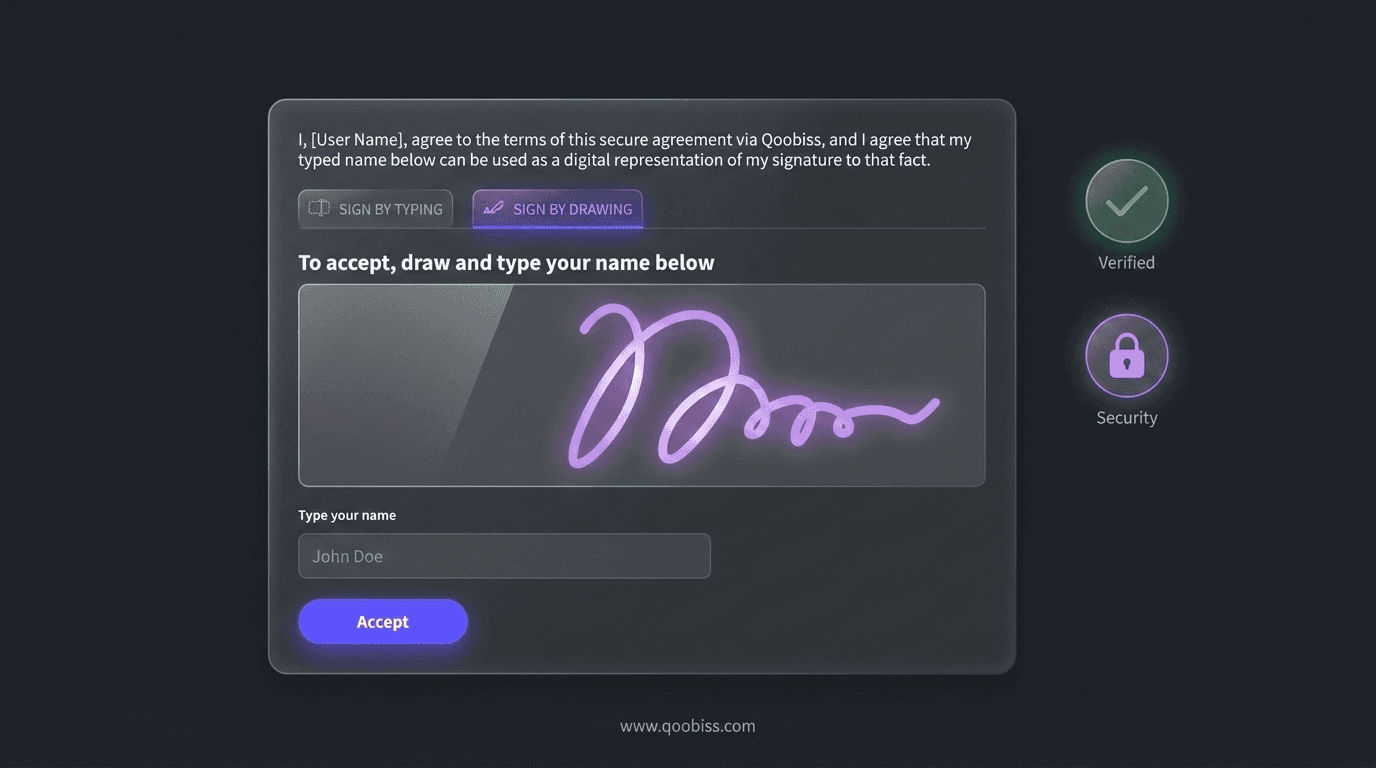
The most visible application of digital signatures is signing documents such as contracts, agreements, and regulatory filings. Platforms that offer high-assurance document signing use digital signatures backed by PKI to provide cryptographic proof of signer identity and document integrity. This is distinct from platforms that offer simple electronic signatures without the underlying cryptographic infrastructure.
Software Distribution
Code signing uses digital signatures to verify that software has not been tampered with since it was published by the developer. Operating systems check code signatures before installing or executing applications. An invalid or missing signature triggers a warning, alerting the user that the software may have been modified.
Email Security
S/MIME (Secure/Multipurpose Internet Mail Extensions) and PGP (Pretty Good Privacy) use digital signatures to authenticate email senders and ensure message integrity. When an email is digitally signed, the recipient can verify that it came from the claimed sender and that its content was not altered during transmission.
Identity Document Authentication
This is the application most directly relevant to identity verification. E-passports and chip-enabled national ID cards use digital signatures to protect the biographic and biometric data stored on their NFC chips. The issuing government signs the chip data through a hierarchical PKI structure defined by ICAO Document 9303: the Country Signing Certificate Authority (CSCA) issues Document Signer certificates, which sign the data on individual documents.
When an identity verification system reads the NFC chip, it validates this digital signature chain. If the signature is valid, the system has cryptographic proof that the data on the chip was written by the issuing government and has not been modified since issuance. This is what makes NFC chip reading fundamentally different from image-based document verification: the trust is mathematical, not visual.
Digital Signatures in Identity Verification
The role of digital signatures in identity verification extends beyond a technical detail of chip design. Digital signatures are the trust mechanism that makes NFC-based document authentication the highest-assurance verification layer available.
ICAO Document 9303 specifies the PKI architecture for machine-readable travel documents. The data stored on an e-passport's NFC chip is organized into Data Groups: DG1 contains the Machine Readable Zone (MRZ) data (name, date of birth, nationality, document number), and DG2 contains the holder's facial image. These Data Groups are hashed and collected into a Security Object Document (SOD), which is signed by the Document Signer certificate.
Passive Authentication is the process of verifying this digital signature. The verification system reads the SOD from the chip, validates the Document Signer certificate against the issuing country's CSCA public key, and confirms that the hashes of the individual Data Groups match the hashes recorded in the SOD. If all checks pass, the system has cryptographic certainty that the chip data is genuine: it was issued by the claimed government, it has not been altered, and it has not been transferred from another chip.
Active Authentication adds a second layer. The chip contains a private key that never leaves the chip hardware. During verification, the reader sends a random challenge to the chip, which signs it with this private key. The reader verifies the response using the corresponding public key stored in the chip's Data Groups. A successful Active Authentication proves the chip itself is genuine (not a clone), because a cloned chip would not possess the original private key.
For identity verification businesses, this means that when the NFC chip data is validated through Passive and Active Authentication, the identity information (name, date of birth, nationality, facial image) is backed by the full weight of the issuing government's PKI. No amount of image manipulation, synthetic document generation, or deepfake technology can produce a valid digital signature without the issuing government's private key. This is why NFC chip reading with digital signature validation provides a verification assurance level that no other method can match.
Legal Framework for Digital Signatures

United States
The ESIGN Act (Electronic Signatures in Global and National Commerce Act, 2000) and UETA (Uniform Electronic Transactions Act, adopted by most states) provide broad legal recognition to electronic signatures, including digital signatures. Both statutes establish that electronic signatures are legally valid and enforceable for most transactions without prescribing specific technology requirements. The US framework is technology-neutral: a digital signature backed by PKI and a simple electronic signature are treated equally under the statute, though parties to a transaction may contractually require a specific signature type.
European Union
The eIDAS Regulation (910/2014), updated by eIDAS 2.0, establishes the most detailed legal framework for digital signatures globally. The regulation creates the three-tier hierarchy of SES, AES, and QES, with each tier carrying defined legal weight and technical requirements. Trust service providers that issue qualified certificates and operate qualified signature creation devices must be supervised by national authorities and meet stringent security and operational standards. QES is the only electronic signature type that automatically carries the legal equivalence of a handwritten signature across all EU member states without additional proof.
United Kingdom
The UK retains eIDAS-derived provisions through the UK Electronic Identification and Trust Services Regulation, enacted following Brexit. The Electronic Communications Act 2000 provides additional statutory recognition for electronic signatures. The UK framework maintains the SES/AES/QES hierarchy with qualified trust service providers supervised by the Information Commissioner's Office.
Other Jurisdictions
Most countries have adopted electronic signature legislation that recognizes digital signatures. India's Information Technology Act, Singapore's Electronic Transactions Act, and Brazil's Provisional Measure 2.200-2 all provide legal frameworks for electronic and digital signatures. The specific legal weight assigned to different signature types varies by jurisdiction, which means businesses operating internationally need to understand which signature standard satisfies the requirements of each market they serve.
FAQ
What is a digital signature in simple terms?
How do digital signatures work?
What is the difference between a digital signature and an electronic signature?
Are digital signatures legally binding?
What are the three types of digital signatures?
How are digital signatures used in identity documents?
Qoobiss ONTRACE validates digital signatures as a core component of its NFC chip reading capability. When verifying an e-passport or chip-enabled national ID card, ONTRACE reads the chip's Data Groups, validates the Document Signer certificate chain against the issuing country's CSCA public key, and confirms the cryptographic integrity of the biographic and biometric data through Passive Authentication. This digital signature validation provides mathematical certainty that the identity data is authentic, issued by the claimed government, and unaltered since issuance. Combined with document image analysis, biometric facial matching, and liveness detection, ONTRACE delivers a verification workflow where every layer of trust is cryptographically grounded.
Request a demo at qoobiss.com to see how digital signature validation strengthens your identity verification process.