Fake IDs: How to Spot Them and Protect Your Business from Fraud


According to the Veriff Identity Fraud Report 2025, approximately 1% of identity verification attempts in North America involve fraudulent documents. That number sounds small until you consider the volume: millions of identity checks processed daily across financial services, fintech platforms, crypto exchanges, and online marketplaces. At scale, even a fraction of a percent translates into thousands of fraudulent accounts opened, compliance obligations breached, and downstream losses absorbed.
Fake IDs are no longer just an underage drinking problem. They are a tool for identity fraud, synthetic identity creation, money laundering, and account takeover at a level that affects every regulated business performing customer onboarding. The techniques used to produce them have advanced significantly in recent years, particularly with the emergence of AI-generated identity documents that can bypass traditional manual inspection. This guide explains what fake IDs are, how they are made, how to spot them, and how businesses can detect fraudulent documents at scale.
What Is a Fake ID?
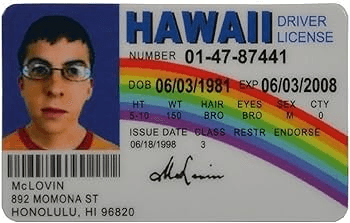
A fake ID is any identity document that has been fabricated, altered, or misused to misrepresent the holder’s identity, age, or other personal information. Not all fake IDs are the same, and the distinctions matter for both detection and legal classification.
Fictitious IDs are documents created entirely from scratch. They are not based on any real government-issued document and typically use fabricated personal information, invented document numbers, and counterfeit security features. These range from crude reproductions printed on cardstock to sophisticated polycarbonate cards with embedded holograms.
Fraudulent IDs use a real document template that closely replicates an authentic government-issued format but contains false personal information. The document number, name, date of birth, or photo may all be fabricated, but the overall appearance and layout match a genuine document closely enough to pass casual inspection.
Altered IDs are genuine government-issued documents that have been physically modified. Common alterations include changing the date of birth, replacing the photograph, or modifying the name. Because the base document is authentic, altered IDs can be particularly difficult to detect through visual inspection alone.
Borrowed IDs are real, unaltered documents used by someone other than the legitimate holder. The person using the ID relies on a physical resemblance to the photograph and correct recitation of the personal details printed on the card.
Beyond physical documents, the category now includes digital fake IDs: AI-generated images of identity documents that exist only as files but can be submitted during remote onboarding and verification processes. This distinction between physical and digital fakes has become critical as more businesses move identity verification online.
How Fake IDs Are Made
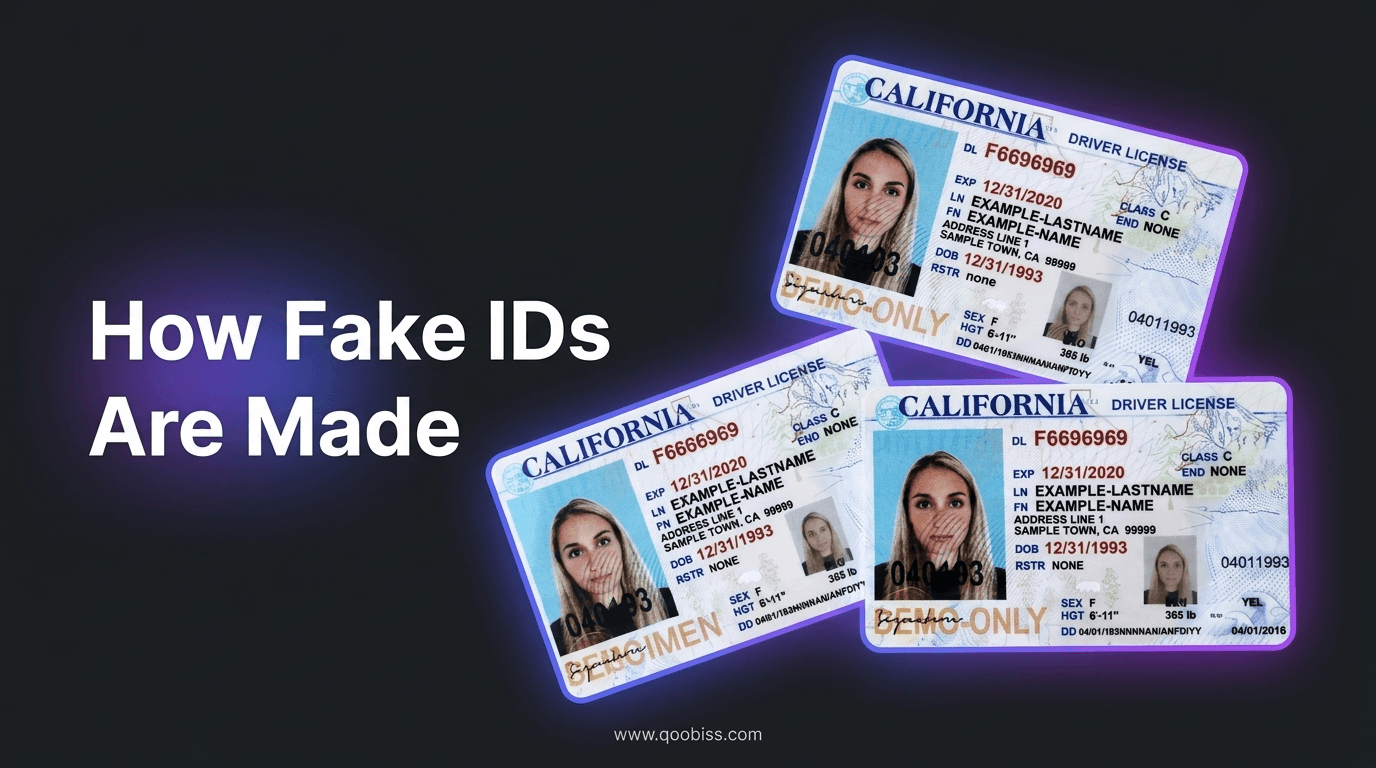
Traditional fake IDs were produced using desktop printers, lamination equipment, and publicly available templates. The quality varied widely. Low-end fakes were identifiable on sight due to incorrect card thickness, poor print resolution, and missing security features. Higher-quality physical fakes replicated more of the genuine document’s characteristics, including holographic overlays, UV-reactive ink patterns, and magnetic stripe encoding, but still required significant skill and equipment.
The manufacturing process has changed fundamentally in two ways.
First, the quality ceiling for physical fakes has risen. Operations producing counterfeit identity documents now use polycarbonate card stock, laser engraving equipment, and holographic foil sourced from industrial suppliers.
The resulting documents replicate the look and feel of genuine driver’s licenses with enough fidelity to pass casual visual and tactile inspection. Barcode data can be encoded to match the printed information, meaning the card will return consistent results when scanned by basic barcode readers.
Second, and more consequentially for regulated businesses, AI-generated fake IDs have emerged as a distinct threat category. Generative AI tools can produce photorealistic images of identity documents without any physical card being created.
These digital fakes are built from scratch using deep learning models trained on document specimens, and they can replicate layout, typography, background patterns, and even simulated security features with high accuracy.
The OnlyFake case in early 2024 demonstrated this at scale: an online service used AI to generate realistic identity document images that reportedly passed verification checks on at least one major cryptocurrency exchange.
AI-generated document fraud is particularly dangerous in remote verification contexts, where the business never handles a physical card. The verification process relies entirely on images or video submitted by the applicant, making it vulnerable to synthetic document submissions that a human reviewer may not distinguish from genuine photographs of real documents.
How to Spot a Fake ID: Common Red Flags
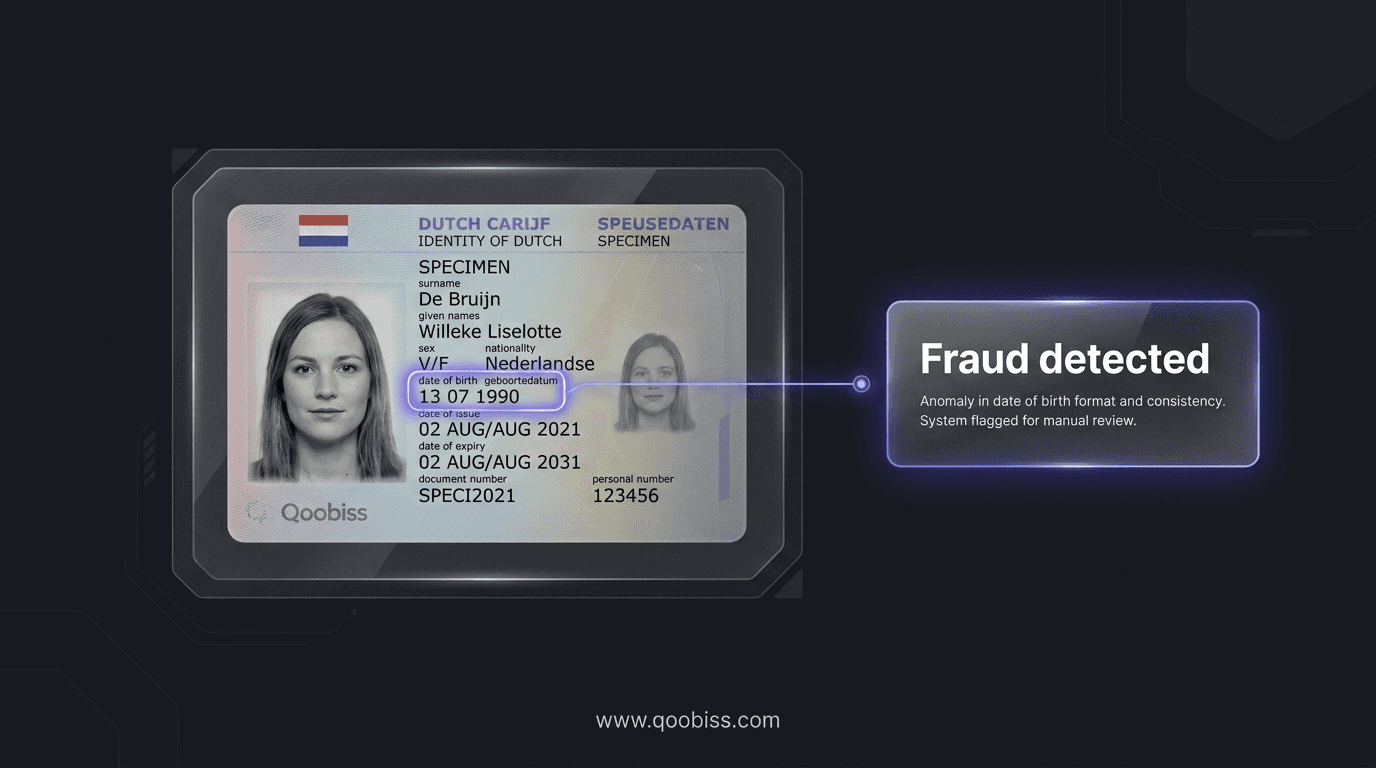
Manual inspection remains a first line of defense for businesses that handle physical identity documents. Knowing what to look for can catch a significant portion of fakes, particularly lower-quality ones.
Card material and construction. Genuine government-issued IDs use specific card stock, usually polycarbonate or Teslin, with consistent thickness and rigidity. A fake ID may feel too thin, too flexible, or too thick compared to an authentic card from the same issuing state. The edges of a genuine card are smooth and uniform. Laminated fakes often show peeling or bubbling at the edges, and the laminate layer may extend slightly beyond the card boundaries.
Holograms and optically variable features. Most US driver’s licenses include holographic overlays or optically variable devices (OVDs) that shift color or pattern when tilted under light. On a genuine card, these features are integrated into the card surface. On a fake, they are often applied as a separate sticker or overlay, which may not align precisely with the card’s printed design or may lack the full range of color shifts.
Microprinting. Many state IDs include microprinted text that is legible under magnification but appears as a solid line to the naked eye. On counterfeit documents, microprinting is frequently absent, blurred, or replaced with a simple line that does not resolve into text under magnification.
UV and infrared features. Genuine IDs contain UV-reactive elements that are visible under ultraviolet light, such as the bearer’s photo repeated in UV ink or state-specific patterns. Fakes produced without access to UV-reactive materials will show nothing under UV inspection, an immediate disqualifier.
Photo quality and positioning. Government-issued photos follow standardized specifications for background color, lighting, head size, and positioning. Fake IDs may show photos with inconsistent lighting, incorrect background color, visible pixelation, or misalignment relative to the printed frame.
Information and formatting. Each state uses specific fonts, layouts, and data formatting conventions. The placement of the date of birth, address fields, document number, and classification codes follows a template. Inconsistencies in font style, character spacing, or field positioning indicate a document that was not produced using the genuine state template.
Barcode and magnetic stripe data. Scanning the barcode on the back of a US driver’s license should return data that matches the printed information on the front. Discrepancies between scanned data and printed data are a strong indicator of alteration or fabrication. However, some high-quality fakes encode matching data, so barcode consistency alone does not confirm authenticity.
State-specific features. Individual states incorporate unique security features. California uses raised lettering (the “CALIFORNIA” text on the surface is tactile). New York incorporates a polycarbonate window with a laser-engraved secondary portrait. Texas includes a laser-perforated state outline visible when held to light. Familiarity with these state-specific elements significantly improves detection accuracy for manual inspection.
Fake ID vs Real ID: Key Differences
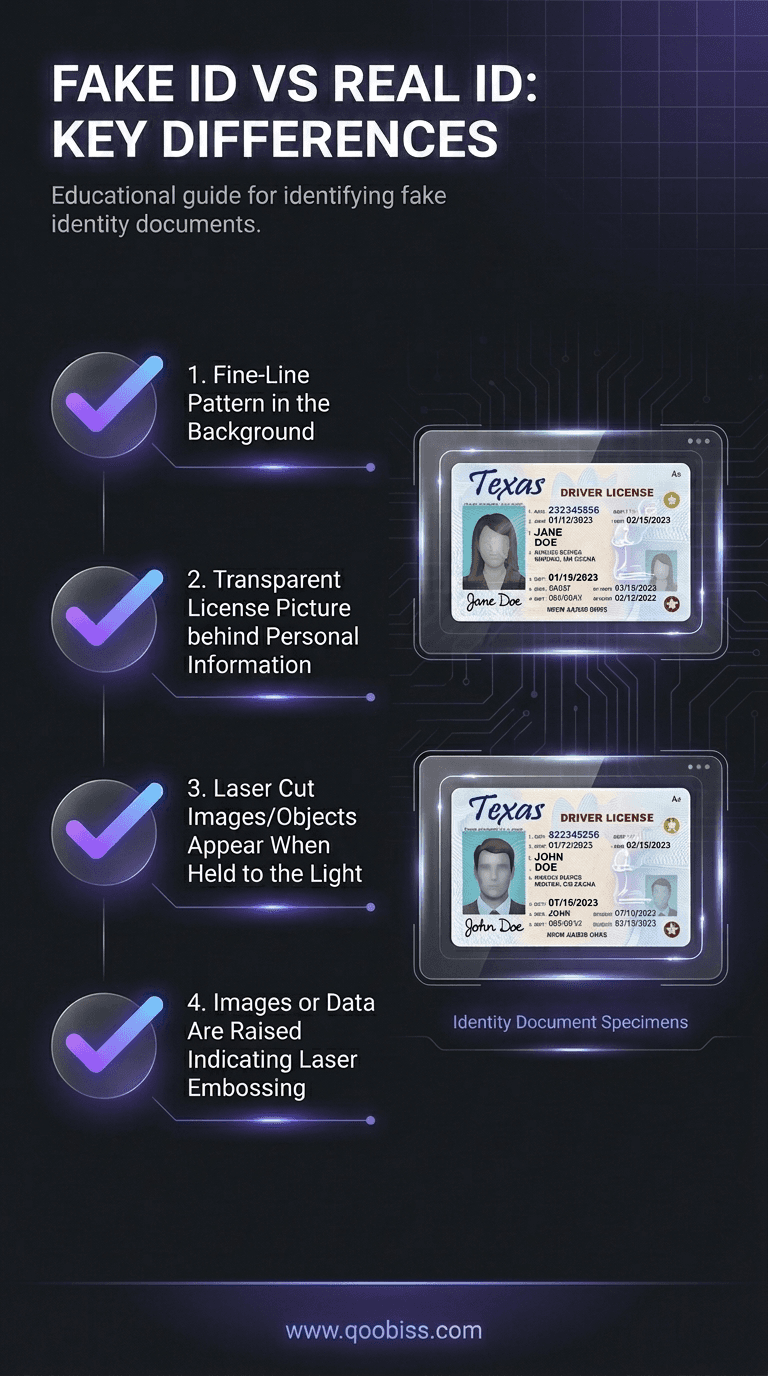
The differences between a fake ID and a real ID fall into categories that are progressively harder to replicate.
At the surface level, genuine IDs use specific materials, printing techniques, and security features that are controlled by government agencies and their authorized manufacturers. Even high-quality fakes typically fail to replicate the full stack of security layers embedded in an authentic document: the combination of polycarbonate substrate, laser-engraved personalization, embedded holographic elements, UV-reactive inks, and chip-based data storage.
The most reliable distinction between a fake and a genuine document lies in features that cannot be replicated through printing or image generation alone. An NFC-enabled e-passport or national ID card contains a cryptographically signed chip that stores biometric and biographical data.
The digital signature on the chip is issued by the document’s issuing authority and can be verified against a public key infrastructure. A fake physical card can replicate the visual appearance of a chip-enabled document, but it cannot reproduce the cryptographic signature, making NFC verification a definitive authenticity check for documents that support it.
For documents without embedded chips, such as most US driver’s licenses, authenticity relies on the accumulation of physical security features. No single feature is conclusive in isolation. A genuine hologram on an otherwise suspicious card could indicate a partially altered document.
Matching barcode data proves only that the barcode was encoded consistently, not that the document was government-issued. Effective verification requires checking multiple layers and cross-referencing them against expected patterns for the specific document type and issuing jurisdiction.
This is why visual inspection alone, regardless of the inspector’s training or experience, is no longer sufficient as a sole verification method for regulated businesses.
Why Fake IDs Matter for Regulated Businesses
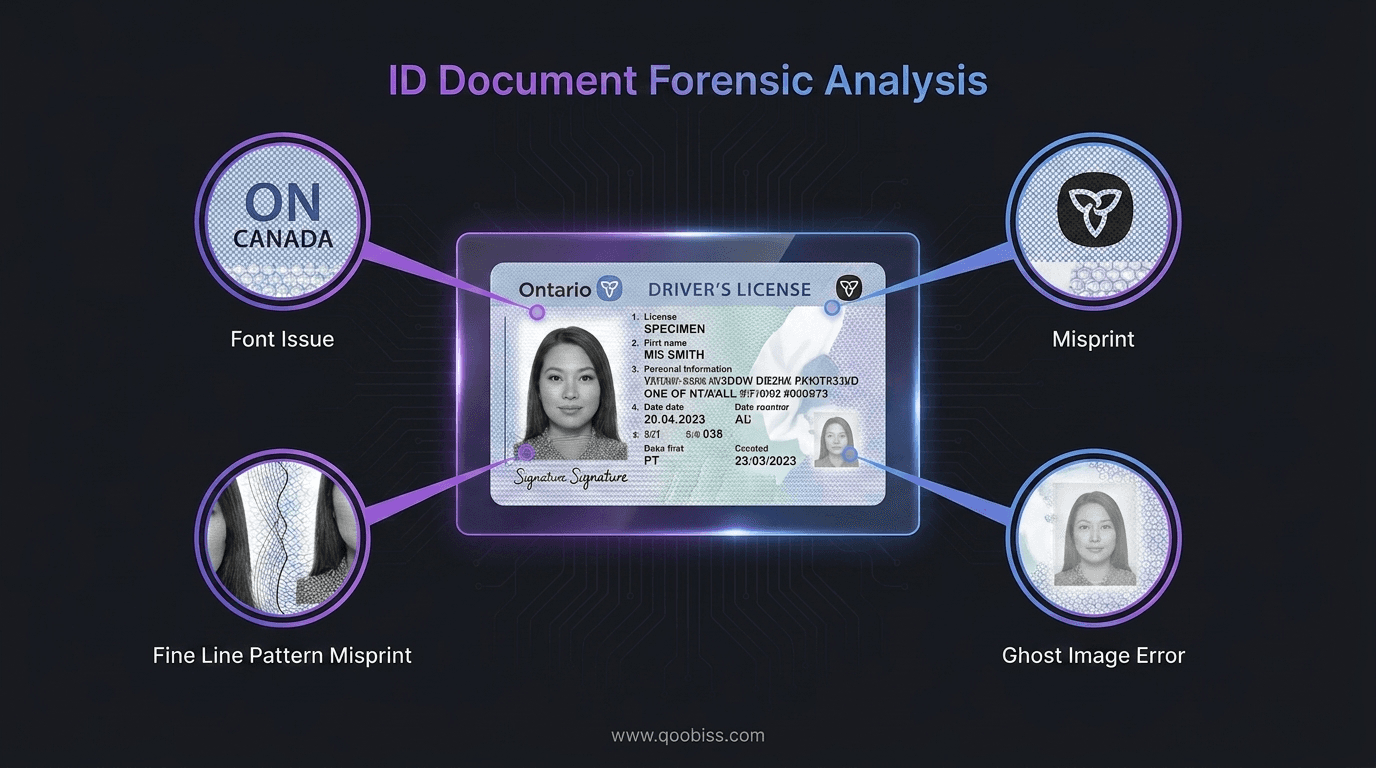
For bars and liquor stores, fake IDs are an age verification problem. For regulated businesses performing customer onboarding under AML and KYC obligations, fake IDs represent a fundamentally different category of risk.
When a fraudulent identity document is accepted during onboarding, the entire customer relationship is built on false information. The customer’s name, date of birth, nationality, and document number are all compromised data points. Every subsequent compliance check, from sanctions screening to transaction monitoring to beneficial ownership verification, operates against a fabricated baseline. The institution has no idea who the customer actually is.
This makes fake ID acceptance a gateway to multiple downstream risks. Fraudsters use fake IDs to open accounts for money laundering, to create synthetic identities that blend real and fabricated data, and to facilitate account takeover by registering under a victim’s partially stolen information. Financial institutions, fintech platforms, crypto exchanges, gaming operators, and telecommunications providers are all targets.
Regulatory frameworks are explicit about the obligation to verify identity documents. The FATF Recommendations, EU Anti-Money Laundering Directives, the US Bank Secrecy Act, and the UK Money Laundering Regulations all require regulated entities to verify the identity of their customers using reliable and independent sources. Accepting a fraudulent document without adequate verification measures is a compliance failure that can result in enforcement action, fines, and reputational damage.
The financial impact extends beyond regulatory penalties. Fraud losses from accounts opened with fake identities are direct costs. Remediation, including account closure, investigation, and SAR/STR filing, consumes compliance team capacity. And the reputational consequence of being identified as a platform with weak identity controls can affect customer trust and partnership opportunities.
How Businesses Detect Fake IDs at Scale
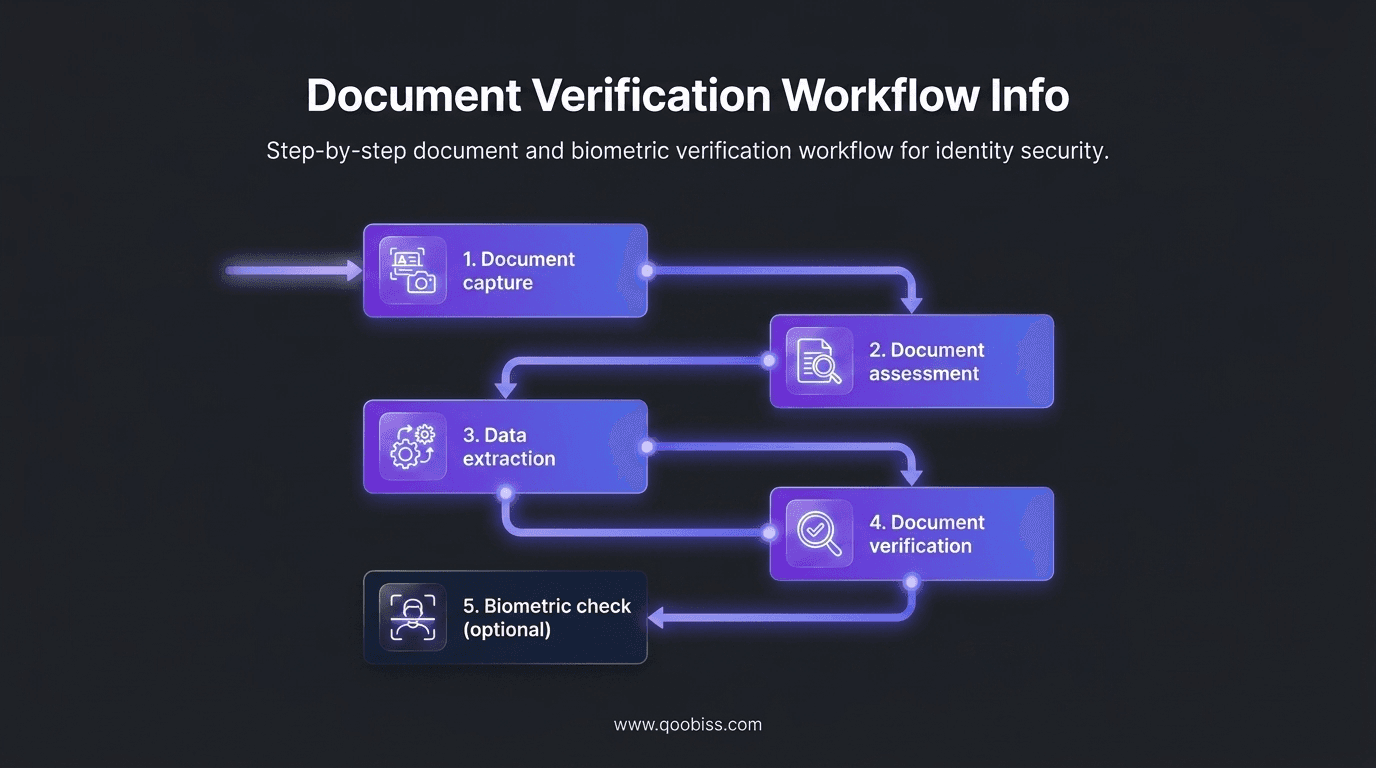
Manual inspection does not scale. A trained bouncer checking twenty IDs per hour can maintain reasonable accuracy. A financial institution processing thousands of onboarding applications per day cannot rely on human reviewers examining document images individually. The error rate, inconsistency, and cost make it unsustainable.
Automated document verification addresses this by applying multiple detection layers in parallel.
OCR and template matching. Optical character recognition extracts text from the document image. Template matching compares the document’s layout, font, color scheme, and field positioning against a database of known genuine document specimens from each issuing authority. Deviations from the expected template trigger alerts for further review.
Security feature analysis. Advanced imaging techniques detect the presence or absence of expected security features: holographic patterns, UV-reactive elements, microprinting, and laser engraving artifacts. Some systems use multispectral imaging to analyze features that are invisible under standard lighting conditions.
MRZ and barcode cross-referencing. For documents with machine-readable zones (passports, some national ID cards) or barcodes (US driver’s licenses), automated systems extract encoded data and compare it against the printed information. Inconsistencies between the two indicate tampering or fabrication.
NFC chip verification. For e-passports and chip-enabled national ID cards, NFC reading extracts the cryptographically signed data stored on the embedded chip. The digital signature can be validated against the issuing country’s public key certificates, providing a definitive check that no amount of physical counterfeiting can defeat. This is the single most reliable method for confirming document authenticity on chip-enabled documents.
Biometric matching and liveness detection. Comparing the photo on the submitted document to a live selfie taken during the verification process confirms that the person presenting the document is the same person depicted on it. Liveness detection adds a layer of defense against presentation attacks, such as holding up a printed photo, a screen displaying a photo, or a deepfake video, by verifying that the selfie is captured from a live person in real time.
Database verification. Where available, automated systems cross-reference document data against government registries or issuing authority databases to confirm that the document number, issuance date, and associated personal information match official records.
How AI Is Changing Both Fake ID Creation and Detection
The relationship between fake ID production and detection is an arms race, and AI has accelerated both sides.
On the creation side, generative AI models have lowered the barrier to producing convincing document images. What previously required physical equipment, materials, and technical skill can now be accomplished with software. AI-generated fakes can replicate document layouts, typography, security feature patterns, and even photographic characteristics with enough fidelity to pass basic automated checks that rely on template matching or OCR alone.
On the detection side, AI-powered verification systems are developing capabilities that go well beyond what manual inspection or rule-based automation can achieve. Deep learning models trained on millions of genuine and fraudulent document specimens can identify anomalies that are imperceptible to the human eye: subtle inconsistencies in image noise patterns, compression artifacts that indicate digital manipulation, font rendering differences between genuine and reproduced text, and lighting or shadow inconsistencies in document photos that reveal compositing.
The practical consequence is that single-layer verification is no longer defensible. A system that checks only whether the document looks right (template matching) or whether the data is internally consistent (barcode cross-referencing) can be defeated by a well-crafted AI-generated fake.
Effective detection now requires multi-layered verification: document analysis combined with biometric matching, liveness detection, NFC chip reading where available, and data cross-referencing against external sources. Each additional layer reduces the attack surface and increases the cost and difficulty of successful fraud.
For regulated businesses, this is not a future concern. AI-generated document fraud is already occurring in production verification environments. The institutions that rely solely on manual review or single-factor automated checks are the ones most exposed.
FAQ
Is having a fake ID a felony?
How can you tell if an ID is fake?
Can fake IDs pass scanners?
What is an AI-generated fake ID?
What should a business do if it detects a fake ID?
What is the difference between a fake ID and a synthetic identity?
Qoobiss ONTRACE provides the multi-layered document verification that fake ID detection now requires. The platform combines automated document analysis, NFC chip reading for e-passports and chip-enabled national ID cards, biometric facial matching, and liveness detection into a single verification flow. Security feature analysis, template matching, and MRZ/barcode cross-referencing run in parallel, identifying anomalies that manual inspection cannot catch. Request a demo to see how ONTRACE strengthens your identity verification process against both traditional and AI-generated document fraud.